
Installing or replacing gutters can help direct rainwater away from your roof, siding, foundation, and surrounding areas of your property. In 2026, professional gutter installation commonly ranges from several hundred dollars to several thousand dollars, depending on gutter length, material, roof design, home height, downspouts, removal, and installation complexity.
Homeowners looking for financial help with gutter installation may have several routes to explore. Depending on the project and household circumstances, assistance may be available through broader home-repair programs, local housing rehabilitation funds, disaster-related programs, weatherization providers, nonprofits, or other qualifying resources. The best option depends on why the gutter work is needed, where the property is located, the condition of the home, and the requirements of each program.
How Much Does Gutter Installation Cost in 2026?
One current published market estimate puts a typical professional gutter installation at about $629–$1,735, with an average near $1,181. Other published cost data uses broader per-linear-foot ranges, so larger homes, premium materials, complex rooflines and additional installation work can result in substantially different project totals. Use these figures as a starting point rather than a guaranteed price for your property.
| Project factor | What affects cost | Why it matters |
| Gutter length | Total linear feet around the roof | More material and installation labor are required |
| Gutter material | Vinyl, aluminum, steel, copper, zinc or other materials | Material prices vary considerably |
| Home height | One-story versus two-story or taller homes | Higher work areas can require additional equipment and labor |
| Roof design | Simple rooflines versus multiple corners, valleys and sections | Complex layouts require more measuring and installation work |
| Downspouts | Number, size, length and placement | Proper drainage may require additional materials |
| Old gutter removal | Removal, hauling and disposal | Existing systems can add labor and disposal costs |
| Gutter guards | Optional debris-control system | Adds another material and installation cost |
Per-linear-foot pricing can vary substantially. Current published estimates show that gutter installation may cost only a few dollars per linear foot for some basic systems but substantially more for premium materials, complex installations, or larger homes. That is why a written estimate based on your actual roofline is more useful than relying on a single national average.
What Does a Gutter Installation Estimate Include?
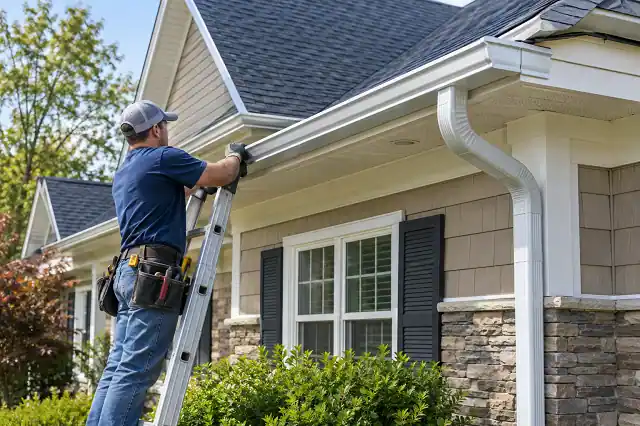
A complete quote should explain exactly what you are paying for. Two contractors can provide very different totals because one quote may include removal, downspouts and cleanup while another lists those items separately.
Gutters
The main gutter channels are usually priced according to their material, size, style and total length. Aluminum is widely used for residential projects, while vinyl, steel, copper and zinc can serve different budget, appearance and durability needs.
Downspouts
Downspouts carry collected rainwater away from the gutter system. Their number and placement should be appropriate for the roof area and local rainfall conditions. Ask the contractor how many downspouts are included in the estimate.
Hangers and mounting hardware
Gutters need secure mounting hardware to maintain the correct slope and support water flow. Ask whether new hangers, brackets, fasteners and related hardware are included.
End caps, corners and outlets
These components help create a complete water-management system around corners and roof edges. A quote should identify whether standard fittings are included or whether specialty pieces will increase the cost.
Removal and disposal
If existing gutters are being replaced, ask whether removal and disposal are included. A quote that excludes these services may appear cheaper even though the final project cost will be higher.
Cleanup
Ask whether the contractor will remove installation debris and leave the work area clean. Put this expectation in the written agreement rather than assuming it is included.
Gutter guards
Gutter guards can reduce the amount of leaves and other debris entering the system, but they are an optional addition unless a particular project requires them. If you want guards, ask for their cost separately so you can compare the base gutter installation with the upgraded system.
Gutter Installation Cost by Material
The gutter material can have a major effect on the final price. Your best choice depends on the budget, appearance, expected service life, climate and design of the property.
| Material | General characteristics | Cost considerations |
| Vinyl or PVC | Lightweight and generally lower-cost | Often one of the more budget-friendly choices |
| Aluminum | Common residential option with many color choices | Mid-range pricing varies by style and installation |
| Steel | Strong and suitable for certain applications | Pricing varies by type and finish |
| Copper | Premium appearance and long potential service life | Usually substantially more expensive |
| Zinc | Premium metal option | Higher material cost than many standard systems |
For example, current published estimates put professionally installed aluminum gutters around $4–$12 per linear foot, while vinyl or PVC systems can be considerably less expensive. Premium materials such as copper can cost substantially more. These are market estimates rather than guaranteed prices for your property.
What Makes Gutter Installation More Expensive?
Large homes
A larger home usually requires more linear feet of gutters and additional downspouts, increasing both material and labor requirements.
Two-story or taller homes
Higher installation areas can require additional safety equipment, setup time and labor. This can increase the total cost compared with a straightforward one-story installation.
Complex rooflines
Multiple roof sections, valleys, corners and difficult access points can require more custom measurements and fittings.
Heavy rainfall
Homes in areas with substantial rainfall may need appropriately sized gutters and downspouts to manage water flow. Your contractor should size the system according to the roof and local conditions rather than simply replacing the old system with identical components.
Damaged fascia or roof edges
If the boards or surfaces supporting the gutters have water damage or deterioration, those repairs may need to be completed before the new gutter system can be securely installed.
Old gutter removal
Removing and disposing of an existing system adds labor. Ask whether the quote includes this work.
Gutter guards
Adding guards increases the project cost but may reduce the amount of debris entering the gutters. Compare the cost and expected maintenance benefits before adding them.
Should You Repair or Replace Your Gutters?
A complete replacement is not always necessary. If the damage is limited to a small section, a professional may be able to repair the affected area instead.
| Gutter condition | Potential approach | What to evaluate |
| Small leak at one joint | Repair | Condition of the surrounding gutter and fittings |
| One loose section | Repair or refasten | Hangers, fascia and slope |
| Small damaged section | Partial replacement | Whether matching material is available |
| Repeated leaks throughout the system | Compare repair with replacement | Age and overall condition |
| Widespread rust, cracking or separation | Replacement assessment | Remaining useful life of the system |
| Damaged supporting fascia | Structural repair plus gutter work | Extent of water damage |
A professional inspection can help determine whether repairing one section makes more sense than replacing the entire system. If several sections are failing at the same time, compare the total repair cost with a new installation.
Are There Grants for Gutter Installation?
There is no universal federal grant specifically reserved for gutter installation for every homeowner. However, gutters can sometimes be part of a broader eligible home-repair or rehabilitation project when the work addresses a qualifying housing condition.
The reason for the gutter project is important. Replacing gutters solely to improve appearance may have fewer potential funding routes than work needed to address water intrusion, structural deterioration, health and safety concerns, disaster damage, or a broader rehabilitation project.
This means homeowners should search for eligible home-repair and rehabilitation programs rather than relying only on the phrase “free gutter installation grant.”
USDA Section 504 Home Repair Assistance
One federal program worth investigating is the U.S. Department of Agriculture Rural Development Single Family Housing Repair Loans and Grants program (Section 504).
The program provides loans to qualifying low- and very-low-income homeowners for eligible repairs, improvements and modernization. Grants are available to qualifying elderly very-low-income homeowners for removing health and safety hazards.
USDA states that applicants generally must own and occupy the home, be unable to obtain affordable credit elsewhere, meet applicable county income limits and live in an eligible rural area. Grant applicants must also generally be at least 62 years old and meet the very-low-income requirement.
The standard Section 504 program currently lists a maximum loan of $40,000 and a maximum grant of $10,000. Those amounts describe the program limits, not an amount automatically available for gutters.
If gutters are part of a documented repair needed to address a qualifying health, safety or property condition, ask USDA Rural Development whether the specific work is eligible. Do not assume that a gutter replacement qualifies simply because the homeowner meets the income or age requirements.
State and Local Home Rehabilitation Programs
State, county and city housing agencies can be particularly important when looking for help with gutter work. HUD’s Community Development Block Grant program supports a range of community development activities, including rehabilitation of residential structures, but individual homeowners generally access such assistance through locally designed programs rather than through one nationwide homeowner application.
The U.S. Department of Housing and Urban Development Community Development Block Grant program (CDBG) allows participating communities to develop programs around local housing and community needs.
A local program may offer owner-occupied rehabilitation, emergency repairs, housing preservation, code-related improvements or other assistance. Whether gutters qualify depends on the local program’s rules and the reason for the work.
When contacting a housing agency, ask specifically about owner-occupied rehabilitation, emergency home repair, housing preservation, water-damage prevention and exterior home rehabilitation.
Can Emergency Home Repair Programs Help With Gutters?
Possibly. Emergency repair programs generally focus on urgent housing conditions rather than cosmetic improvements.
Gutters may become relevant when a failed drainage system is contributing to significant water intrusion, foundation drainage problems, property deterioration or another qualifying housing condition. The exact definition of an eligible emergency varies by program.
Homeowners facing an urgent repair can also compare emergency home repair grants when determining which broader repair programs may fit the situation.
Do not begin funded work before confirming the program’s requirements. Some programs require an inspection, written estimate, contractor approval or formal authorization before work starts.
Can Weatherization Assistance Pay for Gutter Installation?
The Weatherization Assistance Program can appear in searches for home-improvement funding, but it should not be described as a general federal gutter-replacement grant.
The U.S. Department of Energy Weatherization Assistance Program (WAP) supports energy-efficiency and certain health-and-safety improvements for eligible low-income households. The program is administered through state, tribal and local providers.
Because WAP focuses on weatherization and energy-related improvements, homeowners should not assume that ordinary gutter installation will qualify. Ask the local weatherization provider whether the proposed work is an approved measure under the applicable state and local plan.
If your project involves broader weatherproofing work, the weatherproofing grants for older homes resource may help you identify other home-improvement funding categories to investigate.
Can Disaster Assistance Help With Gutter Replacement?
Potentially. If gutters were damaged during an eligible disaster, disaster-recovery assistance may provide a different funding route from ordinary home-repair programs.
The USDA Single Family Housing Disaster Assistance Fund Program (Disaster Assistance Fund) can provide grants and loans to qualifying low- and very-low-income homeowners for eligible disaster-related home repairs in qualifying areas.
The program currently lists a maximum grant of $32,420. This is a separate disaster-program limit and should not be confused with the standard Section 504 grant limit.
If the gutter damage resulted from a qualifying disaster, keep photographs, inspection records, contractor estimates, insurance information and other documentation showing the condition and connection to the event. Confirm eligibility with the administering agency before assuming that gutter replacement will be covered.
Can Homeowners Insurance Pay for New Gutters?
Insurance may cover gutter damage when the cause is a covered event under the policy. Coverage depends on the policy language, cause of damage, deductible, exclusions and the condition of the gutters before the event.
Sudden damage caused by a covered event can be treated differently from ordinary deterioration, rust, aging, poor maintenance or gradual wear.
If you believe a covered event caused the damage, contact your insurer before authorizing major replacement work when practical. Take photographs and keep contractor estimates, inspection reports and claim documentation.
Can Nonprofits Help With Gutter Installation?
Some nonprofit and community organizations provide home-repair assistance, materials, labor, referrals or other localized support. Availability varies considerably by location and funding.
When contacting a nonprofit, explain exactly what the gutter problem is and why replacement is needed. Mention whether the issue is causing water damage, whether you own and occupy the property, whether you have a contractor estimate and whether other home repairs are also required.
If your gutter project is part of a larger home repair, nonprofit home repair grants may provide a broader starting point for your search.
What Documents Should You Prepare?
Preparing basic documents before contacting programs can make it easier to explain the project and determine whether you meet the initial requirements.
| Document or information | Why it may matter | What to prepare |
| Proof of ownership | Confirms homeowner status | Deed or other accepted ownership document |
| Property information | Confirms location and property type | Property address and basic details |
| Income information | May determine eligibility | Recent income or benefit records when required |
| Household information | May affect income limits | Household size and applicable records |
| Gutter photographs | Shows current condition | Clear photographs of leaks, sagging, rust or damage |
| Water-damage photographs | Shows the effect of the drainage problem | Photos of affected siding, foundation area or other damage |
| Contractor estimate | Shows project scope and cost | Written itemized estimate |
| Inspection report | May document safety or structural concerns | Report when available |
| Disaster documentation | May establish disaster-related damage | Insurance claim, inspection or disaster records when applicable |
Only provide documents requested by the program. Keep copies of anything you submit and record the name of the agency or organization handling your application.
How to Apply for Gutter Installation Assistance
Identify the gutter problem
Determine whether you need a small repair, partial replacement or complete gutter-system replacement. Document the condition with photographs.
Get an itemized estimate
Ask a qualified contractor to identify gutter length, material, downspouts, fittings, removal, disposal, labor, guards, repairs and other project costs.
Document why the work is needed
Explain whether the project involves normal deterioration, water intrusion, structural concerns, an emergency condition, disaster damage, or another qualifying circumstance.
Check local housing programs
Contact your city, county or state housing agency and ask about owner-occupied rehabilitation, emergency repair and housing-preservation programs.
Check USDA eligibility
If you are a low-income homeowner in an eligible rural area, review Section 504 requirements and ask USDA Rural Development whether the proposed gutter work is eligible.
Check disaster and insurance options
If the damage resulted from a qualifying disaster or covered insurance event, investigate those routes before paying for the entire project yourself.
Check nonprofit assistance
Contact local nonprofit and community organizations with your property information, photographs, household information and written estimate.
Confirm approval before work begins
Some programs require an inspection or written approval before construction or purchases begin. Obtain confirmation of the program’s requirements before committing to the work.
Which Gutter Assistance Route Fits Your Situation?
| Your situation | First route to investigate | What to verify |
| Low-income homeowner in an eligible rural area | USDA Section 504 | Income, rural eligibility, ownership and whether the gutter work is eligible |
| Gutters are part of a broader housing rehabilitation project | City or county housing program | Eligible repairs, income limits and local funding availability |
| Urgent water-related housing condition | Emergency home repair program | Whether the condition meets the program’s emergency definition |
| Gutters damaged by a qualifying disaster | Disaster recovery assistance | Eligible disaster, property, damage documentation and program deadlines |
| Damage may be covered by insurance | Insurance provider | Cause of damage, policy coverage, deductible and exclusions |
| Energy or weatherization project | Local WAP provider | Whether the proposed work is an approved weatherization measure |
| Government programs do not fit | Nonprofit or community organization | Location, household requirements and available funding |
| Only a small section is damaged | Gutter repair | Repair cost compared with full replacement |
What Gutter Grant Programs May Not Cover
Every program has its own rules, but homeowners should understand that assistance may have important limits.
- A program may not fund gutters as a standalone improvement.
- A program may require the work to address a health, safety or housing-condition issue.
- A program may cover an owner-occupied primary residence but not every property type.
- A detached structure may have different eligibility rules from the main residence.
- Income, age, location and ownership requirements may apply.
- A disaster program may require documented damage from an eligible event.
- Insurance may exclude ordinary deterioration and maintenance-related damage.
- A program may cover only approved project costs.
- Some assistance may be provided as a loan rather than a grant.
- Some programs require approval before work begins.
- Funding availability may depend on local budgets and program cycles.
For homeowners whose gutter project is part of a larger repair, the broader home repair grants resource can help explain how broader repair programs differ from a gutter-specific search.
How to Compare Gutter Installation Quotes
Do not choose a contractor based only on the lowest headline price. A lower quote may exclude removal, downspouts, repairs, disposal or other necessary work.
- Confirm the total linear feet.
- Confirm the gutter material.
- Confirm the gutter size.
- Check the number and size of downspouts.
- Ask whether corners and end caps are included.
- Ask whether new hangers and mounting hardware are included.
- Confirm old-gutter removal.
- Confirm disposal costs.
- Check whether fascia or roof-edge repairs are included.
- Ask whether gutter guards are included or optional.
- Confirm cleanup.
- Review workmanship and material warranties.
- Check the payment schedule.
- Obtain multiple written estimates when practical.
A detailed quote is also useful when applying for assistance because it gives a housing agency, nonprofit or insurer a clear description of the proposed work.
Common Mistakes to Avoid
- Assuming every homeowner can get a free gutter grant: Assistance depends on program rules and individual circumstances.
- Searching only for “free gutter grants”: Broaden the search to home rehabilitation, emergency repair, disaster assistance, weatherization and local housing programs.
- Assuming USDA Section 504 pays for every gutter project: Confirm the exact work and property eligibility.
- Treating WAP as a general gutter-replacement program: Weatherization assistance focuses on qualifying energy and health-and-safety measures.
- Ignoring local housing agencies: Many rehabilitation programs are designed and administered locally.
- Starting work before approval: Some programs require inspections or authorization first.
- Comparing incomplete estimates: A low quote may exclude important work.
- Calling every financial option a grant: Loans, insurance payments, nonprofit assistance and grants have different rules.
- Assuming two programs can pay the same cost: Ask about duplication-of-benefits rules before accepting multiple sources of assistance.
Frequently Asked Questions
How much does gutter installation cost in 2026?
Current published estimates vary considerably. A typical professional installation may fall around $629–$1,735, while larger homes, premium materials, complex rooflines and additional work can increase the total substantially. Per-linear-foot pricing also varies by material and installation conditions.
Is there a federal grant specifically for gutter installation?
There is no universal federal gutter-installation grant available to every homeowner. Potential assistance may instead come through broader home-repair programs, local rehabilitation programs, disaster assistance, weatherization providers, nonprofits or insurance when applicable.
Can USDA Section 504 help pay for gutters?
Potentially, but eligibility is not automatic. Section 504 provides qualifying home-repair loans and grants, with grants focused on eligible elderly very-low-income homeowners who need to remove qualifying health and safety hazards. Ask USDA Rural Development whether your specific gutter project qualifies.
Can seniors get help with gutter installation?
Possibly. Under USDA Section 504, grant applicants generally must be age 62 or older, meet the applicable very-low-income requirement, own and occupy the home, live in an eligible rural area and be unable to obtain affordable credit elsewhere. The proposed work must also qualify under the program.
Can low-income homeowners get help replacing gutters?
Low income can be an eligibility factor for some home-repair programs, but it does not guarantee funding. Location, property ownership, occupancy, project type, household circumstances and available funding can also matter.
Does Weatherization Assistance Program pay for new gutters?
WAP is not a general gutter-replacement program. It focuses on energy efficiency and certain health-and-safety measures for eligible low-income households. Ask the local weatherization provider whether the exact work is an approved measure.
Can homeowners insurance pay for gutter replacement?
It may when the damage results from a covered event under the policy. Coverage depends on the cause of damage, policy language, deductible, exclusions and the condition of the gutters.
Can disaster assistance pay for damaged gutters?
Possibly. Disaster programs can provide assistance for qualifying disaster-related home repairs, but eligibility depends on the program, location, household circumstances, documented damage and available funding.
What if I cannot find a gutter installation grant?
Expand the search to state and local housing rehabilitation programs, emergency repair programs, disaster assistance when applicable, nonprofits, insurance and legitimate financing options. A project does not need to qualify for a gutter-specific grant to have other possible funding routes.
Should I repair or replace my gutters?
That depends on the extent of the damage, the age and condition of the system, repeated repair history and the cost of a lasting repair compared with replacement. A qualified gutter professional can inspect the system and explain the available options.
Why You Should Trust This Guide
Last Updated: September 10, 2026
Reviewed By: HomePropertyGrants Editorial Team
Experience: This guide focuses on the practical decisions homeowners make when comparing gutter installation costs and potential funding routes.
Expertise: Gutter costs, repairs, rehabilitation programs, weatherization, disaster assistance, insurance and nonprofit support are treated as separate funding and project categories.
Authoritativeness: Federal program information is checked against current USDA, HUD and DOE information, while gutter-cost ranges are compared with current published market estimates.
Trustworthiness: Funding is described as potential assistance rather than guaranteed money, and eligibility limitations are explained instead of presenting every program as a universal gutter grant.
Helpful Decision Support: Cost ranges, quote questions, document preparation, program matching, application steps and exclusions help homeowners determine which route to investigate before committing to the project.
Conclusion
Gutter installation costs in 2026 depend on the length and material of the system, home height, roof design, downspouts, removal, access and other project requirements. Current published estimates provide useful starting points, but a detailed local quote is the best way to determine your actual project cost.
For financial help, start with why the gutters need to be installed or replaced. A broader home-repair or local rehabilitation program may be more relevant than a search for a standalone “free gutter grant.” Rural homeowners who meet USDA requirements can investigate Section 504, while qualifying disaster damage, insurance claims, local rehabilitation programs, weatherization providers and nonprofits may create other possible routes.
The most useful next step is to document the gutter problem, obtain an itemized estimate, identify the funding category that matches your circumstances and confirm eligibility before beginning the work.

Arthur Pendelton is a senior housing policy researcher and public welfare analyst with over eight years of experience tracking federal, state, and non-profit residential repair programs. He specializes in statutory grant frameworks, including USDA Section 504 Rural Housing, the Department of Energy’s Weatherization Assistance Program (WAP), and municipal HUD Community Development Block Grants (CDBG). Arthur systematically audits Federal Register publications and Title 7/42 CFR regulatory updates to provide low-income homeowners, seniors, and military veterans with accurate, barrier-free application guidance.