
A drafty front door can make a home uncomfortable and increase the amount of heating or cooling needed to maintain a comfortable indoor temperature. For low-income homeowners, fixing the problem can be difficult when even a basic exterior door replacement costs hundreds or thousands of dollars.
Fortunately, some homeowners may qualify for weatherization assistance, home repair programs, housing rehabilitation funding, or utility incentives that can help address a drafty front door. Depending on the condition of the door and the program rules, the approved solution may be weatherstripping, air sealing, a storm door, repair, or complete replacement.
Quick answer: A drafty front door may qualify for assistance when it contributes to energy loss or creates an eligible housing problem and the household meets the program’s requirements. The Weatherization Assistance Program is one of the best places to start, but a local provider decides whether repair, sealing, or replacement is appropriate after evaluating the home.
For a broader explanation of available repair funding, see our Home Repair Grants 2026 guide. This article focuses specifically on drafty front doors and energy-efficiency assistance.
What Are Energy Efficiency Grants for Drafty Front Door Replacement?
Energy-efficiency assistance for a drafty front door refers to programs that help eligible households reduce air leakage, improve comfort, and address energy-related problems in the home’s exterior envelope.
The U.S. Department of Energy (DOE) operates the federal Weatherization Assistance Program, which is delivered through states, territories, tribes, and local organizations.
Weatherization is not simply a cash grant that allows a homeowner to purchase any door. The local program evaluates the home and determines which improvements are appropriate. Possible measures can include air sealing, weatherstripping, storm doors, and repair or replacement of primary exterior doors.
This distinction matters because a homeowner may believe that complete replacement is necessary when weatherstripping or frame sealing could solve the problem at a lower cost.
Important: A drafty door does not automatically qualify for a free replacement. The program must determine that the work is eligible, appropriate for the home, and justified under its weatherization or housing-rehabilitation rules.
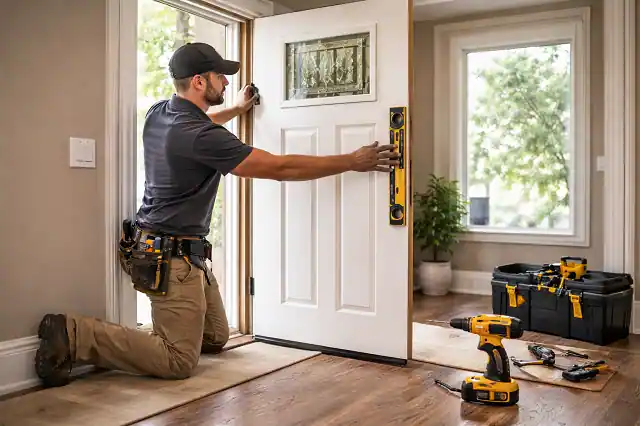
Why a Drafty Front Door Can Cause Energy Loss
Exterior doors are part of a home’s building envelope. Gaps around the frame, worn weatherstripping, damaged thresholds, poor installation, and deteriorated doors can allow unwanted outdoor air to enter the home.
When conditioned air escapes through gaps around a door, heating and cooling equipment may need to operate more frequently. This can increase household energy use and make rooms near the entrance feel colder in winter or hotter in summer.
Weatherization programs therefore look at the door as part of the home’s overall energy performance rather than treating it as an isolated repair.
Signs of a drafty front door:
- Cold or hot air can be felt around the door.
- Daylight is visible around the frame.
- Weatherstripping is cracked, flattened, or missing.
- The door does not close tightly.
- The threshold is damaged or poorly sealed.
- Moisture or deterioration is visible around the opening.
- The room near the door is noticeably less comfortable than other rooms.
Who May Qualify for Drafty Front Door Assistance?
Eligibility depends on the program, state, household income, property type, and reason for the repair. Federal weatherization programs primarily serve low-income households, while state and local providers may establish additional priorities.
Under U.S. Department of Energy guidelines, households at or below 200% of the federal poverty income guidelines or households receiving Supplemental Security Income may qualify for weatherization services. States and territories may also use another permitted eligibility method.
Households containing older adults, people with disabilities, or children may receive priority under applicable state and local rules. Households with high energy use or a high energy burden may also receive priority.
If SSI is part of your eligibility situation, our Home Repair Grants for SSI Recipients in 2026 guide provides additional information.
Homeowners with disabilities can also review our Free Home Repair Grants for Disabled Homeowners guide.
Basic eligibility checklist:
- Your household meets the applicable income requirement.
- Your property is within the program’s service area.
- You meet the program’s homeowner or occupancy requirements.
- The drafty door can be documented.
- The proposed work is an eligible measure.
- Funding is available.
Weatherization Assistance Program for Drafty Doors
The Weatherization Assistance Program is one of the first programs low-income homeowners should investigate when a drafty front door is contributing to energy loss.
WAP uses a whole-house approach. Instead of automatically approving the repair requested by a homeowner, the local provider evaluates the home and determines which improvements are most appropriate.
The assessment can consider air leakage, insulation, the building envelope, heating and cooling systems, and other energy-related conditions.
Exterior door repair or replacement may be considered as part of an eligible weatherization project when it meets the applicable program requirements. DOE weatherization guidance includes exterior door installation among weatherization work, but the local provider determines whether a specific door project is appropriate for the home.
Typical weatherization process:
- Check your eligibility.
- Contact the appropriate local weatherization provider.
- Submit the required household documentation.
- Wait for the home to be selected for assessment.
- Complete the energy assessment.
- Allow the provider to identify appropriate improvements.
- Complete only the work approved by the program.
- Complete the required final inspection.
For a broader explanation of eligibility and the application process, see our Who Qualifies for Free Home Repair Grants 2026 guide.
Can WAP Replace a Drafty Front Door?
Yes, door repair or replacement can potentially be included in weatherization work. However, approval is based on the home’s condition and the applicable program requirements.
If the door can be made substantially more efficient through weatherstripping, caulking, threshold repair, or air sealing, the provider may choose that option instead of complete replacement.
If the door is badly deteriorated, poorly fitted, structurally damaged, or cannot be effectively repaired, replacement may be considered when the program permits it.
Homeowners should therefore ask for an evaluation rather than assuming that a new door will automatically be approved.
Weatherstripping vs. Full Door Replacement
A drafty door does not always need to be replaced. Weatherstripping can address gaps around movable parts of the door, while caulking and air sealing can address stationary gaps around the frame.
Replacement may make more sense when the door itself is damaged, warped, deteriorated, difficult to operate, or unable to provide acceptable performance after repair.
This approach can also make the application stronger because it shows that you are asking the program to solve an energy problem rather than simply requesting an expensive product.
USDA Section 504 Home Repair Assistance
The U.S. Department of Agriculture Rural Development (USDA) operates the Section 504 Single Family Housing Repair Loans and Grants program for eligible rural homeowners.
Section 504 loans can help eligible very-low-income homeowners repair, improve, or modernize their homes. Grants are intended for qualifying older homeowners who need to remove health and safety hazards.
Current USDA program information lists a maximum loan of $40,000 and a standard maximum grant of $10,000. In a presidentially declared disaster area, the maximum grant can be $15,000. Loans and grants can be combined for up to $50,000, or $55,000 in qualifying disaster situations.
| Section 504 Assistance | Maximum | Purpose |
|---|---|---|
| Repair loan | Up to $40,000 | Repair, improve, modernize, or remove qualifying hazards |
| Standard grant | Up to $10,000 | Remove qualifying health and safety hazards |
| Disaster-area grant | Up to $15,000 | Qualifying repairs after a presidentially declared disaster |
| Combined assistance | Up to $50,000 | Eligible projects using loans and grants |
These are overall program limits, not guaranteed amounts for a front door. USDA determines whether the specific repair is eligible and how much assistance is appropriate.
For a deeper explanation of this program, see our Section 504 Home Repair Grants 2026 guide.
Important: Section 504 is not a general rebate for every energy-efficient door. Grant funds are designed for qualifying health and safety hazards, while loans can cover qualifying repairs, improvements, and modernization.
USDA Eligibility for Door Repairs
Applicants generally must own and occupy the home, meet the applicable very-low-income requirement, be unable to obtain affordable credit elsewhere, and live in an eligible rural area. Grant applicants must also meet the applicable age requirement.
Homeowners can check whether their property is in an eligible rural area through the USDA eligibility system.
If your property is rural, our Federal and State Home Repair Grants for Rural Homeowners 2026 guide provides additional options.
State and Local Home Repair Programs
Federal programs are not the only source of assistance. States, counties, cities, housing authorities, community action agencies, and nonprofit organizations may operate home repair programs that can address exterior doors.
The U.S. Department of Housing and Urban Development (HUD) explains that Community Development Block Grant funding can support activities including rehabilitation of residential structures. Local governments determine how their CDBG programs operate and which local activities receive funding.
HUD does not provide CDBG assistance directly to individual homeowners. Homeowners normally need to contact their city, county, or local housing department to determine whether a local rehabilitation program is available.
Our State Home Repair Grants 2026 guide can help you identify state-level starting points.
If you believe your state has programs that are difficult to find, see our guide to finding hidden home repair grants in your state.
Homeowners researching state-specific assistance can also compare programs in Alaska through our Alaska Home Repair Grants for Low-Income Families guide.
Florida homeowners can also review our Florida Home Repair Grants for Low-Income Families guide for state-specific options.
Wisconsin homeowners can use our Wisconsin Home Repair Grants guide to research local and state assistance.
Maine homeowners can also review our Maine Home Repair Grants for Low-Income Homeowners guide.
Utility Assistance for Energy-Efficient Doors
Some utility companies offer rebates or incentives for energy-efficiency improvements. The available programs depend on the utility serving the property.
Possible requirements can include income limits, approved products, energy-performance standards, preapproval, professional installation, or proof of purchase.
Homeowners should check with their utility before purchasing a replacement door because some incentives require approval before the work begins.
What Types of Front Door Problems May Qualify?
The strongest applications explain the actual problem rather than simply requesting a new door.
- Significant air leakage around the door.
- Missing or deteriorated weatherstripping.
- Damaged threshold.
- Gaps around the door frame.
- Door that does not close or seal properly.
- Warped or deteriorated exterior door.
- Moisture damage affecting the door opening.
- Safety problems involving the entrance.
Photograph the problem before applying. Clear photographs can help demonstrate the condition of the door and surrounding frame.
What Types of Doors May Be Considered?
The exact products allowed depend on the program. A local provider may establish requirements for insulation, energy performance, installation, materials, contractors, or product certification.
Potentially relevant products can include insulated steel doors, insulated fiberglass doors, storm doors, and other qualifying exterior doors.
Homeowners should not purchase a product solely because it is advertised as energy efficient. First confirm the requirements of the assistance program.
Energy-Efficient Door Ratings and Installation
Door efficiency depends on more than the material. The door’s insulation, frame, glazing, air leakage, climate zone, and installation quality can all affect performance.
ENERGY STAR-certified products can provide one way to identify products that meet applicable efficiency criteria through ENERGY STAR, but program requirements should always be checked before purchase.
Even an efficient door can perform poorly if the frame is installed incorrectly or gaps remain around the opening.
Which Drafty Front Door Repairs May Be Funded?
| Repair Option | When It May Be Appropriate | Potential Funding Path |
| Weatherstripping | Minor air leakage around an otherwise sound door | Weatherization or local energy-efficiency assistance |
| Air sealing | Gaps around the frame or stationary parts | Weatherization assistance |
| Storm door | Additional weather protection where allowed | Some weatherization or local programs |
| Door repair | Damaged components that can be restored | Weatherization or housing rehabilitation |
| Door replacement | Severely deteriorated or inefficient exterior door | Eligible weatherization or housing programs |
For broader home repair cost information, see The Cost of Delayed Home Repairs: Statistics and Grants 2026.
How Much Assistance Could You Receive?
There is no single nationwide grant amount for drafty front door replacement. Weatherization assistance is based on the work approved for the home, while local housing and utility programs establish their own limits.
| Assistance Source | Potential Help | Amount or Rule |
|---|---|---|
| Weatherization Assistance Program | Approved weatherization measures | Varies by local provider |
| USDA Section 504 Grant | Qualifying health and safety repairs | Up to $10,000 standard maximum |
| USDA Section 504 Loan | Qualifying repairs and improvements | Up to $40,000 |
| Local housing rehabilitation | Home repair and rehabilitation | Varies by locality |
| Utility incentives | Qualifying efficiency improvements | Varies by utility |
If you need to combine several funding sources for a larger project, see our guide to funding a $10,000 home repair project.
Federal Door Tax Credits in 2026
2026 warning: Do not include the former federal exterior-door tax credit in the budget for a new 2026 installation. The Internal Revenue Service (IRS) states that the Energy Efficient Home Improvement Credit is not available for qualifying property placed in service after December 31, 2025.
The former credit allowed qualifying exterior doors to receive a tax credit subject to product requirements and annual limits. The previous maximum for exterior doors was $250 per door and $500 in total for doors, but those rules applied to qualifying property placed in service through 2025.
Therefore, homeowners planning a new door installation in 2026 should not assume that the previous federal credit is available.
How to Apply for Drafty Front Door Assistance
- Inspect the door and identify the source of the draft.
- Take photographs of gaps, weatherstripping, thresholds, and frame problems.
- Check household income eligibility.
- Identify your state weatherization administrator.
- Contact the local weatherization provider.
- Ask whether the front door can be evaluated during the home assessment.
- Submit the required income and household documents.
- Complete the energy or housing assessment.
- Wait for the provider to determine the approved work.
- Complete the work through the required contractor or provider.
- Keep approval, inspection, invoice, and warranty documents.
For more application advice, see our How to Apply for Home Repair Grants Without Getting Rejected guide.
Application document checklist:
- Government-issued identification.
- Proof of homeownership or occupancy when required.
- Recent household income records.
- Recent utility bills when requested.
- Photographs of the drafty door.
- Information about previous repairs.
- Contractor estimates only when requested.
- Documentation for any applicable priority category.
Do Not Buy the Replacement Door Before Approval
One of the most important steps is to contact the program before purchasing materials.
A program may require an assessment, preapproval, an approved contractor, a specific product, or a particular installation method.
Warning: Starting work before receiving required approval can make the project ineligible. Ask the program whether you must receive written authorization before purchasing the door or hiring a contractor.
How to Find Assistance in Your State
Start with the state weatherization agency and local weatherization provider. You can also contact your city or county housing department, Community Action Agency, utility, or state housing agency.
Our Home Repair Program Finder 2026 can help you determine where to begin.
For emergency problems involving an unsafe or unsecured entrance, see our Emergency Home Repair Grants 2026 guide.
Can Renters Get Help With a Drafty Front Door?
Renters may qualify for weatherization assistance, but the landlord generally needs to cooperate before work can be performed.
Because a door is part of the property, renters should contact the weatherization provider before hiring a contractor or purchasing materials.
Can Seniors Get Drafty Door Assistance?
Seniors may receive priority under some weatherization programs. Eligibility and priority rules vary by state and local provider.
Older homeowners in eligible rural areas can also investigate USDA Section 504 when the repair meets the program’s requirements.
For broader assistance, see our Free Home Repair Grants for Seniors 2026 guide.
For state-specific senior assistance, our Alabama Home Repair Grants for Senior Citizens, New York Home Repair Grants for Senior Citizens, and Texas Home Repair Grants for Senior Citizens guides provide examples of state-level research.
Can Veterans Get Drafty Door Assistance?
Veterans can apply for weatherization and housing rehabilitation programs when they meet the applicable requirements. Additional veteran-specific housing assistance may also exist depending on the repair and the homeowner’s circumstances.
For broader information, see our Home Repair Grants for Veterans 2026 guide.
Disabled veterans can also review our Home Repair Grants for Disabled Veterans guide. Florida veterans can also review our Florida Home Repair Grants for Veterans guide for state-specific assistance.
Can Disabled Homeowners Get Door Assistance?
Disabled homeowners may qualify for weatherization or home repair assistance when they meet the applicable program requirements.
If the door problem affects safe entry, mobility, or accessibility, explain that issue during the assessment because some housing programs consider health, safety, and accessibility needs.
What If the Door Is Rotten or Structurally Damaged?
A severely rotten or structurally damaged door may require a different funding strategy from a door that is simply drafty.
Moisture damage, deteriorated framing, an unsafe locking system, or major structural problems can create health and safety concerns that may be better suited to a housing rehabilitation or emergency repair program.
Homeowners who are dealing with multiple repair problems can also review our Home Repair Grants for Low-Income Families guide.
Common Reasons a Drafty Door Application May Be Denied
- The household does not meet the income requirement.
- The property is outside the program’s service area.
- The requested work is not an eligible measure.
- The existing door can be repaired more cost-effectively.
- The home has unresolved health or safety conditions.
- Required documents are missing.
- Funding is temporarily unavailable.
- Work began before required approval.
- The proposed product does not meet program requirements.
A denial from one program does not necessarily mean that no assistance is available. Ask the agency whether it can refer you to another weatherization provider, housing rehabilitation program, utility incentive, or nonprofit organization.
Our Nonprofit Home Repair Grants 2026 guide provides additional places to look when government assistance is unavailable.
How to Improve Your Chances of Approval
- Document the draft with photographs.
- Photograph damaged weatherstripping and visible gaps.
- Keep recent utility bills available.
- Gather income documentation before applying.
- Explain how the door affects comfort or energy use.
- Ask whether repair could solve the problem before requesting replacement.
- Do not purchase the replacement door before approval.
- Check government and utility programs.
- Ask whether a waiting list exists.
- Keep every approval and completion document.
Drafty Front Door Assistance: Quick Comparison
| Option | Best For | Potential Assistance |
|---|---|---|
| Weatherstripping | Minor leakage around a sound door | May be included in weatherization work |
| Air sealing | Gaps around the frame | May be included in weatherization work |
| Storm door | Additional protection and air control | May be approved under applicable weatherization rules |
| Door replacement | Inefficient or damaged primary exterior door | May be approved through weatherization or local programs |
| USDA Section 504 | Eligible rural homeowners | Loans and qualifying grants |
| Utility incentive | Qualifying energy-efficiency improvements | Varies by utility |
Weatherization Statistics and Facts
DOE describes WAP as a whole-house energy-efficiency program serving low-income households. The program is designed to reduce energy costs while improving health and safety.
DOE reports that weatherization generates approximately $2.78 in non-energy benefits for every $1 invested, based on its national evaluation.
Non-energy benefits can include improved comfort, health and safety improvements, and other household or community benefits. The figure is a national program statistic and does not mean that every individual door replacement will generate $2.78 in benefits for each dollar spent.
Why the whole-house approach matters: A drafty door may be only one source of energy loss. An assessment can identify whether the door, windows, insulation, air leakage, heating system, or another part of the home should receive attention first.
Frequently Asked Questions
Can WAP replace a drafty front door?
Yes. Primary door repair or replacement can be considered as a weatherization measure, but the local provider determines whether replacement is appropriate for the home.
Can low-income homeowners get free front door replacement?
Some eligible households may receive weatherization work without paying the full cost themselves. However, free replacement is not guaranteed because the local program determines the approved work.
Does a drafty door qualify as an energy-efficiency problem?
Yes, a drafty door can contribute to unwanted air leakage and energy loss. The program assessment determines whether the door is a significant source of energy loss.
Will the program replace the whole door?
Not necessarily. The program may approve weatherstripping, air sealing, a storm door, repair, or replacement depending on the condition of the door and the program rules.
Can renters receive assistance?
Yes. Renters can apply for weatherization assistance, although landlord cooperation is generally required before qualifying work can be completed.
Can seniors receive priority?
Some weatherization programs give priority to households containing older adults. The exact rules depend on the state and local provider.
Can utility rebates help pay for the door?
Some utilities offer energy-efficiency incentives, but the amount and eligibility requirements vary. Check the utility serving your property before purchasing the door.
Why This Guide Is Reliable
Last Updated: August 2026
Reviewed By: Housing Assistance and Energy Efficiency Research Team
Government sources: This guide uses information from the U.S. Department of Energy, U.S. Department of Agriculture Rural Development, U.S. Department of Housing and Urban Development, and Internal Revenue Service.
Program limits: Official USDA Section 504 limits are separated from general door-replacement cost estimates and local assistance amounts.
Local rules: Weatherization, housing rehabilitation, utility incentives, and local programs can have different income limits, application procedures, funding levels, and eligible repairs.
2026 tax information: The former federal Energy Efficient Home Improvement Credit is not presented as a current 2026 door benefit because the IRS states that qualifying property must have been placed in service by December 31, 2025.
Conclusion
A drafty front door does not always mean that a homeowner must pay the entire cost of fixing the problem. Low-income households should investigate weatherization assistance because an eligible program may address air leakage through weatherstripping, sealing, storm-door installation, repair, or door replacement.
Eligible rural homeowners should also investigate USDA Section 504 when the repair meets its requirements. State and local housing programs, CDBG-funded rehabilitation, utility incentives, and nonprofit organizations can provide additional options.
The best first step is to document the door problem, check your eligibility, contact the appropriate local program, and request an assessment. Do not purchase the replacement door before confirming the program’s requirements.
In some homes, weatherstripping or air sealing will be enough. In others, a storm door, repair, or complete replacement may be appropriate. The goal is to identify the solution that addresses the actual problem and fits the assistance program’s rules.

Arthur Pendelton is a senior housing policy researcher and public welfare analyst with over eight years of experience tracking federal, state, and non-profit residential repair programs. He specializes in statutory grant frameworks, including USDA Section 504 Rural Housing, the Department of Energy’s Weatherization Assistance Program (WAP), and municipal HUD Community Development Block Grants (CDBG). Arthur systematically audits Federal Register publications and Title 7/42 CFR regulatory updates to provide low-income homeowners, seniors, and military veterans with accurate, barrier-free application guidance.