
A severe storm can damage a roof in minutes. High winds can remove shingles, hail can crack roofing materials, and falling trees can create openings that allow rain into the home. Once water enters, damage can spread to ceilings, walls, insulation, flooring, electrical systems, and personal property.
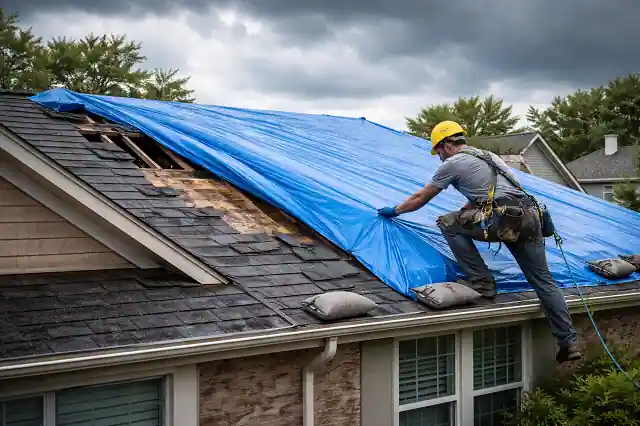
For homeowners dealing with storm damage, the immediate priority is usually to protect the home from additional water intrusion while a permanent repair is arranged. A temporary roof tarp can provide that short-term protection.
However, there is an important distinction: there is no single nationwide federal program called an “emergency roof tarp grant” that automatically pays every homeowner for a roof tarp. Assistance may instead come through Federal Emergency Management Agency (FEMA) disaster assistance, Operation Blue Roof, insurance, U.S. Department of Agriculture Rural Development (USDA Rural Development) assistance, U.S. Department of Housing and Urban Development (HUD) disaster-recovery programs, U.S. Small Business Administration (SBA) disaster loans, state or local programs, or nonprofit assistance.
Quick answer: If your primary home has storm damage, first document the damage safely and contact your insurance company if you have coverage. If the storm is covered by a federal disaster declaration, check DisasterAssistance.gov and FEMA. Also check whether Operation Blue Roof is active in your area. Eligible rural homeowners should review USDA Section 504, while homeowners who need larger financing may qualify for an SBA disaster loan.
This article focuses on immediate storm-damage roof protection. For broader permanent roof repair and replacement funding, see Roof Repair and Roof Replacement Grants For Homeowners 2026.
What Are Emergency Roof Tarp Grants?
The phrase “emergency roof tarp grants” is commonly used online to describe several different types of assistance. The actual benefit may be a free temporary service, a disaster-assistance payment, an insurance benefit, a grant, or a loan.
Understanding that difference prevents homeowners from applying to the wrong program or assuming that a program will pay cash for a tarp when it actually provides another form of assistance.
| Assistance type | What it may help with | Traditional grant? |
| Operation Blue Roof | Temporary roof covering after certain major disasters | No-cost service |
| FEMA Home Repair Assistance | Eligible disaster-related repairs needed to make a primary residence safe, sanitary, and functional | Disaster assistance |
| USDA Section 504 | Eligible health and safety repairs for qualifying rural homeowners | Grant and loan |
| HUD CDBG-DR | Long-term disaster recovery programs administered by eligible state and local grantees | Grant-funded recovery program |
| SBA disaster loans | Repair or replacement of an eligible disaster-damaged primary residence | No; loan |
| Homeowners insurance | Covered storm damage according to the policy | No; insurance benefit |
| State, local, or nonprofit assistance | Emergency stabilization, rehabilitation, repair, or recovery | Depends on program |
Homeowners should therefore search for both temporary roof assistance and storm-damage home repair assistance. The best option depends on the disaster declaration, location, insurance coverage, household circumstances, and the type of damage.
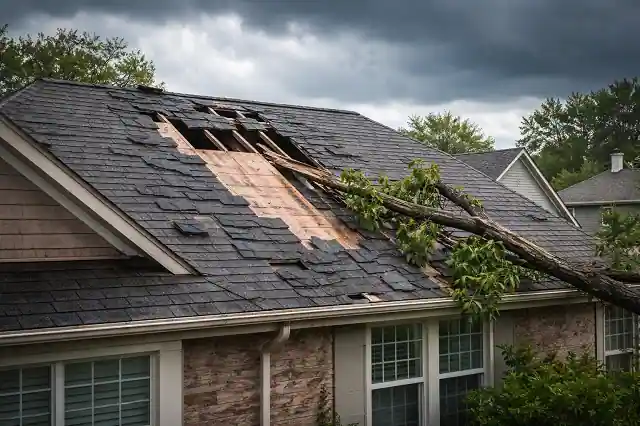
What Roof Damage Usually Requires Emergency Protection?
A roof problem becomes an emergency when the damage creates a significant risk of water intrusion, additional property loss, or an unsafe living environment.
Examples include:
- Large areas of missing shingles
- Holes caused by falling trees or branches
- Exposed roof decking
- Sections of roofing lifted by high winds
- Severe hail damage accompanied by active leaks
- Damaged flashing that allows water to enter
- Storm-created openings above bedrooms or living areas
- Water entering the home during continuing rainfall
- Roof damage combined with ceiling or wall damage
Minor damage should still be addressed quickly, particularly when rain is expected. Homeowners looking specifically for assistance with missing shingles can also review Roof Repair Grants For Damaged or Missing Shingles.
Safety warning: Do not climb onto a storm-damaged roof unless a qualified professional has determined that it is safe. Wet roofing, weakened decking, exposed nails, unstable structures, downed power lines, and electrical damage can create serious hazards.
Operation Blue Roof: Free Temporary Roof Protection
Operation Blue Roof is one of the most important programs to check after certain major disasters. The U.S. Army Corps of Engineers manages the program for FEMA when an active mission has been authorized.
The program provides temporary fiber-reinforced sheeting to eligible homes so that additional water damage can be reduced while permanent repairs are arranged. The official U.S. Army Corps of Engineers (USACE) page states that Operation Blue Roof is a free service to homeowners when the program is active.
Key fact: Operation Blue Roof is not a cash grant. It is a no-cost temporary roof-covering service. Availability is disaster-specific, and an active mission must be authorized for the affected area.
Homeowners should check the official USACE information rather than relying on social-media posts or third-party websites. The program can have specific geographic, property, structural, and application requirements.
The official program information also explains that homeowners generally sign a Right of Entry document allowing authorized personnel or contractors to access the property and perform the temporary roof-covering work.
| Operation Blue Roof feature | What homeowners should know |
| Purpose | Temporary protection against additional water damage |
| Cost | No cost to eligible homeowners when the program is active |
| Management | U.S. Army Corps of Engineers under FEMA disaster missions |
| Material | Fiber-reinforced temporary roof covering |
| Permanent repair | Still required after temporary protection |
| Availability | Only where an authorized disaster mission is active |
Scam warning: The official USACE information says there is no cost associated with the Blue Roof program. If someone claims to represent Operation Blue Roof and demands payment for the service, verify the person through official government channels before providing money or sensitive information.
FEMA Home Repair Assistance After Storm Damage
FEMA Individual Assistance can provide support after certain federally declared disasters. FEMA explains that Individual Assistance can help with disaster damage and losses that insurance does not cover, subject to the program’s eligibility requirements.
For Home Repair or Replacement Assistance, FEMA requires verification that the applicant owned the residence at the time of the disaster, along with other eligibility requirements. FEMA’s current housing-assistance information should be checked for the specific disaster because rules and available assistance can vary.
FEMA Home Repair Assistance is intended to address eligible disaster-related housing needs. It should not be described as an automatic full roof-replacement grant.
Important funding clarification: Do not advertise a fixed “$42,500 FEMA roof grant” or treat a maximum Housing Assistance amount as a guaranteed roof payment. FEMA determines individual assistance based on the disaster, verified damage, eligibility, insurance, and applicable program limits.
Homeowners should apply through official FEMA channels when their area and circumstances qualify. The Federal Emergency Management Agency (FEMA) provides current Individual Assistance information, while DisasterAssistance.gov (DisasterAssistance.gov) provides a federal portal for finding and applying for available disaster assistance.
What FEMA may consider
- Whether the property is the applicant’s primary residence
- Whether the applicant owned the residence at the time of the disaster when ownership is required
- Whether the damage resulted from the declared disaster
- Whether insurance or another source covers the same loss
- Whether the home requires an eligible repair to remain safe, sanitary, or functional
- Whether the damage can be verified through inspection or documentation
For a broader look at urgent repair programs, see Emergency Home Repair Grants 2026.
How Homeowners Insurance Fits Into Roof Tarp Assistance
Homeowners should contact their insurance company as soon as practical after storm damage if the policy may cover the loss. Coverage depends on the policy, cause of damage, exclusions, deductible, limits, and other terms.
Emergency mitigation can be particularly important because allowing rain to continue entering the home may increase the damage. Follow your insurer’s instructions and keep records of reasonable emergency measures.
Keep these records: claim number, adjuster’s contact information, inspection report, photographs, videos, repair estimates, tarp invoices, receipts, contractor communications, settlement documents, and denial letters if a claim is denied.
Insurance proceeds can also affect how other disaster programs calculate eligible assistance. Homeowners should accurately disclose insurance coverage rather than assuming they can receive duplicate payments for the same repair.
USDA Section 504 Roof Repair Assistance
The USDA Section 504 Home Repair program can be particularly relevant to low-income rural homeowners who need essential repairs. The program provides loans to very-low-income homeowners and grants to eligible elderly very-low-income homeowners for removing health and safety hazards.
According to current USDA Rural Development information, the maximum Section 504 loan is $40,000, the standard maximum grant is $10,000, and the maximum grant is $15,000 when repairing a home damaged in a presidentially declared disaster area. Loans and grants can be combined for up to $50,000 in ordinary circumstances or $55,000 in a presidentially declared disaster area.
| USDA Section 504 item | Current published amount or rule |
| Maximum repair loan | $40,000 |
| Standard maximum grant | $10,000 |
| Maximum grant for an eligible home damaged in a presidentially declared disaster area | $15,000 |
| Combined loan and grant maximum | $50,000 |
| Combined maximum in presidentially declared disaster areas | $55,000 |
| Loan interest rate | Fixed at 1% |
| Loan term | 20 years |
| Grant age requirement | 62 or older |
| Application availability | Accepted year-round through local USDA Rural Development offices |
USDA states that loans may be used to repair, improve, or modernize an eligible home or remove health and safety hazards, while grants must be used to remove health and safety hazards. Applicants must own and occupy the home, meet the applicable income requirements, be unable to obtain affordable credit elsewhere, and live in an eligible rural area.
For a more detailed discussion of the program and roof-related safety repairs, see USDA Section 504 Roof Repair Grants 2026.
USDA disaster update: The $15,000 grant maximum applies to the specific USDA disaster-area provision. It should not be presented as a standard $15,000 grant available to every Section 504 applicant.
HUD CDBG-DR Disaster Recovery Assistance
HUD’s Community Development Block Grant Disaster Recovery program can provide substantial long-term recovery funding after qualifying presidentially declared disasters. The funds are appropriated by Congress and allocated by HUD to eligible grantees.
HUD explains that CDBG-DR funds can help states, counties, cities, tribes, and other eligible grantees address long-term disaster recovery, including housing needs. The exact homeowner programs, eligibility rules, deadlines, and repair categories depend on the approved disaster-recovery plan.
Importantly, individual homeowners do not apply directly to HUD for CDBG-DR funds. HUD’s disaster resources page directs individuals to their state or local community development office to determine whether a CDBG-DR-funded program is available and how to apply.
How CDBG-DR works: Congress appropriates disaster-recovery funding, HUD allocates funds to eligible grantees, and state or local administrators create and operate the homeowner programs. This means availability is location-specific rather than a nationwide roof-tarp grant.
Homeowners looking for broader state and local opportunities can also use State Home Repair Grants 2026 to identify potential programs in their state.
SBA Disaster Loans for Major Roof Repairs
The SBA provides disaster loans to eligible homeowners and renters after qualifying declared disasters. Homeowners do not need to own a business to qualify for the homeowner portion of the disaster program.
The current SBA physical-damage loan information states that eligible homeowners may apply for up to $500,000 to repair or replace a primary residence. Homeowners and renters may also be eligible for up to $100,000 for eligible personal-property damage.
This is a loan, not a grant. It may therefore be more relevant when the homeowner needs substantial financing after insurance and grant assistance are insufficient.
| SBA disaster assistance | Current published information |
| Primary residence physical damage | Up to $500,000 for eligible homeowners |
| Personal property | Up to $100,000 for eligible homeowners and renters |
| Primary residence requirement | Homeowner physical-damage assistance applies to an eligible primary residence |
| Assistance type | Low-interest disaster loan, not a grant |
| Mitigation | Eligible applicants may be able to increase a loan for certain mitigation improvements, subject to SBA rules |
Correction from older information: The previously published $200,000 homeowner limit is outdated. Current SBA information states that eligible homeowners may apply for up to $500,000 to repair or replace a primary residence.
State and Local Emergency Roof Assistance
Federal programs are not the only source of help. State emergency-management agencies, local housing departments, counties, cities, community-development agencies, and nonprofit partners may open disaster-repair programs after a major storm.
These programs can differ significantly. Some may provide emergency stabilization, some may reimburse eligible repairs, and others may fund longer-term rehabilitation or reconstruction.
Homeowners should search for:
- State emergency management disaster-recovery programs
- State housing or community-development programs
- County emergency home-repair programs
- City housing rehabilitation programs
- Local community action agencies
- Disaster recovery nonprofit partners
- Local programs funded through federal disaster-recovery allocations
For homeowners with limited income, Home Repair Grants For Low-Income Families may provide additional context about broader repair assistance.
Who May Qualify for Emergency Roof Assistance?
There is no single eligibility test because each program has different rules. However, several factors commonly matter.
| Eligibility factor | Why it may matter |
| Primary residence | Many disaster housing programs focus on the homeowner’s primary residence. |
| Disaster declaration | FEMA, SBA, and some recovery programs require a qualifying declared disaster. |
| Verified storm damage | Agencies may require inspection, photographs, estimates, or other evidence. |
| Income | USDA and many state or local housing programs have income limits. |
| Rural location | USDA Section 504 requires an eligible rural area. |
| Age | USDA Section 504 grants require the applicant to be at least 62. |
| Insurance coverage | Insurance may affect the amount of unmet damage that remains eligible. |
| Ownership | Some programs require ownership at the time of the disaster. |
Homeowners who are unsure whether they qualify should review Who Qualifies For Free Home Repair Grants 2026 before applying to programs with income, ownership, or property-location requirements.
Special Situations That May Open Additional Options
Storm damage does not automatically create special eligibility for seniors, veterans, disabled homeowners, or low-income households. However, some separate housing programs specifically target these groups.
For example, eligible seniors may want to compare Free Roof Replacement Grants For Seniors when temporary storm protection is no longer enough.
Disabled homeowners can also review Free Roof Replacement Grants For Disabled Homeowners for broader permanent-repair options.
Veterans with roof damage can research Federal and State Roof Replacement Grants For Veterans to identify assistance that may apply beyond immediate disaster relief.
Rural homeowners who need broader repair funding can also review Federal and State Home Repair Grants For Rural Homeowners.
Storm Damage Statistics Homeowners Should Know
Severe weather creates a large and recurring repair burden across the United States. The National Centers for Environmental Information (NOAA NCEI) reports that from 1980 through 2024, the United States experienced 403 confirmed weather and climate disaster events with losses exceeding $1 billion each. Severe storms accounted for 203 of those events, the largest category by event count.
NOAA’s data also show that the average number of billion-dollar weather and climate disasters was substantially higher during the 2020–2024 period than the long-term 1980–2024 average.
| NOAA disaster measure | Reported figure |
| Confirmed billion-dollar weather and climate disasters, 1980–2024 | 403 events |
| Severe storm events among those disasters | 203 events |
| Average billion-dollar events per year, 1980–2024 | 9.0 events |
| Average billion-dollar events per year, 2020–2024 | 23.0 events |
These statistics do not mean that every storm causes roof damage or that every homeowner qualifies for assistance. They demonstrate why homeowners should understand emergency mitigation, insurance claims, and disaster-recovery resources before a major storm occurs.

How Much Does Emergency Roof Tarping Cost?
Private emergency tarping does not have one national government-set price. Cost can vary according to the size of the damaged area, roof height, slope, accessibility, structural condition, labor availability, weather conditions, and local contractor rates.
For that reason, homeowners should obtain a written estimate rather than relying on an online “average” that may not apply to their roof.
| Cost factor | Potential effect |
| Roof size | Larger damaged areas generally require more material and labor. |
| Roof slope | Steep roofs can require additional safety equipment and labor. |
| Roof height | Higher roofs can require additional access equipment. |
| Structural damage | Unstable structures may require assessment before a tarp can safely be installed. |
| Emergency timing | Immediate post-storm demand can affect contractor availability and pricing. |
| Local labor availability | Large disasters can temporarily reduce the number of available roofing crews. |
If the damage is a smaller leak rather than a major storm opening, homeowners can also review Free Grants For Fixing Small Roof Leaks.
Emergency Roof Damage Checklist
Use this checklist after a storm:
- [ ] Stay away from unsafe roof areas.
- [ ] Avoid downed electrical wires and damaged electrical equipment.
- [ ] Photograph visible roof and interior damage from safe locations.
- [ ] Record the date and approximate time of the storm.
- [ ] Contact your homeowners insurance company if you have coverage.
- [ ] Ask your insurer about emergency mitigation and temporary tarping.
- [ ] Check whether Operation Blue Roof is active in your area.
- [ ] Check DisasterAssistance.gov for available federal disaster assistance.
- [ ] Check FEMA if your area has an applicable disaster declaration.
- [ ] Check state, county, and city disaster-recovery resources.
- [ ] Check USDA Section 504 if you own an eligible rural property and meet the program requirements.
- [ ] Compare SBA disaster financing if major permanent repairs are required and you qualify.
- [ ] Get a written roofing estimate.
- [ ] Save emergency repair receipts and invoices.
- [ ] Keep insurance, inspection, application, and contractor records together.
How to Apply for Emergency Roof Assistance
Document the damage safely
Take clear photographs and videos of missing shingles, holes, exposed decking, fallen branches, damaged ceilings, water intrusion, and other visible problems. Do not climb onto an unstable roof to obtain better photographs.
Record when the storm occurred, what type of weather caused the damage, when you noticed the problem, and whether rain entered the house.
Contact your insurance company
Report the damage promptly if your homeowners policy may cover the loss. Ask whether emergency tarping is covered, whether the insurer requires a specific mitigation procedure, and what documents you need to submit.
Check FEMA and DisasterAssistance.gov
If a qualifying disaster has been declared, check Federal Emergency Management Agency (FEMA) information and DisasterAssistance.gov (DisasterAssistance.gov). Use the official application channels rather than paying a third party to submit a government application for you.
Check Operation Blue Roof
Review the U.S. Army Corps of Engineers (USACE) Operation Blue Roof information page. Confirm that your disaster and location are covered before assuming the service is available.
Check state and local programs
Contact your state emergency-management agency, local housing department, community-development office, county, or city. Ask specifically about emergency roof repair, temporary roof protection, disaster rehabilitation, and housing-recovery programs.
Review USDA and SBA options
Eligible rural homeowners should check USDA Section 504. Homeowners in declared disaster areas who need substantial financing should also review SBA disaster loans.
Submit complete records
Provide photographs, ownership documents, occupancy information, insurance records, estimates, receipts, inspection reports, income documents when required, and any other information requested by the program.
Application tip: Keep a simple disaster-repair ledger showing each expense, the amount, the contractor or supplier, the date, and whether insurance or another assistance source paid it. This can help prevent confusion when multiple recovery programs are involved.
Documents to Prepare Before Applying
| Document | Why it may be needed |
| Government-issued identification | Identity verification |
| Proof of ownership | May establish ownership of the damaged home. |
| Proof of occupancy | May establish that the property is the primary residence. |
| Storm photographs and videos | Show the condition of the roof and related damage. |
| Insurance policy information | Helps determine whether the loss is insured. |
| Insurance settlement or denial | Shows what insurance did or did not cover. |
| Roofing contractor estimate | Provides a written estimate for emergency or permanent repairs. |
| Emergency repair receipts | Documents expenses incurred to prevent additional damage. |
| Program application forms | Required by the administering agency. |
| Income documentation | May be required by income-based programs such as USDA or local housing programs. |
Common Mistakes That Can Delay Assistance
Calling every program a grant
Operation Blue Roof is a no-cost service. FEMA provides disaster assistance. USDA provides loans and certain grants. HUD CDBG-DR funds are administered through eligible grantees. SBA provides disaster loans. Insurance provides benefits according to the policy. Using accurate terminology helps homeowners understand the actual benefit.
Assuming FEMA pays for every roof replacement
FEMA assistance is based on eligible disaster-related needs and applicable program rules. It is not an automatic full roof-replacement benefit.
Ignoring insurance
Homeowners with insurance should report storm damage and retain all claim documents. Insurance coverage can affect the amount of unmet loss remaining for disaster assistance.
Using old funding figures
Program amounts can change. The current SBA homeowner physical-damage limit is up to $500,000 for an eligible primary residence. USDA Section 504 has a $10,000 standard grant maximum and a $15,000 disaster-area maximum under its current published rules.
Assuming Operation Blue Roof is available everywhere
Operation Blue Roof is activated for specific disaster missions. It is not a permanent nationwide roof-repair program.
Paying a third party for a “guaranteed” government grant
Be cautious when someone promises guaranteed government money, demands an upfront fee, or asks for sensitive information through an unofficial website.
Fraud warning: Use official federal, state, county, and city websites to verify disaster programs. For Operation Blue Roof specifically, the U.S. Army Corps of Engineers states that the service is provided at no cost when available.
Moving From Temporary Tarp to Permanent Roof Repair
A roof tarp is a temporary mitigation measure. It does not repair damaged decking, framing, flashing, underlayment, shingles, insulation, or other roofing components.
After the immediate danger has been controlled, homeowners should obtain a professional inspection and determine whether the roof needs a limited repair, major structural repair, or complete replacement.
This is where the broader Roof Repair and Roof Replacement Grants For Homeowners 2026 guide becomes useful. The pillar article covers the broader funding landscape for permanent roof repairs and replacement, while this cluster article focuses on emergency storm protection and immediate disaster assistance.
Homeowners should not assume that a tarp means the entire roof needs replacement. A qualified inspection can identify which components actually require repair.
When a Roof Tarp Is Not Enough
A temporary covering may not be appropriate when the underlying roof structure is severely compromised.
Professional assessment may be necessary when:
- The roof framing has collapsed or shifted.
- Large structural sections are missing.
- The ceiling is sagging significantly.
- Water is entering near electrical equipment.
- The home has extensive standing water.
- The property has been declared unsafe.
- The roof cannot safely support a temporary covering.
In these situations, homeowner safety should take priority over trying to install a tarp immediately.
Permanent Roof Replacement Assistance
If an inspection determines that the roof cannot be economically repaired, homeowners may need permanent roof replacement assistance rather than emergency tarping assistance.
Low-income homeowners can compare Free Roof Replacement Grants For Low-Income Homeowners, while homeowners researching federal and state options can review Free Federal and State Roof Replacement Grants.
These programs should not be presented as guaranteed storm-damage grants. Eligibility, funding availability, income requirements, geographic restrictions, and repair standards vary by program.
Homeowners who do not qualify for a specific roof program should also broaden the search to general Home Repair Grants 2026, because some housing rehabilitation programs can address roofing as one component of a larger safety or rehabilitation project.
Nonprofit and Community Assistance
Nonprofit organizations may sometimes help homeowners after disasters, particularly when federal or insurance assistance does not cover the entire repair. Availability varies by location, disaster, household circumstances, and funding.
Homeowners can learn more about potential nonprofit sources through Nonprofit Home Repair Grants.
Nonprofit assistance should also be verified carefully. A legitimate organization should be able to explain who funds the program, who qualifies, what repairs are covered, and what documentation is required.
Frequently Asked Questions
What are emergency roof tarp grants?
Emergency roof tarp grants is a broad term for assistance that may help a homeowner protect a storm-damaged roof. The actual assistance may be a free temporary roofing service, FEMA disaster assistance, insurance payment, a USDA grant, a state or local recovery benefit, nonprofit assistance, or a loan.
Can FEMA pay for emergency roof tarping?
FEMA may provide eligible Home Repair Assistance for disaster-damaged primary residences when the repair is necessary to address an eligible housing need. Whether a particular tarp expense qualifies depends on the disaster, applicant, damage, documentation, insurance, and applicable FEMA rules. Operation Blue Roof is a separate no-cost temporary roof-covering service when an active mission is authorized.
How much can FEMA provide for storm-damaged housing?
FEMA does not provide every homeowner with a fixed roof grant. Housing Assistance has program maximums that can be adjusted, and individual awards depend on eligibility, verified disaster damage, insurance, and other applicable factors. Homeowners should check the current FEMA rules for their specific disaster rather than relying on an old dollar figure.
How much does USDA Section 504 provide for roof repairs?
The current USDA Section 504 program provides a maximum loan of $40,000 and a standard maximum grant of $10,000. USDA states that the maximum grant can be $15,000 for repairing a home damaged in a presidentially declared disaster area. Combined loan and grant assistance can reach $50,000 or $55,000 respectively under the applicable rules.
Can SBA help pay for a storm-damaged roof?
Yes. Eligible homeowners in qualifying declared disaster areas may apply for SBA physical-damage disaster loans. Current SBA information states that homeowners may apply for up to $500,000 to repair or replace an eligible primary residence. The assistance is a loan rather than a grant.
Is Operation Blue Roof a government grant?
No. Operation Blue Roof is a no-cost temporary roof-covering service managed by the U.S. Army Corps of Engineers for FEMA when an active disaster mission is authorized. It provides temporary protection rather than cash for permanent roof replacement.
Can I receive insurance and disaster assistance?
Potentially, but disaster programs generally apply rules intended to prevent duplicate benefits for the same loss. Homeowners should report insurance coverage accurately and keep their claim, settlement, denial, estimate, and repair records.
Official Government Sources
Because disaster programs change according to the location, declaration, available funding, and application period, homeowners should verify current information directly with the administering agency.
- Federal Emergency Management Agency (FEMA) — Individual Assistance and disaster housing information.
- Disaster Assistance.gov (DisasterAssistance.gov) — federal disaster assistance information and application portal.
- U.S. Army Corps of Engineers (USACE) — Operation Blue Roof information.
- U.S. Department of Agriculture Rural Development (USDA Rural Development) — Section 504 Home Repair Loans and Grants.
- U.S. Department of Housing and Urban Development (HUD) — disaster resources and CDBG-DR information.
- U.S. Small Business Administration (SBA) — disaster loans for eligible homeowners and other applicants.
- National Centers for Environmental Information (NOAA NCEI) — official U.S. weather and climate disaster statistics.
Official-source rule: Never rely on an old article, social-media post, or third-party grant directory for a current funding amount or deadline. Confirm the program’s current rules with the agency that administers the assistance.
Expert Review and Content Trust Information
Last Updated: August 14, 2026
Reviewed By: Home Property Grants Editorial Team
- Program accuracy: Federal program descriptions and current published funding limits were checked against FEMA, USDA Rural Development, HUD, SBA, and U.S. Army Corps of Engineers information.
- Funding distinction: Grants, loans, insurance benefits, and no-cost temporary services are clearly separated.
- FEMA correction: The outdated fixed $42,500 statement was removed. The article no longer presents an old FEMA maximum as a guaranteed roof payment.
- SBA correction: The outdated $200,000 homeowner figure was replaced with the current SBA physical-damage limit of up to $500,000 for an eligible primary residence.
- USDA correction: The current $40,000 maximum loan, $10,000 standard grant, $15,000 disaster-area grant, and $50,000/$55,000 combined limits are clearly distinguished.
- Operation Blue Roof clarification: The program is correctly described as a free temporary roof-covering service rather than a cash grant.
- HUD clarification: CDBG-DR is correctly presented as a locally administered disaster-recovery funding source rather than a direct HUD homeowner grant application.
- Internal linking: Contextual links are limited to relevant HomePropertyGrants articles rather than adding generic links merely to increase link count.
- External linking: Official government sources are used for federal program claims, with the source’s full name followed by the linked short name.
- Safety: The article warns homeowners not to climb unsafe roofs and includes disaster-assistance scam guidance.
Final Takeaway
Emergency roof tarp assistance can help homeowners prevent a storm-damaged roof from causing even more damage, but it should not be confused with a nationwide cash grant. The most direct temporary option may be Operation Blue Roof when an authorized mission is active. FEMA may provide eligible disaster housing assistance, while USDA Section 504 can help qualifying rural homeowners and SBA disaster loans can provide larger financing for eligible primary-residence repairs.
The best approach is to use the assistance sources in the correct order: document the damage safely, contact insurance, check FEMA and DisasterAssistance.gov, look for Operation Blue Roof, check state and local recovery programs, and then compare USDA or SBA assistance when appropriate.
Once the emergency is stabilized, arrange a professional inspection and determine whether the roof needs repair or replacement. A temporary tarp should be treated as a short-term protection measure, not the final repair.
For permanent roof funding, continue with the Roof Repair and Roof Replacement Grants For Homeowners 2026 guide, which serves as the broader pillar for roof repair and roof replacement assistance.

Arthur Pendelton is a senior housing policy researcher and public welfare analyst with over eight years of experience tracking federal, state, and non-profit residential repair programs. He specializes in statutory grant frameworks, including USDA Section 504 Rural Housing, the Department of Energy’s Weatherization Assistance Program (WAP), and municipal HUD Community Development Block Grants (CDBG). Arthur systematically audits Federal Register publications and Title 7/42 CFR regulatory updates to provide low-income homeowners, seniors, and military veterans with accurate, barrier-free application guidance.
1 thought on “Emergency Roof Tarp Grants-Storm Damage Roof Assistance 2026”