
Walk-in bathtub grants can help eligible homeowners make bathing safer, easier, and more accessible while reducing the financial burden of an approved home modification. The best opportunity depends on why the modification is needed and which program matches the homeowner’s circumstances. Rural seniors, veterans with qualifying disabilities, Medicaid beneficiaries, and low-income homeowners may each have different funding routes to explore.
This article answers one primary question: where should you look first for grants that may help pay for a walk-in bathtub, accessible shower, or related bathing modification? It focuses on program fit, eligibility, official requirements, application preparation, and the costs that should not be assumed to qualify.
Homeowners comparing a bathing modification with other projects can begin with Home Improvement Grants for Homeowners in 2026 to understand how accessibility projects fit into the broader home-improvement funding landscape.
Older homeowners who may qualify for the federal rural program can also review Section 504 Home Repair Grants for Seniors when age, income, ownership, and rural-location requirements may apply.
What Is the Best Funding Route for a Walk-In Bathtub?
There is no single federal walk-in bathtub grant that automatically pays for every homeowner. The strongest route depends on the homeowner’s age, income, location, disability or veteran status, Medicaid eligibility, and the reason for the proposed modification.
| Homeowner situation | First route to investigate | Main reason |
| Age 62 or older, very-low-income, rural homeowner | USDA Section 504 | May fund health and safety repairs for qualifying elderly homeowners. |
| Veteran with qualifying disability | VA home-modification programs | Can support qualifying accessibility and medically necessary home adaptations. |
| Medicaid beneficiary receiving qualifying HCBS | State Medicaid HCBS | Some state programs allow environmental or home modifications. |
| Low-income homeowner needing accessibility rehabilitation | Local housing rehabilitation | Local programs may support eligible accessibility improvements. |
| Older adult unsure which agency to contact | Local aging resources | Can help identify programs serving the homeowner’s area. |
The goal is not to apply everywhere. It is to identify the program whose official purpose most closely matches the actual need and then follow that program’s application process.
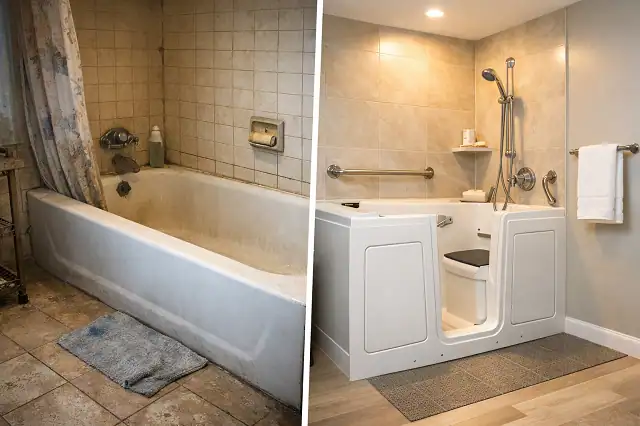
Who Is Most Likely to Find a Matching Program?
Homeowners with a documented accessibility, mobility, health, safety, or independent-living need are the most relevant audience for walk-in bathtub funding.
Age and income can be important for USDA and local housing programs. Veteran status and qualifying disability can be important for VA programs. Medicaid enrollment and participation in an eligible HCBS program can be important for state Medicaid modifications.
Homeowners with disabilities who need broader accessibility work can compare Bathroom Accessibility Grants for Disabled Homeowners when the project extends beyond the bathtub itself.
The condition of the existing bathroom also matters. Replacing an old bathtub purely for appearance is different from replacing a conventional tub because a homeowner can no longer safely step over the tub wall.
What Makes a Walk-In Bathtub Project a Stronger Funding Request?
The strongest applications explain the actual problem that the modification is intended to solve.
| Situation | Useful project explanation | Funding relevance |
| Difficulty entering a conventional tub | Explain how the existing tub creates an entry or exit problem. | Connects the modification to safer bathing access. |
| Wheelchair or mobility-device use | Explain how the existing bathroom restricts movement. | Shows the accessibility purpose of the project. |
| Difficulty standing during bathing | Explain the need for safer seated bathing. | May support an accessibility or functional-need request. |
| Need to remain safely at home | Explain how the modification supports independent living. | Relevant to some home-based care programs. |
Best Program for Your Situation
Rural Seniors: Start With USDA Section 504
The Single Family Housing Repair Loans and Grants program, commonly called Section 504, is one of the most relevant federal options for elderly homeowners who meet its income, property, credit, and rural-location requirements.
The U.S. Department of Agriculture (USDA) states that its grant component is intended for elderly very-low-income homeowners who need to remove health and safety hazards from their homes.
USDA currently lists a standard maximum grant of $10,000. This is a program limit, not a guaranteed payment for a walk-in bathtub.
Homeowners who want to understand the broader USDA repair pathway can also review Section 504 Home Repair Grants before deciding whether the walk-in bathtub project is worth submitting.
To qualify for the grant component, the homeowner generally must be at least 62, own and occupy the property, meet the applicable very-low-income requirement, be unable to obtain affordable credit elsewhere, and live in an eligible rural area.
A walk-in bathtub should therefore be presented as part of a qualifying health or safety project rather than simply as a bathroom upgrade. The local USDA Rural Development office determines whether the proposed work fits the program.
Veterans: Start With VA Home-Modification Programs
Veterans should investigate the U.S. Department of Veterans Affairs (VA) when the bathing modification is connected to a qualifying disability or medically necessary accessibility need.
The Home Improvements and Structural Alterations benefit, known as HISA, can cover medically necessary improvements and structural alterations to a qualifying primary residence. VA specifically identifies access to essential lavatory and sanitary facilities as an eligible type of improvement and gives roll-in showers as an example.
Veterans comparing bathroom-specific funding with broader veteran programs can also review Bathroom Upgradation Grants for Veterans when the project includes several accessibility changes.
For qualifying situations, VA currently lists a lifetime HISA benefit of up to $6,800. This is a benefit limit rather than a promise that a walk-in bathtub will receive that amount.
HISA also has clear exclusions. The program does not cover spas, hot tubs, or Jacuzzi installations, making it important to distinguish an accessibility project from a luxury bathroom renovation.
Veterans with qualifying service-connected disabilities should also investigate Specially Adapted Housing and Special Home Adaptation benefits. These are broader housing-adaptation programs rather than dedicated bathtub grants.
For fiscal year 2026, VA lists maximum SAH funding of $126,526 and maximum SHA funding of $25,350. These are statutory program limits and should not be presented as guaranteed funding for a particular bathroom project.
Medicaid Beneficiaries: Ask About HCBS Modifications
Medicaid can be relevant when a homeowner receives or qualifies for Home and Community-Based Services, but coverage is determined by the state program and the applicable eligibility pathway.
The Centers for Medicare & Medicaid Services (CMS) explains that states can provide HCBS through several Medicaid authorities and may include environmental modifications under applicable programs.
Instead of asking only whether Medicaid pays for walk-in bathtubs, ask your state Medicaid agency whether your specific HCBS program covers environmental modifications or bathroom accessibility modifications for your eligibility group.
Low-Income Homeowners: Check Local Housing Rehabilitation
Homeowners who do not fit USDA or VA eligibility should investigate city, county, or state housing rehabilitation programs.
The U.S. Department of Housing and Urban Development (HUD) provides the federal framework for Community Development Block Grant activities, which can support eligible homeowner rehabilitation and accessibility improvements under applicable rules.
Homeowners with broader low-income repair needs can compare Home Repair Grants for Low-Income Families when the project involves repairs beyond the accessible bathing area.
HUD does not operate one nationwide walk-in bathtub application. Local governments and other eligible grantees administer their own programs, so income limits, application procedures, priorities, inspections, and approved project categories can differ.
Older Adults Who Need Help Finding a Local Program
The Administration for Community Living (ACL) operates the Eldercare Locator, which connects older adults and families with local aging resources and Area Agencies on Aging.
This can be useful when you know you need an accessibility modification but do not know which local agency administers the relevant program.
What Can a Walk-In Bathtub Grant Potentially Cover?
Each program determines its own eligible project scope. A walk-in bathtub may be one component of a larger accessibility project.
| Possible modification | Potential purpose | What must be confirmed |
| Walk-in bathtub | Safer entry and exit from the bathing area. | Whether the fixture qualifies under the specific program. |
| Roll-in or low-entry shower | Improved access for people with mobility limitations. | Eligibility and approved project scope. |
| Grab bars | Additional support during bathing and transfers. | Program and installation requirements. |
| Shower seat | Supports seated bathing. | Whether the equipment is an eligible modification. |
| Bathroom doorway modification | Improves access for mobility devices. | Property and accessibility requirements. |
| Plumbing or electrical work | May be necessary to complete an approved modification. | Whether related installation costs are eligible. |
Homeowners planning several accessibility upgrades can also compare Accessibility Home Modification Grants for Senior Citizens when the project extends beyond bathing.
Before selecting equipment, ask the administering agency whether the fixture, labor, plumbing, electrical work, permits, and related construction can be included in the approved scope.
What These Programs Do NOT Cover
A homeowner’s age, disability, veteran status, or income level does not automatically make every bathroom expense eligible.
VA’s HISA program specifically excludes spas, hot tubs, and Jacuzzi installations. USDA Section 504 grants have a different limitation because their grant purpose is tied to removing health and safety hazards.
Local HUD-funded programs can also impose their own project limits. Federal eligibility does not mean that every local rehabilitation program will approve every accessible bathroom fixture.
How Do You Apply for Walk-In Bathtub Grants?
The application process begins with identifying the agency that controls the program.
| Your situation | First contact | Question to ask |
| 62+, very-low-income, rural homeowner | USDA Rural Development | Can my accessible bathing project qualify as a health or safety repair? |
| Eligible veteran | VA | Which VA home-modification benefit fits my disability and proposed work? |
| Medicaid HCBS participant | State Medicaid agency or case manager | Does my program cover environmental or bathroom accessibility modifications? |
| Low-income homeowner | City, county, or state housing agency | Do you offer homeowner rehabilitation or accessibility grants? |
| Older adult without a local contact | Local aging agency | Which local organization handles home modification grants? |
Homeowners who need to compare federal, state, and local opportunities can also use State Home Repair Grants as a broader starting point.
What Documents Should You Prepare?
- Proof of homeownership.
- Proof of occupancy.
- Household income documentation.
- Identification and household information.
- Medical documentation when required.
- Disability or veteran documentation when applicable.
- Photographs of the existing bathroom when requested.
- An itemized contractor estimate.
- A clear description of the proposed modification.
- Required inspection, permit, or project documents.
Homeowners who want to understand the application process in greater detail can review How to Apply for Home Repair Grants before submitting documentation.
Do not submit a vague request such as “I need a new bathroom.” Explain the accessibility problem, the proposed modification, and how the project addresses that problem.
When Should You Apply?
Apply before purchasing the bathtub or beginning construction whenever the program requires prior approval.
Some programs require inspections, medical recommendations, contractor estimates, property reviews, or written authorization. Starting work first can create a funding problem if the program does not reimburse unauthorized construction.
USDA states that Section 504 applications are accepted on an ongoing basis subject to funding availability. VA, Medicaid, and local housing programs can follow different procedures and schedules.
How Can You Make the Application Stronger?
A complete application is easier for an agency to evaluate than a request that only identifies the desired product.
- Match the project to the program’s stated purpose.
- Explain the accessibility or safety need clearly.
- Provide the requested income and ownership documents.
- Obtain medical documentation when required.
- Use an itemized estimate.
- Ask whether the contractor must be approved.
- Confirm whether an inspection is required.
- Do not include unrelated cosmetic upgrades.
- Do not start work before required authorization.
- Keep copies of the application and approval documents.
What Does Medicare Cover?
Medicare should not be treated as a general funding source for installing a walk-in bathtub.
Medicare covers certain home health services and durable medical equipment when its requirements are met, but that is different from paying for a permanent bathroom remodeling project.
If a homeowner has both Medicare and Medicaid, the Medicaid route may be more relevant for an accessibility modification because some state HCBS programs can include environmental modifications.
What Statistics Help Explain the Opportunity?
Home-based services are an important part of the U.S. long-term-care system. The Centers for Medicare & Medicaid Services reported that 86.2% of Medicaid long-term services and supports users received Home and Community-Based Services in 2021.
This statistic does not mean Medicaid automatically pays for a walk-in bathtub. It shows why eligible homeowners should investigate state HCBS programs when a home modification is connected to an approved long-term-care or independent-living need.
The actual benefit, eligibility pathway, and covered modification must still be confirmed with the relevant state Medicaid program.
What Other Home Repair Funding May Be Relevant?
A walk-in bathtub may be only one part of a larger repair project. If the home also needs structural, plumbing, safety, or accessibility work, homeowners can compare Home Repair Grants to identify broader categories that may be relevant.
Homeowners dealing with several bathroom repairs rather than a focused accessibility project can also consider Bathroom Repair and Renovation Grants for Low Income Homeowners when the project falls within that page’s broader intent.
Common Mistakes to Avoid
- Assuming every government grant covers walk-in bathtubs.
- Calling a cosmetic bathroom remodel an accessibility project.
- Using a program maximum as if it were guaranteed funding.
- Starting construction before approval.
- Applying to an agency that does not administer the program.
- Ignoring state-specific Medicaid rules.
- Including luxury features in an accessibility request.
- Failing to obtain an itemized estimate.
- Failing to ask whether a contractor must be approved.
Frequently Asked Questions
Are there free grants for walk-in bathtubs?
Potentially. USDA, VA, Medicaid HCBS, local housing programs, and some nonprofit programs may help with qualifying accessibility work. There is no universal federal walk-in bathtub grant available to every homeowner.
What is the best grant for seniors who need a walk-in bathtub?
A homeowner age 62 or older with very low income who lives in an eligible rural area should investigate USDA Section 504 first. Other seniors should check local housing rehabilitation programs, Medicaid if eligible, and local aging resources.
Can disabled homeowners get grants for walk-in bathtubs?
Potentially. State Medicaid HCBS programs and local accessibility rehabilitation programs may cover qualifying environmental modifications. The homeowner must meet the applicable eligibility and project requirements.
Can veterans get grants for accessible bathroom modifications?
Yes, eligible veterans can investigate VA home-modification benefits. HISA is particularly relevant when the work is medically necessary and involves access to essential lavatory and sanitary facilities. SAH and SHA may provide broader housing adaptations for qualifying disabilities.
Does Medicare pay for a walk-in bathtub?
Medicare does not provide a general benefit for installing a walk-in bathtub as a bathroom remodeling project. Homeowners who also qualify for Medicaid should investigate their state’s HCBS modification rules.
Can Medicaid pay for a walk-in shower?
Some state Medicaid HCBS programs can include environmental modifications. Coverage depends on the state, benefit authority, eligibility group, service plan, and documentation requirements.
How much money can I get for a walk-in bathtub?
There is no standard grant amount. USDA Section 504 currently lists a maximum standard grant of $10,000, while VA HISA, SAH, and SHA have separate benefit limits. These are program limits and are not guaranteed payments for a bathtub.
Can grants pay for installation and plumbing?
They may, if those costs are included in the program’s approved project scope. Ask the administering agency before construction begins.
Should I buy the walk-in bathtub before applying?
No. Apply first whenever prior approval is required. Buying the fixture or starting construction before authorization can make the work ineligible.
Where should I apply first?
Start with the agency that matches your strongest qualification: USDA for qualifying rural seniors, VA for eligible veterans, the state Medicaid agency for HCBS beneficiaries, and local housing agencies for other eligible rehabilitation projects.
Why You Should Trust This Guide
Last Updated: August 25, 2026
Reviewed By: Home Accessibility & Grant Research Team
- Experience: The article is organized around the actual decisions homeowners must make when seeking funding for accessible bathing.
- Expertise: Major federal program information is checked against current official agency materials.
- Authoritativeness: Federal programs are separated from state and locally administered programs.
- Trustworthiness: Program limits are identified as limits rather than guaranteed payments.
- Helpful Decision Support: The program-matching sections show which agency a homeowner should contact first.
Conclusion
Walk-in bathtub funding is most useful when the project is matched to the program designed for the homeowner’s actual situation. Rural seniors can investigate USDA Section 504, eligible veterans can review VA home-modification benefits, Medicaid beneficiaries can ask about HCBS environmental modifications, and other low-income homeowners can check local housing rehabilitation programs.
The best next step is to document the accessibility need, contact the correct administering agency, prepare an itemized project description, and obtain any required approval before spending money on construction.
For the broader home-improvement funding structure, return to Home Improvement Grants for Homeowners in 2026 and compare this specialist topic with other eligible home repair and upgrade categories.

Arthur Pendelton is a senior housing policy researcher and public welfare analyst with over eight years of experience tracking federal, state, and non-profit residential repair programs. He specializes in statutory grant frameworks, including USDA Section 504 Rural Housing, the Department of Energy’s Weatherization Assistance Program (WAP), and municipal HUD Community Development Block Grants (CDBG). Arthur systematically audits Federal Register publications and Title 7/42 CFR regulatory updates to provide low-income homeowners, seniors, and military veterans with accurate, barrier-free application guidance.
This info is great but where and how do I apply