
Disabled homeowners may have several legitimate ways to reduce the cost of making a bathroom safer, more accessible, and easier to use. Bathroom upgrade grants for disabled homeowners may be available through federal, state, local, Medicaid, VA, and nonprofit programs, depending on the homeowner’s circumstances and the type of modification needed.
The most effective approach is to match the bathroom project with the program designed for that type of need. A roll-in shower, grab bars, an accessible sink, a widened doorway, or another accessibility modification may qualify under a different funding pathway than a general cosmetic bathroom remodel.
Quick answer: Disabled homeowners may find bathroom funding through USDA Section 504, locally administered HUD-funded housing rehabilitation programs, Medicaid Home and Community-Based Services, VA housing benefits for eligible veterans, state and local housing programs, and nonprofit organizations. Disability alone does not guarantee a grant. Income, location, homeownership, medical need, veteran status, age, and the exact work proposed can all affect eligibility.
For the broader home-improvement funding picture, see Home Improvement Grants for Homeowners in 2026. This article focuses specifically on bathroom accessibility funding for disabled homeowners.
What Bathroom Upgrade Grants for Disabled Homeowners May Cover
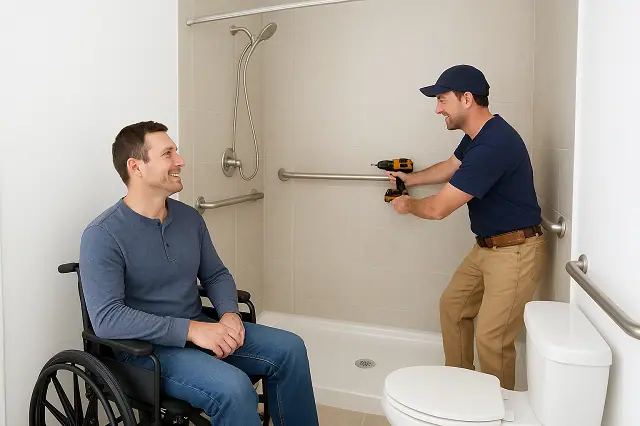
Most legitimate housing and accessibility programs focus on work that improves safety, accessibility, health, or independent living. Cosmetic remodeling is usually a weaker fit than a modification that directly addresses a documented functional need.
| Bathroom modification | Why it may qualify | What to verify |
| Roll-in shower | Can improve bathing access for wheelchair users and people with limited mobility | Confirm accessibility or medical-need requirements |
| Walk-in shower | Can reduce the need to step over a traditional bathtub | Ask whether the program covers the specific installation |
| Grab bars and handrails | Can support safer transfers and movement | Confirm approved installation requirements |
| Accessible or lowered sink | Can improve access for wheelchair users and people with limited reach | Check whether plumbing changes are included |
| Raised toilet | Can make sitting and standing easier | Confirm whether the modification is within program scope |
| Wider bathroom doorway | Can improve wheelchair or mobility-device access | Some programs may require inspection or construction approval |
| Slip-resistant flooring | Can improve safety in wet areas | Confirm that the flooring is considered an eligible safety modification |
| Handheld shower controls | Can make bathing easier from a seated position | Verify whether the fixture is eligible |
| Necessary plumbing or electrical changes | May be needed to complete an approved accessibility modification | Coverage varies by program |
Federal programs can support accessibility-related improvements, but each program has its own rules. For example, VA HISA specifically identifies access to essential bathroom facilities among potentially eligible improvements, while HUD’s CDBG framework allows local grantees to design homeowner rehabilitation and accessibility programs. Medicaid HCBS programs can also include environmental modifications in states where the approved program covers them.
If your main project is a walk-in or roll-in bathing solution, you can also review grants for walk-in bathtubs for a more specific funding pathway.
Who May Qualify for Bathroom Upgrade Grants?
There is no single national eligibility rule for disabled homeowners. Each funding program defines its own requirements, so the strongest application usually begins by identifying which eligibility category fits your situation.
- You own the home or meet the program’s occupancy requirements.
- The property is your primary residence when required.
- You have a disability or documented functional need when required.
- The bathroom modification directly addresses that need.
- Your household meets the applicable income requirements.
- Your property is located within the program’s eligible service area.
- You meet additional rules if the program is designed for veterans, seniors, Medicaid beneficiaries, or rural homeowners.
Important: Disability status alone does not qualify a homeowner for every bathroom grant. Some programs are income-based, some are disability-specific, some are veteran-specific, some are limited to rural properties, and others are created locally by cities, counties, or states.
Disability and Functional Need
A disability-related bathroom project is generally easier to explain when you connect the requested work directly to a functional need. Instead of simply saying that you want to remodel the bathroom, explain what prevents you from using the existing bathroom safely or independently.
Examples include difficulty stepping over a bathtub, difficulty standing while bathing, inability to reach a standard sink from a wheelchair, difficulty transferring from a wheelchair to a toilet, or the need for additional support while entering and exiting the shower.
For VA HISA, medical justification is an important part of the application, and VA requires appropriate medical documentation for the proposed improvement.
Income and Household Circumstances
Income requirements vary widely. USDA Section 504 uses very-low-income standards tied to household circumstances and location. Local housing rehabilitation programs can use their own income limits, while Medicaid eligibility follows state and federal Medicaid rules.
Do not rely on one nationwide income number when deciding whether you qualify. Check the actual program rules for your county, state, household size, and program category.
Homeownership and Occupancy
Many home-repair programs are designed for homeowners who occupy the property. USDA Section 504, for example, requires applicants to own and occupy the home. Some VA programs have different housing requirements, including specific rules for eligible veterans and temporary family residences.
If you are looking for broader options beyond the bathroom, review home repair grants for disabled homeowners.
Age and Rural Location
Age matters for some programs but not all. USDA Section 504 is an important example because its grant component is designed for qualifying very-low-income homeowners age 62 or older who need to remove health and safety hazards from an eligible rural property.
If you are an older homeowner, you can also compare the broader bathroom renovation grants for seniors pathway, while keeping this article’s focus on disability-related bathroom needs.
Which Funding Routes Are Available?
The best way to understand bathroom funding is to separate programs according to how they work. Some provide grants or benefits directly to eligible applicants. Others send federal funds to states, cities, counties, or nonprofit organizations that operate their own housing programs.
USDA Section 504 Home Repair Grants
The U.S. Department of Agriculture Rural Development Single Family Housing Repair Loans and Grants program (Section 504) is an important federal pathway for qualifying homeowners in eligible rural areas.
USDA Section 504 is not a disability-specific grant. The grant component is for qualifying very-low-income homeowners age 62 or older who own and occupy the home, cannot obtain affordable credit elsewhere, and need to remove health and safety hazards. The program also provides loans for eligible repairs, improvements, and modernization.
| Section 504 feature | Official program rule | Bathroom relevance |
| Grant maximum | Up to $10,000 | May apply when eligible bathroom work removes a health or safety hazard |
| Loan maximum | Up to $40,000 | May support broader eligible repair, improvement, or modernization work |
| Grant age requirement | 62 or older | Important for disabled homeowners under age 62 |
| Property requirement | Eligible rural property | Property eligibility must be checked |
| Grant purpose | Removal of health and safety hazards | Cosmetic remodeling is not the core purpose |
USDA also explains that Section 504 grants can have repayment conditions in certain circumstances, including situations involving the sale of the property. Therefore, do not describe the grant as unconditional free money.
You can also review the site’s Section 504 home repair grants article for broader program information.
HUD-Funded Local Housing Rehabilitation Programs
The U.S. Department of Housing and Urban Development Community Development Block Grant program (CDBG) provides funding to eligible state and local governments. HUD does not operate one universal nationwide CDBG bathroom grant that homeowners apply for directly.
Local governments have flexibility in designing eligible rehabilitation programs. HUD’s CDBG materials identify residential rehabilitation as an eligible activity, and HUD guidance also describes accessibility programs that can include modifications such as ramps and grab bars.
For that reason, a disabled homeowner should search for a local owner-occupied rehabilitation, housing rehabilitation, accessibility modification, or critical repair program rather than searching only for a national “HUD bathroom grant.”
For additional HUD-related information, see HUD home improvement grants.
HOME-Funded Housing Rehabilitation
The U.S. Department of Housing and Urban Development HOME Investment Partnerships Program (HOME) provides federal housing funds to participating jurisdictions.
A local HOME-funded program may support eligible homeowner rehabilitation, but there is no universal national HOME bathroom grant amount. The local administrator determines how its eligible program is structured and what work it accepts.
When contacting a housing department, ask whether it operates an owner-occupied rehabilitation or accessibility program using HOME, CDBG, state housing funds, or another source.
Medicaid Home and Community-Based Services
The Centers for Medicare & Medicaid Services Home and Community-Based Services authorities (HCBS) can be relevant for Medicaid beneficiaries who need environmental modifications to remain safely in the community.
CMS materials show that environmental modifications can include accessibility improvements, but the exact services depend on the approved state program. Some HCBS programs can cover modifications such as grab bars, widened doorways, or bathroom changes when they are necessary to meet the participant’s assessed needs.
Best Medicaid question to ask: Contact your state Medicaid agency or HCBS case-management program and ask whether your current benefit includes environmental modifications or bathroom accessibility modifications for your documented functional needs.
VA Home Modification Benefits for Disabled Veterans
For an eligible disabled veteran, VA housing benefits can provide a strong pathway for accessibility work.
The U.S. Department of Veterans Affairs Home Improvements and Structural Alterations benefit (HISA) can support medically necessary home improvements, including modifications involving access to essential bathroom facilities.
For a veteran whose primary need is a medically necessary modification to an existing bathroom, HISA is an important program to investigate first. Veterans with qualifying severe service-connected disabilities and larger housing-adaptation needs may instead qualify for SAH or SHA.
| VA pathway | FY2026 information | Best fit |
| HISA | Lifetime benefit limits depend on the qualifying category | Medically necessary home improvements, including eligible bathroom modifications |
| SAH | Up to $126,526 for FY2026 | Veterans with qualifying severe service-connected disabilities requiring major home adaptation |
| SHA | Up to $25,350 for FY2026 | Veterans with qualifying service-connected disabilities who need home adaptation |
| TRA | FY2026 limits depend on SAH or SHA eligibility | Eligible veterans temporarily living in a family member’s home |
VA states that the FY2026 maximum for SAH is $126,526 and the maximum for SHA is $25,350. These are maximum program amounts, not guaranteed bathroom awards, and eligibility depends on the veteran’s qualifying disability and housing circumstances.
If you are a disabled veteran, you can also compare the broader bathroom renovation grants for veterans page and home repair grants for veterans.
Weatherization Assistance
The U.S. Department of Energy Weatherization Assistance Program (WAP) is primarily an energy-efficiency program rather than a bathroom-remodeling grant.
It may still be relevant when a bathroom project is part of a broader home health, safety, moisture, ventilation, or energy-efficiency issue identified through the weatherization process.
DOE reports that WAP provides weatherization services to approximately 32,000 homes each year using DOE funds, with participating households saving an average of $372 or more annually according to the national evaluation cited by DOE.
What These Programs Do NOT Cover
Understanding exclusions helps you prepare a stronger application. A bathroom project can be important without every part of the project being eligible for grant funding.
- Luxury remodeling unrelated to accessibility or safety.
- Decorative upgrades chosen mainly for appearance.
- Premium fixtures when a basic eligible alternative meets the program purpose.
- Unrelated repairs elsewhere in the house when the program is limited to the bathroom project.
- Work started before required program approval.
- New construction when the program is intended for modifications to an existing home.
- Spas, hot tubs, and similar luxury features under programs that specifically exclude them.
- Routine maintenance outside the program’s approved purpose.
- Costs that duplicate benefits from another funding source when duplication is prohibited.
Important: Do not start funded bathroom work simply because a program appears to cover the modification. Ask the administering agency whether prior approval, inspection, contractor approval, or a written authorization is required before construction begins.
Best Program for Your Situation
The best starting point depends on your circumstances. Use this table to identify the most relevant pathway before preparing an application.
| Your situation | Best starting point | Why |
| Disabled veteran needing a medically necessary bathroom modification | VA HISA | Designed for medically necessary home improvements and accessibility needs |
| Veteran with a qualifying severe service-connected disability needing major home adaptation | VA SAH or SHA | Designed for larger housing-adaptation needs |
| Age 62+, very-low-income, rural homeowner | USDA Section 504 | Grant pathway for qualifying older homeowners needing health and safety repairs |
| Low-income disabled homeowner in a city or county | Local HUD-funded rehabilitation program | Local programs may support accessibility and owner-occupied rehabilitation |
| Medicaid beneficiary with disability-related functional needs | State Medicaid HCBS | Some state programs can cover environmental modifications |
| Bathroom project connected with broader energy or health-safety work | WAP or local energy program | May address eligible energy and health-safety improvements |
| Does not fit federal programs | Local nonprofit or community housing program | May provide repairs, modifications, labor, referrals, or another funding route |
For a broader overview of repair pathways, see home repair grants guide.
How to Match Your Bathroom Project to the Right Program
A strong application begins with the exact project rather than the amount of money you hope to receive.
Describe the Functional Problem
Instead of writing “I want to remodel my bathroom,” explain what prevents you from using it safely or independently.
- I cannot safely step over my existing bathtub.
- I need a roll-in shower because I use a wheelchair.
- I need grab bars for safer transfers.
- My sink needs to be lowered for wheelchair access.
- The bathroom doorway needs modification so my mobility device can enter.
This explanation helps the administering agency understand why the proposed work is connected to accessibility, health, safety, or independent living.
Separate Essential Work From Optional Work
Create two lists before applying. The first should contain the modifications required for safe use. The second can contain optional improvements such as decorative tile, premium fixtures, or cosmetic changes.
Lead with the essential accessibility work. If the program allows additional improvements, the administering agency can explain what may be included.
Confirm the Scope Before Construction
Before paying a contractor or ordering materials, ask the program:
- Is this exact bathroom modification eligible?
- Does the project require medical documentation?
- Does the property require an inspection?
- Do I need an approved contractor?
- Can any work begin before approval?
- Will the program pay the contractor directly?
- Is a homeowner contribution required?
- Are there repayment, lien, occupancy, or property-sale conditions?
Documents to Prepare Before Applying
Exact requirements vary, but preparing a basic application file can make the process easier.
Bathroom Grant Application Checklist
- Proof of identity
- Proof of homeownership
- Proof of primary residence when required
- Recent household income documentation
- Property tax or mortgage information when requested
- Clear photographs of the existing bathroom
- A written description of the accessibility or safety need
- Medical documentation when required
- VA documentation for veteran-specific programs
- Contractor estimate when requested
- Insurance information when relevant
- Program-specific application forms
Privacy reminder: Start with the official administering agency or a verified local organization before sending sensitive documents. Avoid websites that request Social Security numbers, bank information, or detailed medical records simply because they promise guaranteed grant approval.
How to Apply for Bathroom Upgrade Grants
The application process becomes easier when the project, eligibility pathway, documents, and funding source are clear before you submit anything.
- Define the bathroom modification. Write down exactly what needs to change and how it improves accessibility, safety, or independent living.
- Identify your strongest eligibility pathway. Consider disability status, veteran status, age, income, Medicaid eligibility, rural location, and local housing programs.
- Verify the property. Confirm ownership, occupancy, location, and any rural or service-area requirements.
- Check the current program rules. Review the official program page and confirm that your proposed work is eligible.
- Prepare the requested documents. Gather only the records required by the program.
- Submit through the correct agency. Use the official application route instead of a third-party website promising guaranteed approval.
- Wait for required approval. Ask whether you must receive written authorization before beginning the bathroom work.
If your bathroom project is part of a larger repair project, the home repair grant eligibility information can help you understand broader eligibility factors.
When Should You Apply?
The best time to apply is generally before the project begins, once you can clearly document the need and identify the appropriate program.
- You know which accessibility modification is required.
- A medical professional has documented the need when required.
- You have photographs showing the current bathroom condition.
- You have confirmed that the program is accepting applications.
- You are prepared to complete an inspection if required.
Do not assume that expenses incurred before approval will qualify. Always confirm the rule with the administering agency first.
When the Bathroom Need Is Connected to Disaster Damage
If your bathroom was damaged by a qualifying disaster, a disaster-recovery program may be more appropriate than a standard accessibility grant. Disaster programs have their own rules involving declarations, damage, insurance, ownership, occupancy, inspections, and duplication of benefits.
For urgent repair situations, see emergency home repair grants and check the official disaster agency serving your area.
State and Local Bathroom Funding
State and local programs can be especially important because federal housing funds often reach homeowners through local housing agencies rather than through a single national application.
A city or county may operate an owner-occupied rehabilitation program, accessibility modification program, critical repair program, housing preservation program, or another locally funded initiative.
For many disabled homeowners, the local housing department may be the most practical place to ask about an accessibility or rehabilitation program because local agencies can establish their own priorities and application procedures.
When contacting your local housing department, ask:
- Do you have an owner-occupied rehabilitation program?
- Do you fund accessibility modifications for disabled homeowners?
- Is bathroom modification an eligible expense?
- Is the program funded through CDBG, HOME, state housing funds, or another source?
- Is there an income limit?
- Is there a waiting list?
- Does the property require an inspection?
- Do you require an approved contractor?
For a broader state-by-state starting point, see state home repair grants.
Nonprofit Options When Government Funding Is Limited
Government programs are not the only possible route. Local nonprofit housing organizations may provide accessibility modifications, critical repairs, volunteer labor, referrals, or combinations of funding sources.
USDA’s Housing Preservation Grants program also supports organizations that repair or rehabilitate rural housing occupied by low- and very-low-income residents. Recent USDA information specifically notes accessibility and independent-living needs among the types of housing challenges these programs can address.
You can also review nonprofit home repair grants to identify additional community-based pathways.
Smart fallback strategy: If one federal program does not fit, continue with your local housing department, state housing agency, Medicaid program when applicable, veteran housing resources, nonprofit repair organizations, and community-based disability organizations.
Other Home Repair Programs That May Help
A bathroom project sometimes forms part of a larger accessibility or safety project. If the bathroom is not your only repair need, use related programs carefully rather than applying the same funding request everywhere.
For example, a homeowner who also needs a safer entrance can review front door replacement grants. A disabled veteran who needs broader energy improvements can review window replacement grants for disabled veterans.
If roof damage is also affecting the home, see roof repair grants for disabled homeowners. For broader roof and bathroom repair pathways, see grants for roof and bathroom upgrades.
For plumbing problems connected to the bathroom, you can also review grants for leak repairs.
What to Do If You Are Denied
A denial from one program does not necessarily mean that your bathroom project is ineligible everywhere. First identify why the application was denied.
| Reason | Next step |
| Income is above the program limit | Check local programs with different eligibility rules |
| Property is outside the service area | Check another city, county, state, or federal pathway |
| Bathroom work is outside program scope | Ask whether a narrower accessibility modification is eligible |
| Medical documentation is missing | Ask what specific documentation is required |
| Application is incomplete | Complete the missing documents and ask whether resubmission is allowed |
| Funding is unavailable | Ask about a waiting list or the next application period |
| Program is closed | Search another legitimate federal, state, local, Medicaid, VA, or nonprofit pathway |
For homeowners who need a different type of financing after a grant search, broader single-family housing funding options may provide another pathway.
Important Statistics About Disability and Home Modification Needs
The need for accessible housing is substantial. The Centers for Disease Control and Prevention reports that 28.7% of U.S. adults have some type of disability.
That statistic does not mean that every disabled homeowner qualifies for a bathroom grant. It shows why accessible housing modifications are an important part of housing policy and community-based living.
| Official statistic | What it means |
| 28.7% of U.S. adults have some type of disability | Accessibility needs affect a significant portion of the adult population |
| WAP serves approximately 32,000 homes each year using DOE funds | Energy-focused housing programs operate through a nationwide network of state and local providers |
| WAP households save an average of $372 or more annually according to DOE’s national evaluation | Energy-related programs can provide benefits beyond the initial improvement |
Bathroom Grant Application Checklist
Before You Apply
- Identify the exact bathroom modification you need.
- Explain how the modification addresses your functional need.
- Confirm homeownership and occupancy requirements.
- Check the program’s income rules when applicable.
- Confirm that your property is in the eligible service area.
- Determine whether medical documentation is required.
- Check veteran eligibility if applicable.
- Ask whether an inspection is required.
- Ask whether a contractor estimate is required.
- Confirm whether work must wait until approval.
- Read repayment, lien, occupancy, and property-sale conditions.
- Keep copies of every document submitted.
Common Mistakes to Avoid
- Searching only for one universal federal bathroom grant. Many housing programs are administered locally.
- Assuming disability automatically qualifies you. Every program has its own eligibility rules.
- Using outdated funding amounts. Program limits can change.
- Using one nationwide income threshold. Eligibility calculations vary by program.
- Calling a loan a grant. Always confirm whether the funding must be repaid.
- Starting work before approval. Some programs require prior authorization.
- Requesting cosmetic remodeling. Focus on the safety, accessibility, health, or functional purpose of the work.
- Ignoring local housing programs. Local agencies may administer federally funded rehabilitation programs.
- Sending sensitive information to unknown websites. Start with official agencies or verified organizations.
- Using the same application for every program. Adapt your documents and project description to the actual program requirements.
Frequently Asked Questions
Can disabled homeowners get bathroom upgrade grants?
Some eligible homeowners can receive grant-funded repairs, benefits, direct services, or nonprofit modifications that help pay for bathroom accessibility work. However, there is no universal federal program that guarantees a free bathroom remodel to every disabled homeowner. Eligibility depends on the specific program, household circumstances, property, location, and type of modification.
What bathroom modifications are most likely to qualify?
Safety and accessibility modifications generally have a stronger program fit than cosmetic remodeling. Examples can include roll-in showers, grab bars, accessible sinks, wider doorways, raised toilets, slip-resistant flooring, and other modifications connected to a documented functional need.
Can I get a USDA Section 504 bathroom grant if I am disabled?
Disability by itself does not qualify someone for the Section 504 grant. USDA states that the grant is for qualifying very-low-income homeowners age 62 or older who own and occupy an eligible rural property and need to remove health and safety hazards. The program also provides a loan pathway for eligible homeowners.
Can Medicaid pay for bathroom modifications?
Some Medicaid Home and Community-Based Services programs can cover environmental modifications, but the exact services and eligibility rules are determined by the state. Ask your state Medicaid agency or HCBS program whether bathroom accessibility modifications are included in your benefit.
What bathroom grant is best for a disabled veteran?
For an eligible veteran with a medically necessary bathroom modification, HISA is an important program to investigate first. Veterans with qualifying severe service-connected disabilities may also be eligible for SAH or SHA housing adaptation grants. VA eligibility is specific, so compare your disability and housing circumstances with the official requirements before applying.
Can HUD give me a bathroom grant directly?
Usually, no. HUD’s CDBG and HOME programs send federal funding to eligible states and local jurisdictions. A homeowner generally applies through the local agency operating the rehabilitation program rather than applying to HUD for a universal nationwide bathroom grant.
Can I start the bathroom renovation before my grant is approved?
Do not assume that you can. Ask the administering agency whether pre-approval work is eligible before signing a construction contract or beginning the project. Starting work too early can make some costs ineligible.
Why You Should Trust This Information
Last Updated: August 25, 2026
Reviewed By: HomePropertyGrants Housing & Government Grant Research Team
- Official evidence: Major federal program information is checked against current USDA Rural Development, HUD, VA, Medicaid/CMS, and Department of Energy information.
- Program accuracy: Grants, loans, VA benefits, Medicaid services, local rehabilitation programs, and weatherization programs are treated as separate funding pathways.
- Funding transparency: The article avoids unsupported universal dollar promises and identifies program maximums only when they are tied to specific official rules.
- Decision support: The article helps readers compare programs according to disability, veteran status, age, income, rural location, Medicaid eligibility, and the type of bathroom work needed.
- Limitations are clear: Program availability, funding levels, income rules, local priorities, and eligibility requirements can change, so applicants should verify the final requirements with the administering agency before submitting sensitive documents or beginning work.
Conclusion
Bathroom upgrade grants for disabled homeowners can come through different federal, state, local, Medicaid, VA, and nonprofit pathways. The most effective strategy is to match the bathroom project to the right program rather than searching for one universal grant.
If you are an eligible disabled veteran, investigate VA home-modification benefits. If you are age 62 or older, have very low income, and live in an eligible rural area, check USDA Section 504. If you live in a city or county, ask your local housing department about owner-occupied rehabilitation and accessibility programs. If you receive Medicaid and have disability-related functional needs, ask about HCBS environmental modifications.
Then document the exact bathroom need, gather the required records, confirm the eligible scope of work, and apply through the correct agency before beginning funded construction.
The strongest application is not necessarily the one requesting the largest amount. It is the one that clearly connects your functional need, bathroom modification, household circumstances, property, and the actual purpose of the program.
Final takeaway: Treat bathroom funding as a program-matching process. Verify eligibility, document the need, use the official application route, confirm the approved scope of work, and keep local or nonprofit options available as a backup. This gives disabled homeowners a clearer and more reliable path toward a safer, more accessible bathroom.

Arthur Pendelton is a senior housing policy researcher and public welfare analyst with over eight years of experience tracking federal, state, and non-profit residential repair programs. He specializes in statutory grant frameworks, including USDA Section 504 Rural Housing, the Department of Energy’s Weatherization Assistance Program (WAP), and municipal HUD Community Development Block Grants (CDBG). Arthur systematically audits Federal Register publications and Title 7/42 CFR regulatory updates to provide low-income homeowners, seniors, and military veterans with accurate, barrier-free application guidance.
1 thought on “Free Bathroom Upgrade Grants For Disabled Homeowners 2026”