
Disabled homeowners may have several paths to make a home safer, more accessible, and easier to live in. Depending on the repair and the homeowner’s circumstances, funding may be available through federal housing programs, Veteran benefits, weatherization services, state and local rehabilitation programs, and nonprofit organizations.
The key is finding the program that matches the actual home improvement need. A wheelchair ramp, accessible bathroom, doorway modification, energy-efficiency improvement, roof repair, or health and safety project can fall under very different program rules. Income, age, location, homeownership, disability status, Veteran status, and the purpose of the repair can all affect which option is appropriate.
This article answers one practical question: which home repair grants and home modification programs should a disabled homeowner check first, and how can they choose the option that best matches their situation? The article organizes these options around the type of repair, eligibility requirements, program purpose, application process, and important coverage limits so homeowners can identify the most relevant funding path more easily.
Quick answer: Disabled homeowners can explore several potential funding routes, including USDA Section 504 for qualifying rural homeowners, locally administered HUD-funded rehabilitation programs, the Department of Energy’s Weatherization Assistance Program, state and local accessibility programs, and specialized VA housing benefits for eligible disabled Veterans and Servicemembers. The best option depends on the homeowner’s circumstances and the specific repair.
For the broader national picture, see Home Repair Grants: Complete Guide to Free Home Repair Assistance. This article focuses specifically on disability-related repairs, accessibility modifications, program matching, documentation, and application decisions.
What counts as a disability-related home repair?
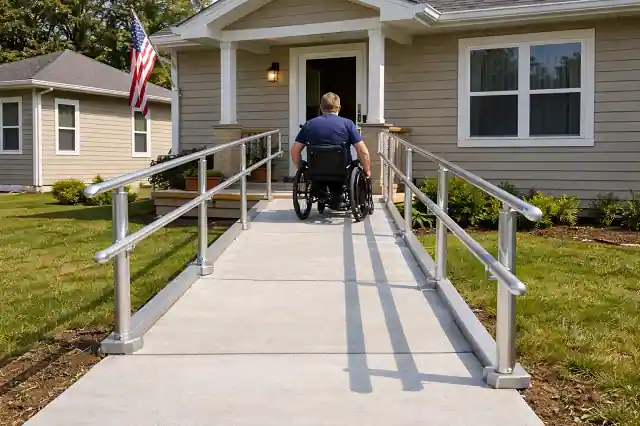
A disability-related home repair is work that helps a homeowner safely enter, leave, move through, or use essential areas of the home, or work that removes a serious health or safety barrier affecting independent living.
The connection does not always have to be a traditional accessibility modification. A permanent ramp is an obvious example. A bathroom modification can also qualify when it addresses a mobility barrier. Energy-efficiency or health-and-safety work may be relevant when poor housing conditions create additional risks for a disabled household.
The U.S. Census Bureau’s 2024 American Community Survey reports that 13.3% of the U.S. population has a disability. The Census Bureau explains that disability data help communities plan services and understand the needs of people with limitations affecting basic functioning and independent living.
U.S. Census Bureau (Census Bureau) provides the underlying disability information.
Why the repair explanation matters: A program administrator normally needs more than a statement that an applicant has a disability. The application should explain the home barrier, why the requested work is necessary, and how the proposed repair addresses the safety, accessibility, health, or independent-living problem.
Common examples include:
- Permanent ramps and accessible entrances
- Doorway modifications for wheelchair access
- Accessible bathroom modifications
- Grab bars and fixed safety improvements
- Walk-in or roll-in shower modifications where eligible
- Changes to kitchen or bathroom counters and sinks
- Permanent accessibility improvements around an entrance
- Electrical or plumbing modifications required for qualifying home medical equipment
- Weatherization work addressing energy efficiency and eligible health or safety issues
- Repairs that remove serious health and safety hazards
- Structural repairs needed to keep an occupied home safe
Which programs should disabled homeowners check first?
The right program depends on the reason for the repair. A disabled homeowner living in a rural area may have a different option from a disabled Veteran who needs a medically necessary bathroom modification. A low-income homeowner struggling with energy costs may be better served by weatherization than by a general rehabilitation program.
| Program | Best fit | Primary purpose |
| USDA Section 504 | Very-low-income rural homeowners who meet the program’s age and other requirements | Repair, improve, or remove health and safety hazards; grants are for qualifying elderly homeowners |
| HUD CDBG-funded rehabilitation | Low- and moderate-income homeowners served by participating local governments | Local housing rehabilitation and other eligible community development activities |
| DOE WAP | Eligible low-income households needing energy-efficiency and health-and-safety improvements | Weatherization and energy-efficiency improvements |
| VA SAH/SHA | Eligible Veterans and Servicemembers with qualifying service-connected disabilities | Major home adaptation and accessibility modifications |
| VA HISA | Eligible Veterans and Servicemembers needing medically necessary structural modifications | Specific medically necessary home improvements and structural alterations |
| State and local programs | Homeowners served by state, county, city, or disability-focused housing programs | Local rehabilitation, accessibility, emergency, or preservation work |
| Nonprofit programs | Homeowners who do not receive enough help from government programs | Repair labor, materials, or supplemental funding depending on the organization |
USDA Section 504 Home Repair Loans and Grants
The U.S. Department of Agriculture Rural Development’s Section 504 program provides loans to very-low-income homeowners to repair, improve, or modernize their homes. USDA also provides grants to qualifying elderly homeowners to remove health and safety hazards.
USDA requires applicants to own and occupy the home, meet the applicable very-low-income limit, be unable to obtain affordable credit elsewhere, and live in an eligible rural area. For the grant portion, the homeowner must be age 62 or older.
For 2026, USDA lists a maximum loan of $40,000, a maximum grant of $10,000, and a maximum grant of $15,000 for qualifying repairs to homes damaged in a presidentially declared disaster area.
For a disabled homeowner, Section 504 can be particularly relevant when the requested work addresses a qualifying health, safety, or accessibility need and the property and household meet USDA’s requirements.
USDA limitation: A disability does not automatically qualify a homeowner for a Section 504 grant. The grant has a specific age requirement of 62 or older, in addition to income, rural-area, ownership, occupancy, and other program requirements.
If your situation combines disability, low income, and rural residency, compare this program with Federal and State Home Repair Grants For Rural Homeowners.
HUD-funded local rehabilitation programs
The U.S. Department of Housing and Urban Development’s Community Development Block Grant (CDBG) program provides funding to eligible communities for a range of local activities, including rehabilitation of residential properties.
HUD explains that CDBG funding is administered by state and local governments, which determine which eligible activities receive funding in their communities. Over the applicable program period, at least 70% of CDBG funds must benefit low- and moderate-income persons.
HUD does not provide CDBG assistance directly to individual homeowners. If you are looking for a CDBG-funded home repair or rehabilitation opportunity, contact your local municipal or county housing department and ask whether it currently operates a homeowner rehabilitation or accessibility program.
Best CDBG strategy: Describe the exact repair you need and ask which local rehabilitation program handles that type of project. Local participation requirements and available projects can differ between communities.
For another explanation of locally administered HUD housing programs, see HUD Home Improvement Grants.
DOE Weatherization Assistance Program
The U.S. Department of Energy’s Weatherization Assistance Program (WAP) helps eligible low-income households improve energy efficiency while addressing qualifying health and safety needs.
DOE states that priority is given to several vulnerable groups, including elderly households and families with one or more members with a disability. DOE’s application guidance also identifies income as a primary eligibility factor and explains that states and local weatherization providers administer the program.
For qualifying households, weatherization can include measures identified through the program’s home assessment process. The local provider determines the appropriate scope of work based on the home’s energy performance and applicable health and safety requirements.
DOE reports that low-income households typically spend 13.9% of annual income on energy costs compared with 3% for other households. This helps explain why energy-focused programs can be particularly valuable for households managing high housing costs.
VA Specially Adapted Housing and Special Housing Adaptation
Eligible disabled Veterans and Servicemembers have access to specialized housing benefits through the U.S. Department of Veterans Affairs (VA). These programs are designed to help qualifying Veterans and Servicemembers buy, build, or modify a home to meet needs related to certain service-connected disabilities.
For fiscal year 2026, VA lists a maximum of $126,526 for Specially Adapted Housing (SAH) and $25,350 for Special Home Adaptation (SHA). Eligibility depends on the specific service-connected disability and the applicable home ownership or family-home requirements.
VA also provides Temporary Residence Adaptation (TRA) grants for certain eligible Veterans and Servicemembers who temporarily live in a family member’s home. For FY2026, VA lists maximum TRA amounts of $50,961 for qualifying SAH recipients and $9,100 for qualifying SHA recipients.
| VA benefit | Best use | FY 2026 maximum |
| Specially Adapted Housing (SAH) | Major home adaptation for qualifying severe service-connected disabilities | Up to $126,526 |
| Special Housing Adaptation (SHA) | Home purchase or modification for certain qualifying service-connected disabilities | Up to $25,350 |
| Temporary Residence Adaptation (TRA) | Qualifying adaptation of a family member’s home where the Veteran temporarily resides | Subject to VA’s applicable SAH or SHA limits |
These benefits are not available to every disabled homeowner. VA has specific disability categories and ownership or family-home requirements.
Disabled Veterans can continue with Free Home Repair Grants For Disabled Veterans for a more focused discussion of Veteran-specific housing options.
VA Home Improvements and Structural Alterations
The VA Home Improvements and Structural Alterations benefit (HISA) is especially relevant when a Veteran needs a medically necessary modification to the primary residence.
VA states that HISA can support improvements that allow entrance or exit from the home, improve access to essential bathroom or sanitary facilities, improve access to kitchen or bathroom sinks and counters, provide permanent ramping immediately around the home, or modify plumbing or electrical systems made necessary by qualifying home medical equipment.
VA currently lists a lifetime benefit of up to $6,800 for certain qualifying service-connected situations and up to $2,000 for other qualifying situations.
HISA warning: HISA is not a general home maintenance fund. VA specifically lists routine repairs such as ordinary roof, furnace, and air-conditioner replacement among excluded work. Exterior decking, hot tubs, home security systems, removable equipment, and other excluded items also do not qualify simply because a homeowner has a disability.
VA states that HISA projects must be medically justified. The application process can require medical documentation, an itemized estimate, photographs, and other program-specific information.
Best Program for Your Situation
The most useful question is not “Which grant gives the most money?” It is “Which program has a legitimate reason to pay for my particular repair?”
| Your situation | First program to check | Reason |
| Age 62+, very-low income, rural homeowner with qualifying repairs | USDA Section 504 | Its grant component is designed for qualifying elderly homeowners facing health and safety hazards |
| Low-income disabled homeowner in a participating city or county | Local CDBG-funded rehabilitation | Local governments may fund residential rehabilitation through eligible CDBG activities |
| Low-income household with energy-efficiency problems | DOE WAP | WAP focuses on energy efficiency plus eligible health and safety improvements |
| Disabled Veteran with qualifying service-connected disability | VA SAH or SHA | These programs are specifically designed for qualifying disability-related housing adaptation |
| Veteran needing a medically necessary entrance, bathroom, or structural modification | VA HISA | HISA is specifically designed for medically necessary home improvements and structural alterations |
| Repair does not fit a federal program | State, county, city, or nonprofit programs | Local programs can have specialized accessibility and rehabilitation categories |
| Home has qualifying disaster damage | Disaster-specific programs | Disaster funding follows separate eligibility and geographic rules |
If you want to compare eligibility categories before applying, see Who Qualifies For Free Home Repair Grants.
What can these programs pay for?
The same repair can qualify under one program and be excluded under another. The reason for the work is therefore just as important as the physical repair itself.
| Repair | Programs worth checking | Key consideration |
| Permanent accessibility ramp | VA SAH/SHA, VA HISA, local rehabilitation, USDA where eligible | Program rules and documentation determine eligibility |
| Accessible bathroom | VA HISA, VA SAH/SHA, local rehabilitation, USDA where eligible | Explain the actual accessibility or safety barrier |
| Doorway modification | VA adaptation programs, HISA, local rehabilitation | Permanent accessibility work may be considered when program requirements are met |
| Roof repair | USDA, local rehabilitation, disaster programs | Do not assume a disability-specific program pays for ordinary roof maintenance |
| Electrical safety work | USDA, local rehabilitation, WAP, HISA in qualifying medical-equipment situations | The purpose and circumstances of the work matter |
| Plumbing work | USDA, local rehabilitation, WAP, HISA in qualifying situations | Eligibility depends on the program’s purpose |
| Insulation and air sealing | DOE WAP and other energy programs | Usually evaluated through the weatherization process |
| Energy-related window improvements | DOE WAP, local programs, eligible energy programs | Energy performance and local rules determine eligibility |
For bathroom-specific accessibility options, see Free Bathroom Accessibility Grants for Disabled Homeowners.
If windows are the problem, the disability-specific Energy-Efficient Window Replacement Grants For Disabled article provides a narrower path.
What these programs do NOT cover
One of the most important lessons for applicants is that “home repair grant” does not mean every home improvement is eligible.
Do not assume eligibility from the name of the repair. Program administrators apply their own statutory authority, funding rules, income requirements, property standards, and eligible-project definitions.
| Potential project | Why it may not qualify | Better approach |
| Cosmetic remodeling | Many programs prioritize safety, health, accessibility, or energy efficiency | Explain the functional or safety problem |
| Luxury bathroom remodeling | Accessibility funding generally focuses on necessary modifications | Document the actual accessibility barrier |
| Ordinary roof maintenance under HISA | VA specifically excludes routine roof replacement under HISA | Check USDA, local rehabilitation, or disaster programs |
| Portable accessibility equipment under HISA | Some removable equipment is excluded | Ask VA whether a permanent structural modification is eligible |
| Repairs outside the service area | USDA and local programs have geographic restrictions | Verify the property address before applying |
| Work unrelated to the program’s purpose | Programs cannot generally fund projects outside their authorized use | Match the repair to the program first |
For serious roof problems, continue with Free Roof Replacement Grants For Disabled while remembering that the individual funding program—not the article—determines eligibility.
How is eligibility determined?
Disability is only one factor. A program may also evaluate income, age, homeownership, occupancy, location, property condition, repair urgency, Veteran status, service-connected disability, or medical necessity.
Disability or functional need
Explain the real-world problem created by the disability.
“I am disabled and need money” is much less useful than “The existing entrance has stairs that prevent me from safely entering the home because I use a wheelchair, and I need a permanent accessible entrance.”
Household income
Many programs target low-income or very-low-income households, but there is no single national income limit that applies to every repair program.
Income limits can vary according to household size, county, program, and administering agency. Do not copy an income number from another article without checking the current program rules.
If disability benefits are an important part of your household income, review Home Repair Grants For SSI Recipients for additional context.
Homeownership and occupancy
Many homeowner repair programs require the applicant to own and occupy the property. USDA Section 504, for example, requires the applicant to be the homeowner and occupy the house.
VA programs have their own ownership and family-home requirements depending on the benefit.
Location
Location can completely change the answer.
- USDA Section 504 requires an eligible rural area.
- CDBG-funded programs operate through participating local governments.
- WAP is delivered through state and local weatherization networks.
- State and county programs can have specific service boundaries.
- VA benefits follow federal eligibility rules rather than ordinary city or county boundaries.
For state-level research, see State Home Repair Grants.
Type and urgency of the repair
The requested work should match the purpose of the program. A permanent accessibility modification may fit an adaptation benefit. Insulation may fit weatherization. A dangerous roof may fit a rehabilitation or rural repair program.
When a repair creates an immediate health or safety threat, emergency programs may be more appropriate than waiting for a standard rehabilitation cycle. See Emergency Home Repair Grants for additional options.
What documents should you prepare?
Requirements vary, but preparing a basic document file can make the first conversation with an agency much easier.
Application document checklist
- Proof of homeownership or qualifying occupancy
- Government-issued photo identification
- Recent household income documentation
- Disability or benefit documentation when required
- Property address and basic property information
- Photographs showing the repair or accessibility barrier
- Written explanation of why the repair is necessary
- Contractor estimate when requested
- Medical prescription or justification when required by a VA benefit
- Program-specific forms and supporting documents
For VA HISA, the official process can require medical justification, an itemized estimate, photographs, and other supporting documentation. Always ask the administering VA facility which documents are currently required.
How can you find programs in your state or county?
State and local programs can add important options because housing rehabilitation and accessibility funding is often administered through state, county, city, or local organizations. The exact program, eligibility rules, funding cycle, and application process depend on the agency serving the property.
For example, HUD explains that CDBG-funded activities are administered by participating state and local governments, and homeowners should contact their local municipal or county officials to learn how the program operates in their area.
For weatherization, the U.S. Department of Energy likewise directs applicants to their state weatherization administrator and local provider.
Best local search strategy: Contact your state housing agency and your city or county housing department. Ask specifically about owner-occupied rehabilitation, accessibility modifications, emergency home repairs, weatherization, and disability-related housing programs.
Homeowners with multiple health and safety problems can also compare Free Home Hazard Removal Grants For Homeowners.
How should you apply without unnecessary delays?
Do not start by submitting every application you can find. Match the repair to the program first.
Describe the actual barrier
Write down exactly what needs to change. Separate accessibility problems from unrelated repairs when appropriate.
Match the repair to the funding purpose
Use the program-selection table in this article. Rural older homeowners should investigate USDA Section 504. Qualifying disabled Veterans should investigate VA adaptation benefits. Low-income households with eligible energy problems should investigate WAP. Other low-income homeowners should contact their local housing department about rehabilitation and accessibility programs.
Confirm eligibility before spending money
Do not begin construction simply because you expect a grant to reimburse you later. Some programs require approval, inspection, procurement, or other steps before work starts.
Prepare evidence
Take clear photographs, keep estimates, gather ownership and income documents, and write a short explanation connecting the repair to safety, accessibility, health, or independent living.
Apply through the actual administering agency
Use the official federal program website and the designated state, county, city, or VA office. For CDBG, contact the local government rather than attempting to submit a generic homeowner application directly to HUD.
For broader application strategy, see How to Apply for Home Repair Grants Without Getting Rejected.
Can different programs be combined?
Sometimes, but never assume that two programs can automatically be combined.
Different funding sources may have rules concerning duplication of benefits, the same repair expense, property requirements, or coordination between agencies.
Funding warning: Tell each program administrator about other grants, loans, insurance payments, disaster funding, or assistance you have received or are seeking. Ask whether the programs can be coordinated before assigning the same repair cost to more than one funding source.
A possible strategy is to separate projects by purpose. For example, one program might address an accessibility modification while another handles eligible weatherization work. Whether this is permitted depends on the actual program rules.
What should you do when the repair is urgent?
If a repair creates an immediate health or safety problem, contact your local housing department and ask whether it operates an emergency repair program. Also contact the relevant utility, emergency service, disaster-recovery agency, or nonprofit when appropriate.
Examples include:
- Dangerous electrical conditions
- No safe way to enter or exit the home
- Major water intrusion
- Unsafe bathroom conditions preventing essential use
- Loss of essential heating during dangerous weather
- Serious structural hazards
Disaster-related programs have separate rules. A presidentially declared disaster may create additional federal or state recovery programs, but homeowners should verify the actual administering agency and current application status.
If a household has several urgent problems, Nonprofit Home Repair Grants can be another research path while government applications are being evaluated.
What mistakes can weaken an application?
- Applying to a program that does not serve the property’s location
- Assuming disability automatically creates eligibility
- Using an outdated income limit
- Using an old grant amount
- Calling a loan a grant
- Failing to explain why the repair is necessary
- Submitting incomplete disability or income documentation
- Starting work before receiving required approval
- Ignoring local rehabilitation programs
- Failing to disclose other funding sources
- Requesting cosmetic work when the program prioritizes safety or accessibility
- Using a generic repair description instead of explaining the disability-related barrier
Strong application principle: Connect the homeowner, the disability-related barrier, the requested modification, and the program’s purpose. A clear connection makes it easier for the administering agency to determine whether the request fits its rules.
Application Checklist
Complete these seven steps before submitting.
- ☐ Identify the exact repair or accessibility barrier.
- ☐ Confirm homeownership and primary occupancy requirements.
- ☐ Check the program’s income, age, location, disability, and Veteran rules.
- ☐ Gather disability, income, ownership, and property documents.
- ☐ Obtain required estimates, photographs, or medical documentation.
- ☐ Confirm whether approval is required before construction begins.
- ☐ Submit through the actual administering agency and keep a complete copy.
How should you prioritize multiple repairs?
When money is limited, prioritize work that affects safety, accessibility, essential living functions, or the ability to remain safely in the home.
| Priority | Examples | Reason |
| Immediate safety | Dangerous wiring, structural hazards, severe water intrusion | Can create immediate health or safety risks |
| Basic accessibility | Safe entrance, bathroom access, doorway modifications | Can determine whether the homeowner can safely use the home |
| Essential systems | Heating, plumbing, electrical systems | Supports safe and functional living conditions |
| Energy efficiency | Insulation, air sealing, eligible window improvements | Can improve comfort and reduce energy waste |
| Cosmetic improvements | Decorative finishes and nonessential remodeling | Usually lower priority for public repair funding |
Electrical hazards can require immediate attention. For a repair-specific resource, see Grants To Replace Outdated Electrical Panels or Fuse Boxes.
Frequently Asked Questions
Can disabled homeowners get free home repair grants?
Yes, some disabled homeowners can qualify for grants or other no-cost repair programs, but disability alone does not guarantee funding. Eligibility can depend on income, age, location, homeownership, repair type, Veteran status, and the rules of the specific program.
What is the best federal program for a disabled homeowner?
There is no single best program. USDA Section 504 may be appropriate for qualifying very-low-income rural homeowners age 62 or older. Eligible disabled Veterans may have specialized VA housing options. Low-income households with energy-related needs should also investigate WAP, while city and county homeowners may need to check locally administered rehabilitation programs.
Can SSI recipients get home repair grants?
SSI does not automatically provide a home repair grant. However, SSI can be relevant when a housing program uses low-income eligibility rules. The administering agency decides how income is counted and whether all other requirements are satisfied.
Can a disabled homeowner get help paying for a wheelchair ramp?
Potentially. Permanent accessibility modifications may be eligible under VA housing programs for qualifying Veterans, VA HISA for eligible medically necessary modifications, USDA Section 504 where all requirements are met, and certain state or local rehabilitation programs.
Can grants pay for an accessible bathroom?
They can in qualifying circumstances. VA HISA specifically addresses access to essential lavatory and sanitary facilities, while other rehabilitation and accessibility programs may also fund qualifying bathroom modifications. The applicant should document the actual barrier rather than simply request a bathroom remodel.
Can disabled Veterans use more than one VA home modification benefit?
Different VA benefits have different purposes and eligibility requirements. A Veteran should discuss the specific project with VA rather than assume that SAH, SHA, TRA, and HISA can automatically be combined for the same work.
Does USDA Section 504 give grants to every disabled homeowner?
No. USDA Section 504 grants have specific requirements. The applicant must generally be age 62 or older for the grant portion, have very-low income, own and occupy the home, live in an eligible rural area, be unable to obtain affordable credit elsewhere, and meet the other program requirements. Disability can be relevant to eligible accessibility work but is not by itself a grant qualification.
Why You Can Trust This Information
Last Updated: August 18, 2026
Reviewed By: Homepropertygrants Editorial Team
Experience
This article is organized around the practical decisions disabled homeowners face when looking for funding for accessibility, safety, energy-efficiency, and essential home repairs.
Expertise
The information distinguishes major federal programs by their purpose and eligibility, including USDA Section 504, HUD-funded rehabilitation, the Weatherization Assistance Program, and VA housing benefits for eligible Veterans and Servicemembers.
Authoritativeness
Major program information is supported by official sources from the U.S. Department of Agriculture, U.S. Department of Housing and Urban Development, U.S. Department of Energy, U.S. Department of Veterans Affairs, FEMA, and the U.S. Census Bureau.
Trustworthiness
Program limits, eligibility requirements, geographic restrictions, and eligible repairs can vary. This article distinguishes program maximums from guaranteed awards and encourages readers to verify current requirements with the administering agency.
Helpful Decision Support
The article helps readers match their disability-related repair need with the most relevant funding pathway, prepare the appropriate documentation, and identify the agency to contact before beginning work.
What Should a Disabled Homeowner Do First?
Start by identifying the exact repair or accessibility change your home needs. Then match that need to the program whose purpose best fits the work. For example, USDA Section 504 may be relevant for qualifying rural homeowners, WAP focuses on energy-efficiency improvements, local housing programs may support rehabilitation or accessibility work, and eligible disabled Veterans can explore VA housing benefits.
Before paying a contractor or starting the project, contact the official program administrator and ask whether your specific repair, property, income, and household circumstances qualify. This helps you confirm the correct funding pathway and learn which documents or inspections are required.

Arthur Pendelton is a senior housing policy researcher and public welfare analyst with over eight years of experience tracking federal, state, and non-profit residential repair programs. He specializes in statutory grant frameworks, including USDA Section 504 Rural Housing, the Department of Energy’s Weatherization Assistance Program (WAP), and municipal HUD Community Development Block Grants (CDBG). Arthur systematically audits Federal Register publications and Title 7/42 CFR regulatory updates to provide low-income homeowners, seniors, and military veterans with accurate, barrier-free application guidance.