
Foggy double-pane windows usually point to a problem inside the sealed glass unit, but the right repair is not always a full window replacement. When moisture remains trapped between the panes, the insulating seal may have failed. Drafts, damaged frames, water intrusion, or rot can create a different repair situation.
For homeowners searching for free grants for replacing foggy double-pane windows in 2026, the practical answer is more specific than a list of generic window grants. There is no single nationwide program that automatically pays every homeowner to replace a foggy window. Instead, the best route depends on what failed, whether the glass unit or the whole window needs work, the home’s location, household eligibility, and whether the repair fits a program’s approved purpose.
This article helps you make that decision in the right order: identify the window problem, determine the smallest reasonable repair, match that repair to a legitimate funding route, verify the official rules, and obtain any required inspection or approval before spending your own money.
Important 2026 warning: The federal Energy Efficient Home Improvement Credit under Section 25C is not available for qualifying property placed in service after December 31, 2025. Do not build a 2026 window budget around the former federal window tax credit.
What Does a Foggy Double-Pane Window Actually Mean?
A double-pane window has two panes of glass separated by an insulating space. When the sealed unit remains intact, the space between the panes helps reduce heat transfer. When moisture or a cloudy appearance stays trapped between the panes, the insulated glass unit may have experienced seal failure.
That is different from condensation on the room-facing or outdoor surface of the glass. Surface condensation can result from humidity, temperature, ventilation, or weather conditions and does not automatically mean the sealed unit has failed.
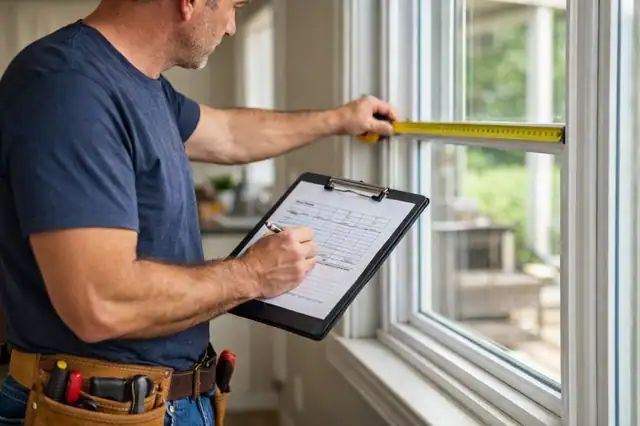
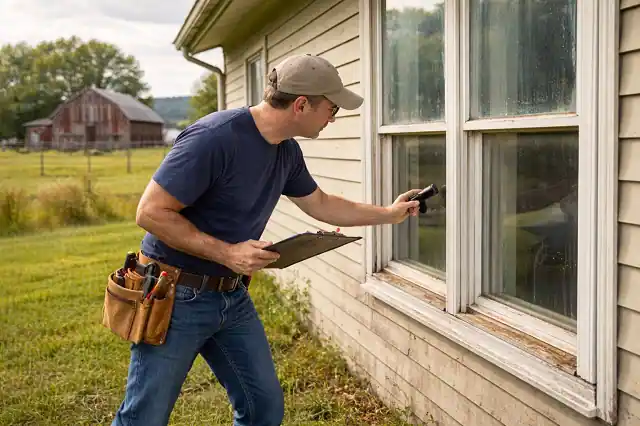
Document the actual problem first. Photograph the fogging, identify the affected rooms, and photograph drafts, damaged frames, water intrusion, rot, broken glass, or other visible conditions. Evidence of the actual defect is more useful than simply stating that you want new windows.
If the main problem is deteriorated framing rather than failed glazing, compare the situation with our window frame rot repair grants resource.
How Can You Tell if the Fogging Is Between the Panes?
Clean both accessible glass surfaces and inspect the window from several angles. If the cloudy appearance remains inside the sealed space, the insulated glass unit may have failed. If the appearance disappears after cleaning, it may be surface dirt or condensation instead.
When speaking with a contractor, inspector, or program administrator, describe what you can actually observe. Do not state that the entire window needs replacement unless the condition supports that conclusion.
Does a Foggy Window Need Glass Replacement or a New Window?
This is one of the most important decisions in the funding process. A failed insulated glass unit does not automatically mean that the frame and entire window must be replaced.
If the frame and sash are sound, a qualified contractor may determine that the insulated glass unit can be replaced separately. If the frame has serious rot, water damage, structural deterioration, severe air leakage, or another functional problem, a complete window replacement may be more appropriate.
| Window condition | Possible solution | Useful evidence |
| Moisture trapped between panes | Insulated glass unit evaluation | Photographs and inspection notes |
| Fogging plus damaged frame | Possible complete window replacement | Photographs and contractor assessment |
| Significant drafts around the window | Air-sealing or replacement evaluation | Inspection or energy assessment |
| Water intrusion around the opening | Moisture-source and repair evaluation | Photographs and written assessment |
| Severe deterioration | Repair or replacement based on the approved scope | Condition report and photographs |
If you are comparing the broader economics of replacing an entire double-pane unit, our double-pane window replacement grants resource covers the broader replacement topic.
Because this article focuses on failed double-pane windows, single-pane rules should not automatically be applied to your situation. Our single-pane window replacement grants resource covers that separate window type.
Which Funding Options Can Help With a Failed Double-Pane Window?
The word grant should not be used as a blanket term for every form of home-repair funding. For a foggy double-pane window, the important question is whether a program can address the underlying problem, such as failed glazing, air leakage, moisture intrusion, damaged framing, or a qualifying health, safety, or energy concern.
An actual grant is different from a repayable loan. A weatherization service is different from a cash grant. A utility rebate is different from both. A local rehabilitation program may use federal funds while operating under local eligibility and construction rules.
| Funding type | What it provides | How it may relate to foggy windows |
| Actual grant | Funding that generally does not have to be repaid when all program conditions are satisfied | Possible only when the specific program authorizes the window-related work |
| Loan | Funds that must be repaid under the program terms | May support eligible repair, improvement, or modernization work |
| Weatherization service | Approved energy-efficiency and related health-and-safety improvements | A window may be considered after an assessment, but WAP is not a standard cash window grant |
| Utility rebate | A payment or credit after qualifying work or purchase under the utility’s rules | Some utilities offer incentives for qualifying efficient windows |
| Local housing rehabilitation | Repair funding or services administered locally | May include eligible window rehabilitation depending on local rules |
| Nonprofit program | Repairs, labor, materials, grants, loans, or other help depending on the organization | Must be verified with the specific organization and local program |
For a broader look at legitimate repair funding categories, see our home repair grants resource.
If you are comparing window work with other federally supported home-renovation categories, our government home renovation grants resource provides broader context without replacing the window-specific analysis on this page.
Best Program for Your Situation
The strongest program to investigate depends first on what is wrong with the foggy double-pane window. After documenting the condition, consider household income, age, rural location, homeownership, disability or Veteran status, energy burden, and whether the work addresses health, safety, accessibility, or energy efficiency.
| Your situation | First program to investigate | Why it may fit |
| Low-income household with broader energy-efficiency problems | Weatherization Assistance Program | The home can be assessed for eligible weatherization measures |
| Very-low-income rural homeowner age 62 or older with a qualifying health or safety hazard | USDA Section 504 | The grant component is designed for qualifying elderly rural homeowners and health-and-safety hazards |
| Home is covered by an owner-occupied rehabilitation program | Local housing department | Local rehabilitation programs may include eligible window work |
| Homeowner is buying qualifying efficient windows | Utility rebate search | Some utilities offer current incentives for qualifying products |
| Veteran has a qualifying disability and medically necessary housing modification | VA housing benefits | Specialized VA benefits may apply when the project fits the program rules |
| First program does not fit | State, local, utility, or nonprofit programs | Other programs may use different eligibility and property rules |
Best starting strategy: Start with the route that matches the actual defect. Broader energy problems point toward weatherization. A qualifying rural health-and-safety hazard may point toward USDA Section 504. A medically necessary disability modification may point toward VA benefits. Local rehabilitation programs and utility incentives can be important when federal routes do not fit.
Weatherization Assistance Program for Foggy Double-Pane Windows
The U.S. Department of Energy Weatherization Assistance Program (WAP) helps eligible low-income households improve energy efficiency while addressing applicable health and safety concerns.
WAP is a weatherization service program, not a nationwide cash grant that homeowners receive simply to buy replacement windows. DOE’s current Program Year 2026 materials continue to direct funding through state and local weatherization administrators.
DOE’s published eligibility framework uses income rules that include households at or below 200 percent of the federal poverty guidelines, along with other approved eligibility pathways. Because state and local administrators handle applications, homeowners should verify the current rules and income test with the provider serving their location.
Program statistics: DOE reports that WAP has helped more than 7.2 million families since the program began, supports about 8,500 jobs, and provides weatherization services to approximately 32,000 homes each year using DOE funds. A national evaluation reported average annual household energy savings of $372 or more. These are program-wide statistics, not a promise for an individual home.
The U.S. Department of Energy (DOE) directs applicants to identify the weatherization administrator serving their state or territory and contact the appropriate provider.
Can WAP Pay for a Foggy Double-Pane Window?
Potentially, but fogging alone does not guarantee that window replacement will be approved. The local provider evaluates the home and determines which eligible measures are appropriate under the program’s rules.
The assessment may identify air sealing, insulation, heating or cooling work, health-and-safety measures, or other improvements instead of replacing a particular window. Explain the actual window condition and let the provider determine the approved scope.
If the foggy windows are part of a broader building-envelope problem, our weatherproofing grants for older homes resource may help you compare that related repair route.
USDA Section 504 for Qualifying Rural Window Repairs
The U.S. Department of Agriculture Rural Development Single Family Housing Repair Loans and Grants Program (Section 504) is an important federal option for eligible rural homeowners.
For a foggy window, the key question is whether the failed or damaged window represents a qualifying health or safety hazard rather than simply an old or less efficient window.
The Section 504 loan is repayable financing for eligible very-low-income homeowners to repair, improve, or modernize their homes or address health and safety hazards. The Section 504 grant is for qualifying elderly very-low-income homeowners and is restricted to removing health and safety hazards.
| Section 504 feature | Official program rule |
| Maximum standard loan | $40,000 |
| Maximum standard grant | $10,000 |
| Maximum combined standard loan and grant | $50,000 |
| Grant age requirement | Generally age 62 or older |
| Grant purpose | Removal of health and safety hazards |
| Loan purpose | Eligible repair, improvement, modernization, or health-and-safety work |
| Loan term | 20 years |
| Loan interest rate | 1% fixed |
USDA’s official program information confirms these standard limits and the separate purposes of the grant and loan. The amounts are program limits, not guaranteed funding for a foggy-window project. USDA also notes that grants have repayment rules if the property is sold within the applicable period.
What Section 504 does NOT cover automatically: A foggy window is not automatically a qualifying health or safety hazard. The homeowner must satisfy the applicable rural, income, ownership, age, credit, and property requirements, and USDA must determine that the proposed work fits the program.
For more information about this specific program, see our Section 504 home repair grants resource.
If the homeowner is age 62 or older and the property is rural, our home repair grants for seniors resource can help with the broader senior eligibility question.
HUD CDBG and Local Window Rehabilitation
The U.S. Department of Housing and Urban Development (HUD) administers the Community Development Block Grant Program (CDBG), but CDBG is not a direct nationwide homeowner grant.
HUD states that CDBG funds can support residential rehabilitation and that HUD does not provide CDBG assistance directly to individuals. Local governments administer the program and determine which local projects receive funding.
For a foggy double-pane window, the practical question is whether the local owner-occupied rehabilitation program treats failed glazing, deteriorated frames, water damage, or another documented window problem as an eligible repair.
Ask your local housing department: Is there an owner-occupied rehabilitation program? Are failed or deteriorated windows eligible? Is the funding a grant, loan, deferred loan, or direct repair service? Is an inspection required? Must the work be approved before construction starts?
For broader HUD-related information, our HUD home improvement grants for seniors resource may be useful.
Utility Rebates for Energy-Efficient Replacement Windows
Utility rebates are another possible way to reduce the cost of qualifying window work, but a rebate is not a grant.
The U.S. Environmental Protection Agency ENERGY STAR program (ENERGY STAR) provides tools for finding local rebates and incentives. Current offers can vary by utility territory and product requirements.
Check before purchasing: A utility may require a specific product, contractor, pre-approval, proof of purchase, installation within a defined period, or other documentation. Verify the current offer before ordering windows.
For a broader energy-window funding discussion, see our energy-efficient window grants resource.
VA Programs for Qualifying Veterans
Veterans should not assume that ordinary window replacement qualifies for a VA grant. VA housing-adaptation benefits and HISA are tied to specific disability, medical, and project requirements.
The U.S. Department of Veterans Affairs (VA) provides Specially Adapted Housing and Special Home Adaptation grants for qualifying disabilities.
The VA Home Improvements and Structural Alterations program (HISA) provides medically necessary improvements and structural alterations for eligible Veterans and service members. VA states that HISA projects must be medically justified and provides defined lifetime benefit limits based on eligibility.
What HISA does NOT cover automatically: HISA is not a general energy-efficiency window replacement program. A window-related project would need to satisfy the program’s medical-necessity and structural-alteration requirements.
If a service-connected disability makes a window modification medically necessary or part of an approved housing adaptation, see our window replacement grants for veterans resource.
If the project is being considered primarily as an energy-efficiency upgrade for a qualifying Veteran, our energy-efficient window grants for veterans resource provides additional context.
What These Programs Do Not Cover Automatically
Understanding exclusions can prevent an applicant from applying to a program that does not match the project.
| Potential problem | Why it can cause trouble | Better approach |
| Cosmetic window upgrade | The program may focus on safety, health, energy, accessibility, or habitability | Describe the genuine functional, health, safety, or energy problem |
| Wrong property location | Some programs have rural or local geographic limits | Verify the address before preparing the full application |
| Wrong income category | Programs use different income standards and eligibility routes | Ask the administering agency which income test applies |
| Work started too early | Some programs require inspection, approval, or a defined scope before work | Get instructions from the administrator before starting |
| Unapproved contractor | A program may require a particular contractor or procurement process | Follow the program’s contractor requirements |
| Duplicate funding | Insurance or another award can affect eligible costs | Disclose other funding when required |
| Assuming a maximum is guaranteed | Program limits are not promises of individual awards | Verify the approved amount and current funding |
If the window problem is urgent because of a safety hazard or disaster, our emergency home repair grants resource covers that separate funding situation.
Who Is Most Likely to Qualify for Foggy Window Repair Funding?
There is no universal income limit or eligibility test for all window programs. Depending on the program, eligibility can consider household income, age, rural location, homeownership, primary residence, disability, Veteran status, property condition, energy burden, health and safety concerns, or local funding priorities.
Homeowners researching low-income eligibility can continue with our home repair grants for low-income families resource.
What Documents Help Prove a Foggy Window Needs Repair?
A strong application should establish two things: why the household meets the program’s eligibility rules and why the proposed window work is necessary.
Application checklist
- Photographs of each affected window
- Photographs showing moisture trapped between panes
- Photographs of damaged frames or surrounding water damage
- Proof of household income when required
- Proof of homeownership when required
- Proof of primary residence when required
- Identification documents when required
- Utility bills when requested
- Disability documentation when applicable
- Veteran documentation when applicable
- Contractor estimate when required
- Inspection or energy-assessment documentation when available
For a broader application process, see our how to apply for home repair grants resource.
How to Apply for Foggy Double-Pane Window Funding Without Losing Eligibility
Document the Window Condition
Take photographs before making repairs. Record the number of affected windows and the rooms where they are located.
Determine the Scope of Work
Find out whether the insulated glass unit can be replaced or whether the frame and complete window require replacement.
Identify Your Strongest Eligibility Route
Review income, age, rural location, ownership, disability, Veteran status, and the actual reason for the repair.
Contact the Correct Administrator
Do not assume the federal agency named in an article accepts direct homeowner applications. Many programs are administered by state, county, city, Tribal, nonprofit, or community organizations.
Ask About Pre-Approval
Before ordering windows, ask whether an inspection, energy assessment, contractor approval, written authorization, or product approval is required.
Submit the Requested Documents
Follow the administrator’s document requirements rather than relying on a generic checklist from another website.
Wait for Required Approval
Do not begin work simply because you believe you qualify. If the program requires approval before construction, wait for that approval.
Our home repair grants program finder can help organize your search for the correct administrator.
Can You Combine Grants, Loans, and Rebates?
Sometimes different funding sources can support different parts of a broader project, but homeowners should never assume that the same expense can be paid twice.
For example, a household might receive weatherization services and separately qualify for a utility incentive, subject to each program’s rules. A local rehabilitation program may have additional requirements concerning other funding.
Funding warning: Tell each program about other funding you are receiving or requesting when disclosure is required. Ask whether the same window, labor cost, or installation expense can be supported by more than one source.
How to Choose Replacement Windows After Foggy Window Funding Is Approved
Once a program approves window work, do not select a product solely because an advertisement calls it energy efficient or “government approved.” Ask what specifications the program actually requires.
Important characteristics can include U-factor, solar heat gain coefficient, glazing type, low-emissivity coatings, frame performance, air leakage, climate-zone suitability, and installation requirements.
The U.S. Environmental Protection Agency ENERGY STAR program (ENERGY STAR) explains that certified windows must meet performance requirements that vary by climate zone. ENERGY STAR also reports average nationwide heating and cooling savings of up to 13 percent compared with non-certified products; that figure should not be treated as a guaranteed saving from replacing a failed double-pane unit.
For additional energy-window cost and product context, our energy-efficient window replacement grants resource may be useful.
Does the Federal Window Tax Credit Help With a 2026 Replacement?
The former federal Energy Efficient Home Improvement Credit included qualifying exterior windows during its active period. Current IRS guidance states that the Section 25C credit is not available for qualifying property placed in service after December 31, 2025.
2026 budgeting rule: Do not add the former federal 30 percent window tax credit or former exterior-window limit to a 2026 replacement budget. Those rules belonged to the earlier eligibility period.
What If Your Foggy Window Funding Application Is Denied?
A denial does not necessarily mean that no funding option exists. First determine why the application was denied.
| Possible reason | What to do next |
| Income is above the program limit | Check another program with different eligibility requirements |
| Window is not an approved measure | Ask whether another repair or energy-efficiency measure is eligible |
| Documents are missing | Ask which documents are required and whether resubmission is allowed |
| Funding is unavailable | Ask about waitlists, future funding, or other providers |
| Property is not eligible | Investigate programs with different property or location requirements |
For broader eligibility research, see our home repair grants eligibility requirements resource.
Where to Find State and Local Funding for Foggy Windows
Federal programs are only one part of the search. State agencies, counties, cities, utilities, community organizations, and nonprofits may offer additional programs, but the rules can differ substantially between locations.
For nonprofit funding that may include window-related repairs, see our nonprofit window replacement grants resource. Verify any nonprofit offer directly with the organization before providing personal or financial information.
For another broad funding route when a window project is part of a larger home-repair need, our nonprofit home repair grants resource provides additional context.
When a Foggy Window Problem Requires a Different Repair Route
Not every foggy-window problem requires the same repair. The appropriate next resource depends on whether the property is a manufactured home, the damage is storm-related, the homeowner needs a disability-related modification, or only the insulated glass needs replacement.
For manufactured or mobile homes, see our mobile home window replacement grants resource.
For storm-related window upgrades, see our storm window and door grants resource.
For senior homeowners, see our window replacement grants for senior citizens resource.
For homeowners considering replacement of only the glass, see our window pane replacement grants resource.
Frequently Asked Questions
Can I get a grant to replace foggy double-pane windows?
Possibly, but fogging alone does not guarantee a grant. Eligibility depends on the specific program, household, property, repair need, approved scope of work, and available funding.
Does WAP provide cash grants for replacement windows?
No. WAP is a weatherization service program. Eligible households receive approved services through state and local providers rather than a standard cash payment for windows.
Can USDA Section 504 provide a grant for a foggy double-pane window?
It may be possible when the homeowner and proposed work satisfy the program’s requirements. The Section 504 grant is restricted to qualifying elderly rural homeowners and must be used to remove health and safety hazards. The loan component is separate and repayable.
Can HUD funding pay for foggy window repairs through a local program?
HUD does not provide CDBG assistance directly to individuals. A local government may operate a rehabilitation program using CDBG funds, and that local program may include eligible window work.
Are utility window rebates the same as grants?
No. A rebate generally returns part of an eligible purchase or project cost under the utility’s rules. Availability and requirements depend on the current local program.
Can a Veteran get a VA grant for foggy windows?
VA has housing-adaptation grants and HISA benefits for qualifying Veterans and service members, but these are not general-purpose grants for ordinary window replacement. The project must fit the applicable disability and medical requirements.
Should I replace a foggy double-pane window before applying for funding?
Do not assume that you should. Ask the program administrator whether inspection or written approval is required before work begins. Starting early can affect eligibility under some programs.
Seven-Step Foggy Window Funding Checklist
Use this checklist before spending your own money:
- Photograph every foggy window.
- Determine whether the moisture is actually between the panes.
- Find out whether the insulated glass unit or complete window needs replacement.
- Identify the strongest grant, weatherization, loan, rehabilitation, rebate, or other funding category.
- Ask whether inspection or pre-approval is required.
- Submit the requested eligibility and property documents.
- Wait for required approval before starting the work.
Official Evidence and Program Verification
| Official source | What it verifies |
| U.S. Department of Energy Weatherization Assistance Program (WAP) | Weatherization services, program purpose, national statistics, and energy-saving information |
| U.S. Department of Energy Program Year 2026 Weatherization information (DOE 2026 notice) | Current 2026 WAP grant-administration information |
| U.S. Department of Agriculture Single Family Housing Repair Loans and Grants Program (Section 504) | Grant and loan structure, eligibility, purposes, and program limits |
| U.S. Department of Housing and Urban Development Community Development Block Grant Program (CDBG) | Local administration, residential rehabilitation, and direct-assistance limitations |
| U.S. Department of Veterans Affairs Disability Housing Grants (VA) | SAH and SHA housing-adaptation grant information |
| U.S. Department of Veterans Affairs Home Improvements and Structural Alterations Benefit (HISA) | Medical necessity, eligible improvements, benefit limits, and application requirements |
| U.S. Environmental Protection Agency ENERGY STAR residential windows program (ENERGY STAR) | Window performance requirements, climate-zone information, and efficiency statistics |
| U.S. Environmental Protection Agency ENERGY STAR Rebate Finder (Rebate Finder) | Current local rebate-search tools |
| Internal Revenue Service Energy Efficient Home Improvement Credit (IRS) | Termination of the Section 25C credit for qualifying property placed in service after December 31, 2025 |
Five-Point EEAT Review
Last Updated: August 2026
Reviewed By: Home Property Grants Editorial Team
Official evidence: Major federal program claims are connected to official DOE, USDA, HUD, VA, IRS, and ENERGY STAR sources.
Program accuracy: Grants, repayable loans, weatherization services, utility rebates, local rehabilitation, and nonprofit programs are separated instead of being grouped together as free grants.
Financial accuracy: USDA Section 504 figures are presented as official program limits rather than guaranteed awards. No unsupported nationwide window-grant amounts are used.
Transparency: The article explains local administration, program limitations, pre-approval requirements, funding uncertainty, and the difference between grants and other funding.
Practical usefulness: The reader can identify a likely funding route, document the window condition, prepare the application, contact the correct administrator, and avoid starting work before required approval.
Conclusion
Foggy double-pane windows should be treated first as a window-condition problem and only then as a funding problem. The strongest application starts by determining whether the insulated glass unit failed, whether the frame is also damaged, and whether glass-only replacement is possible.
If the household has broader energy-efficiency problems, WAP is an important route to investigate, but it provides weatherization services rather than a standard cash grant for replacement windows. If an eligible rural homeowner age 62 or older has a qualifying health or safety hazard, USDA Section 504 may provide an actual grant subject to its rules. Local rehabilitation programs, utility incentives, and qualifying VA benefits can provide other routes when their specific requirements fit.
The safest next step is to photograph the fogging, determine whether the insulated glass unit or complete window needs work, identify the funding route that matches that condition, ask about inspection and pre-approval, and wait for required authorization before starting the project.
Your next step: Document the affected windows, gather your basic eligibility documents, and contact the appropriate program administrator. Ask whether a failed double-pane window is an eligible repair and exactly what must be completed before work begins.
For the broader question of how low-income homeowners can find and compare window replacement funding, continue with our window replacement grants guide.

Arthur Pendelton is a senior housing policy researcher and public welfare analyst with over eight years of experience tracking federal, state, and non-profit residential repair programs. He specializes in statutory grant frameworks, including USDA Section 504 Rural Housing, the Department of Energy’s Weatherization Assistance Program (WAP), and municipal HUD Community Development Block Grants (CDBG). Arthur systematically audits Federal Register publications and Title 7/42 CFR regulatory updates to provide low-income homeowners, seniors, and military veterans with accurate, barrier-free application guidance.