
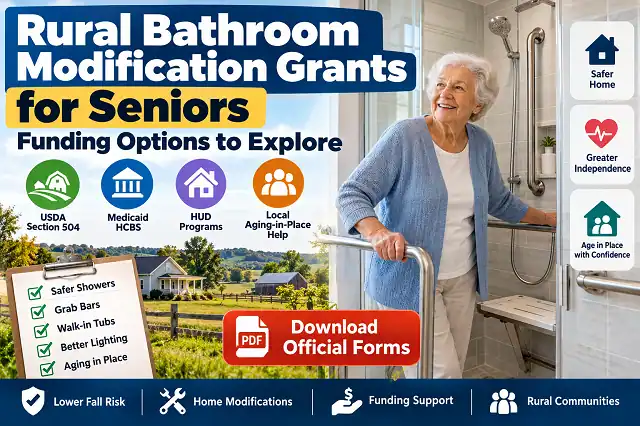
Rural bathroom modification grants for seniors can help eligible homeowners make bathing safer. See rural home repair grants for the funding map. A project may cost $6,000 to $22,000 when it includes accessibility work, so funding fit matters. USDA Section 504 is a rural option for qualifying homeowners age 62 or older. The grant can address health and safety hazards. USDA also supports accessibility needs tied to a disabling condition. Applicants must own and occupy the home, meet the very-low-income test, and live in an eligible rural area. Local programs and Medicaid may add other routes. A bathroom safety assessment can clarify the need.
If the main goal is aging in place, start with the bathroom tasks that affect daily independence. The Administration for Community Living (ACL) lists common bathroom modifications. These include grab bars, walk-in showers, roll-in showers, or a tub-to-shower conversion. They also include lever handles, improved lighting, and wider doorways.
How Rural Bathroom Modification Grants for Seniors Fit Aging in Place
The most useful funding route depends on why the modification is needed, who owns the home, household income, disability or medical needs, and where the home sits.
| Funding route | Best fit | Bathroom work to ask about |
| USDA Section 504 Home Repair | Very-low-income rural homeowners age 62+ | Health and safety or accessibility-related work |
| Medicaid HCBS | Eligible Medicaid participants whose state benefit covers environmental modifications | Accessibility adaptations such as bathroom changes |
| HUD Older Adults Home Modification Program | Low-income older adults served by a funded local provider | Low-cost, high-impact safety and functional modifications. See Section 504 Home Repair Grants for the main rural route. |
| Area Agency on Aging/local programs | Older adults seeking local repair or modification help | Local home modification, referral, or repair assistance |
| VA HISA or housing grants | Veterans or service members who meet VA rules | Medically necessary bathroom and accessibility alterations |
For rural homeowners, USDA deserves the first eligibility check because its Section 504 program directly targets eligible rural properties. The program is open for individual applications on an ongoing basis, subject to funding.
USDA Section 504: the main rural grant route
The U.S. Department of Agriculture Rural Development (USDA Rural Development) provides the clearest federal fit for many older rural homeowners. See Bathroom Upgradation Grants For Seniors for bathroom-specific context. The current USDA rules require the applicant to own and occupy the home. The applicant must also show that affordable credit is unavailable. Household income must meet the county limit. A grant applicant must meet the age requirement.
The grant has a maximum of $10,000 and a lifetime limit of $10,000 under the standard program. USDA also lists a maximum loan of $40,000, with loans and grants potentially combined up to $50,000. The loan carries a fixed 1% interest rate over 20 years. A grant must be repaid if the property is sold in less than three years.
For a bathroom project, the key question is whether the proposed work removes a health or safety hazard. USDA states that grants must be used for health and safety hazards. Its program materials also state that older homeowners may receive grant help for accessibility needs tied to a disabling condition.
For rural bathroom modification grants for seniors, a safety-focused scope is stronger than a cosmetic remodel. A safer shower entry or grab bars can fit a safety-focused request. The same applies to another modification tied to a documented safety need. A decorative remodel has a different purpose.
Before hiring a contractor, contact the local USDA Rural Development office. Ask whether the proposed bathroom work fits the grant purpose.
Confirm the project with USDA before contacting a contractor.
USDA Section 504 Income Limits for Seniors
USDA Section 504 does not use one income limit for every rural household in the United States. The very-low-income limit varies by county and household size. USDA uses adjusted household income when reviewing eligibility. For the grant portion, the applicant must be age 62 or older and have adjusted household income at or below the applicable very-low-income limit.
| Household size | Income limit used for USDA review | What the senior should do |
| 1–4 people | County-specific very-low-income limit | Check the USDA income-limit tool for the property location |
| 5–8 people | County-specific very-low-income limit | Check the USDA income-limit tool for the property location |
| More than 8 people | County-specific threshold | Contact the local USDA Rural Development office for the applicable limit |
Important: Do not use a national income number to decide whether you qualify. USDA’s published worksheets show that limits can differ substantially between counties and metropolitan areas. The agency’s current eligibility tools should be used for the property and household being evaluated.
USDA also allows certain deductions when calculating adjusted family income. Its application materials specifically instruct elderly or disabled applicants to ask Rural Development staff about additional deductions that may apply.
Check Current USDA Income Limits
Download the USDA application package
USDA lists relevant local and federal options. See senior home accessibility grants for another route. Form RD 3550-35, the Section 504 Home Repair Loan and Grant Program Intake Form, and Form RD 3550-1, Authorization to Release Information, are among its applicant resources. The official application package is available as a PDF.
Download Official USDA Section 504 PDF Application
Downloading the USDA intake form does not mean you have been approved. Use it to understand the documents USDA may request. Then confirm the current instructions with the appropriate Rural Development office before submitting anything.
Other funding routes for aging in place
USDA is not the only path. Medicaid HCBS can be important when the bathroom change is tied to disability-related independence. A functional home modification may qualify when the state includes environmental modifications.
That means Medicaid eligibility alone does not guarantee payment for an accessible bathroom. Ask the state Medicaid agency whether its HCBS benefit covers environmental accessibility adaptations. Also ask whether an assessment or service plan is required. The Centers for Medicare & Medicaid Services (CMS) explains that states can offer environmental modifications through certain HCBS authorities.
HUD’s Older Adults Home Modification Program also matters, but homeowners do not normally apply to HUD for an individual grant. HUD funds experienced nonprofit organizations, state and local governments, and public housing authorities that operate modification programs for low-income seniors.
This local modification provider structure is an important distinction. See home repair grants for seniors for broader context. One rural county may have a participating provider nearby. Another senior may need USDA, Medicaid, or a local nonprofit instead.
The Area Agency on Aging can help identify local programs. The Administration for Community Living (ACL) operates the Eldercare Locator. It connects older adults and families with community services. Call 1-800-677-1116.
Local programs can add another funding route when federal eligibility does not fit.
What the top search results leave out
The live search set surfaced five highly relevant pages: AskSamie, MoneyGeek, Home Access Advisor, AARP, and USAGov. These are relevant results, not fixed Google ranks.
- AskSamie: Its October 2026 guide clearly explains that there is no blanket federal bathroom remodel benefit for every senior. It covers Medicaid HCBS, HUD, and USDA. The gap is a rural decision matrix that starts with property, age, income, and project purpose.
- MoneyGeek: MoneyGeek provides a broad 2026 funding overview and useful cost ranges. Its scope covers many types of accessibility work. It does not focus on a rural senior’s specific decision path.
- Home Access Advisor: Home Access Advisor gives a practical funding order of operations. The gap is current USDA application detail, including the rural property test and direct application-package route.
- AARP: AARP explains the role of Medicaid, HUD, VA programs, and local resources in aging in place. The gap is a bathroom-specific rural screening process and current program-status check.
- USAGov: See the home repair grants guide for the broader funding landscape. Its special-groups page is strong for routing readers toward USDA rural repair help and VA options. The gap is project-level bathroom screening and a side-by-side funding decision path.
There is also a freshness point that matters in 2026. The HUD Older Adults Home Modification Grant opportunity was closed on August 31, 2026. HUD’s program still exists, but homeowners generally need a funded local provider.
The missing decision layer is simple. First, identify the safety or accessibility need. Then match it to the funding rule. Verify the property and applicant requirements. Only then obtain a detailed estimate. That sequence helps avoid paying for work that a program will not cover.
Which bathroom changes are easiest to justify?
Aging-in-place projects should connect the requested work to a real daily function. Examples include a shower entry that reduces the need to step over a high tub wall. Other examples include properly installed grab bars, better lighting, safer flooring, and lever-style controls. See the home repair grants guide for the broader landscape. Doorway changes can also improve mobility access. ACL lists many of these as typical home modifications for people who want to remain at home longer.
When comparing rural bathroom modification grants for seniors, do not assume every improvement qualifies. A nicer bathroom is not automatically an eligible project. Funding programs often focus on safety, health, function, disability-related need, or a combination of those factors.
If the project includes a major structural change, ask about permits and inspections before work starts. Keep the project scope, photos, and medical-need documentation when relevant. Keep program correspondence together.
How to apply without wasting time
- Define the aging-in-place problem. Write down what the senior cannot safely do in the current bathroom and what change would solve it.
- Check rural and property eligibility. Complete a property eligibility check with USDA’s property tool. Confirm that the applicant owns and occupies the home.
- Check the income rule. USDA grant eligibility uses the county income threshold. Do not rely on a national income number.
- Ask about the project before hiring a contractor. Describe the exact bathroom modification and ask the program administrator whether it fits the funding purpose.
- Gather the requested documents. Keep income information, ownership records, estimates, and any relevant medical or functional documentation ready.
- Get a detailed estimate. Ask the contractor for an itemized contractor estimate. It should separate labor, materials, permits, and each modification.
- Keep every approval in writing. Do not start funded work until the program confirms the required approval and construction steps.
Broader senior programs may follow different eligibility rules.
Use the program rules and official contact route before starting funded work.
Frequently Asked Questions
Can rural seniors get a bathroom remodel grant?
Rural bathroom modification grants for seniors are available through specific programs rather than one universal federal benefit. USDA Section 504 is a major rural option for qualifying homeowners age 62 or older. Medicaid HCBS and local programs may provide other routes.
How much can USDA Section 504 provide?
The standard Section 504 grant maximum is $10,000, with a $10,000 lifetime grant limit. USDA also lists loans up to $40,000 and a possible combined loan-and-grant amount up to $50,000.
Does USDA pay for a new luxury bathroom?
The grant is designed to remove health and safety hazards. A cosmetic or luxury remodel does not automatically meet that purpose. Ask USDA whether each proposed modification fits the program before construction.
Can Medicaid help with bathroom accessibility?
Some state Medicaid HCBS programs can include environmental modifications. CMS states that states define the services and eligibility rules within approved HCBS authorities, so coverage varies by state.
Where can I find local aging-in-place help?
The Eldercare Locator can connect older adults and families with local services. It is operated as a public service of the Administration for Community Living and can be reached at 1-800-677-1116.
Why You Should Trust This Guide
Last Updated: October 2026
Reviewed By: HomePropertyGrants Editorial Team
Experience: This guide focuses on the real decision points a rural homeowner faces when planning an aging-in-place bathroom project: property location, ownership, income, safety needs, and program fit.
Expertise: Program details are checked against current federal sources. Sources include USDA Rural Development and CMS Medicaid guidance. They also include the Administration for Community Living, HUD, and VA materials.
Authoritativeness: The primary funding claims use official government sources rather than contractor advertisements or lead-generation pages.
Trustworthiness: The guide separates grants, loans, Medicaid benefits, and local programs. It does not present them as one universal funding pool. USDA’s current rules, including the $10,000 grant limit and rural eligibility requirements, are stated from official program information.
Helpful Decision Support: The goal is to help readers verify the route before paying for a remodel. Final eligibility belongs to the administering agency.
Next Step
If you are 62 or older, contact USDA Rural Development first. You must own and occupy the home. The home must be in an eligible rural area. You must also meet the very-low-income requirement. Ask whether your bathroom safety project fits Section 504 grant rules.
If USDA is not a fit, contact your state Medicaid agency about HCBS environmental modifications. You can also use the Eldercare Locator to find local aging-in-place assistance. Do not begin the funded work until the responsible program confirms the approval path.

Arthur Pendelton is a senior housing policy researcher and public welfare analyst with over eight years of experience tracking federal, state, and non-profit residential repair programs. He specializes in statutory grant frameworks, including USDA Section 504 Rural Housing, the Department of Energy’s Weatherization Assistance Program (WAP), and municipal HUD Community Development Block Grants (CDBG). Arthur systematically audits Federal Register publications and Title 7/42 CFR regulatory updates to provide low-income homeowners, seniors, and military veterans with accurate, barrier-free application guidance.