
Disabled veterans have several potential pathways to make important home repairs and accessibility improvements more affordable in 2026. VA housing adaptation benefits, medically necessary home modification programs, USDA rural housing programs, HUD-funded local rehabilitation, weatherization services, and state and nonprofit programs can each serve different types of home projects.
The most useful approach is to match the repair with the program that is designed for that need. This article explains which programs may fit disability-related modifications, rural home repairs, energy-efficiency improvements, health and safety work, and broader rehabilitation needs, along with the eligibility factors, documents, application steps, and program limits to check before starting a project.
Can disabled veterans get free home repair grants in 2026?
Disabled veterans may qualify for free or partially funded home modifications through VA programs such as HISA, SAH, SHA, and TRA. Other assistance may come from USDA Section 504, HUD-funded local rehabilitation programs, Weatherization Assistance, state programs, and nonprofits. Eligibility and funding depend on the veteran, property, repair, and program.
For the broad national overview, see our Home Repair Grants 2026 complete guide. This article focuses specifically on disabled veterans and the programs that may be relevant to disability-related housing needs.
Important: A program’s maximum amount is not a guaranteed award. The veteran must meet the program’s eligibility requirements, the proposed work must be eligible, and the administering agency must approve the project.
Home Repair Assistance for Disabled Veterans in 2026
The best starting point depends on why the repair is needed. A medically necessary accessibility modification may point toward HISA, SAH, SHA, or TRA. A very-low-income veteran in an eligible rural area may also consider USDA Section 504. A broader rehabilitation need may be handled through a local housing program, while eligible energy-efficiency work may be considered through weatherization assistance.
| Program or Assistance | 2026 Maximum or Funding Type | Best Fit |
| VA HISA | Up to $6,800 or $2,000 lifetime, depending on eligibility | Medically necessary home improvements and structural alterations |
| VA SAH | Up to $126,526 for FY2026 | Qualifying severe service-connected disabilities requiring major home adaptation |
| VA SHA | Up to $25,350 for FY2026 | Qualifying service-connected disabilities requiring specified home adaptations |
| VA TRA | Up to $50,961 with SAH or $9,100 with SHA for FY2026 | Eligible temporary residence adaptations |
| USDA Section 504 | Up to $10,000 grant or $40,000 loan | Eligible very-low-income rural homeowners |
| HUD-funded local rehabilitation | Varies by local program | Eligible homeowners in participating communities |
| Weatherization Assistance Program | Services determined by the local provider | Eligible low-income households needing energy-efficiency and eligible health-and-safety work |
These programs are not interchangeable. A veteran should match the repair to the program’s actual purpose rather than choosing a program simply because it advertises a larger maximum benefit.
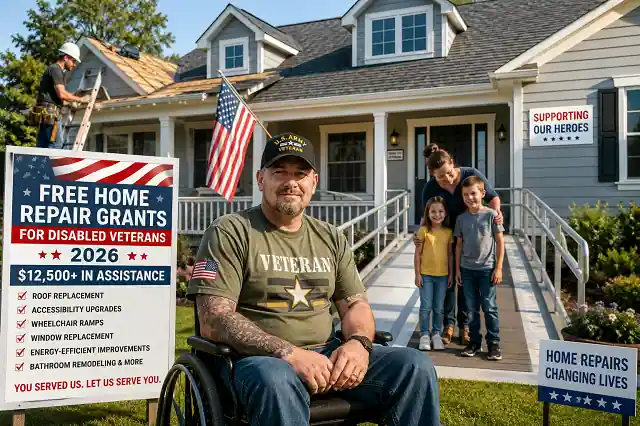
Why Disabled Veterans May Need Home Repair Assistance
A disability can turn an ordinary home problem into a serious accessibility or safety barrier. A high threshold can make entry difficult. An inaccessible bathroom can create fall risks. A narrow doorway can prevent wheelchair access. Unsafe electrical, plumbing, heating, roofing, or structural conditions can also become more difficult to manage when mobility or income is limited.
Common reasons disabled veterans seek assistance include:
- Creating a safer entrance or exit.
- Improving wheelchair or mobility access.
- Making bathrooms safer and easier to use.
- Modifying kitchens for independent use.
- Installing accessibility features.
- Removing serious health and safety hazards.
- Addressing eligible energy-efficiency problems.
- Repairing urgent housing conditions.
A disability can turn an ordinary home problem into an important accessibility or safety improvement opportunity. A high threshold can affect entry and exit, while an inaccessible bathroom or narrow doorway can make independent movement harder. When the project involves a safer entrance, veterans can also review our front door replacement grants resource for additional door-related funding pathways. Older veterans working on entrance accessibility can also compare our door replacement grants for senior citizens resource when age-specific programs are relevant.
Who Qualifies for Home Repair Grants for Disabled Veterans?
There is no single eligibility test for all home repair programs. A veteran may qualify for one program and not another because federal, state, local, VA, and nonprofit programs use different requirements.
Military Service
Veteran-specific programs generally require documentation showing qualifying military service. Depending on the program, applicants may need service records or discharge documentation.
Disability Status
Disability is particularly important for VA housing adaptation benefits. Some VA programs require a qualifying service-connected disability, while HISA focuses on medically necessary improvements and structural alterations that meet VA requirements.
Homeownership and Occupancy
Many home repair programs require the applicant to own and occupy the property. VA housing adaptation programs can have additional rules for family-member residences and temporary residences.
Household Income
Income is especially important for USDA, HUD-funded local programs, Weatherization Assistance, and many nonprofit programs. A veteran who does not qualify for one VA benefit may still qualify for a different program based on income and property conditions. Older veterans can also compare age-related eligibility pathways through our home repair grants for senior citizens resource when senior-specific programs may apply.
Property Location
Rural location is important for USDA Section 504. Local housing programs may also restrict assistance to particular cities, counties, or service areas.
Eligibility rule: A VA disability rating does not automatically qualify a veteran for every home repair program. Match the veteran’s disability, property, income, location, ownership status, and repair need to the specific program.
For a broader explanation of income, ownership, disability, property, and location requirements, see our home repair grants eligibility guide.
Low-income veterans can also compare the requirements in our home repair grants for low-income families guide.
VA HISA for Medically Necessary Home Modifications
The Home Improvements and Structural Alterations program (HISA) is one of the most relevant VA benefits for veterans who need medically necessary changes to their primary residence.
The U.S. Department of Veterans Affairs (VA) explains that HISA can support medically necessary improvements and structural alterations for qualifying purposes, including improving entrance and exit access, access to essential sanitary facilities, access to kitchen or bathroom sinks and counters, and certain plumbing or electrical improvements related to home medical equipment.
HISA is therefore best understood as a medically necessary home modification benefit, not as a general-purpose home repair grant.
HISA warning: HISA does not automatically pay for ordinary maintenance or any repair a veteran wants to make. The proposed work must satisfy VA requirements and be medically necessary under the program.
How Much Does HISA Provide in 2026?
| HISA Situation | Lifetime Benefit |
| Qualifying service-connected disability and certain other covered situations | Up to $6,800 |
| Other covered disability situations | Up to $2,000 |
The current U.S. Department of Veterans Affairs (VA) HISA information lists lifetime benefits of up to $6,800 for qualifying situations and up to $2,000 for other covered situations.
What Can HISA Help With?
- Improving access into or out of the home.
- Making essential bathroom facilities accessible.
- Lowering kitchen or bathroom counters or sinks.
- Installing certain permanent accessibility features.
- Installing certain handrails and access improvements.
- Making qualifying electrical or plumbing improvements needed for home medical equipment.
Veterans should obtain the required medical determination before treating a proposed project as HISA-eligible.
When the project involves an accessible bathroom, veterans can also review our bathroom upgrade grants for disabled homeowners resource for broader accessibility funding options, or our bathroom upgrade grants for veterans resource when veteran-specific programs are relevant.
HISA Documents and Application Requirements
A HISA application can require medical documentation or a prescription, the applicable VA application, an itemized project estimate, photographs, and other information requested by the VA facility. Property-owner authorization may also be required in rental situations.
The current Veterans Application for Assistance in Acquiring Home Improvements and Structural Alterations is VA Form 10-0103.
HISA checklist
- Medical prescription or supporting VA medical documentation.
- Medical explanation showing why the modification is necessary.
- Completed VA Form 10-0103.
- Itemized project estimate when required.
- Photographs of the existing condition.
- Property-owner authorization if applicable.
- Additional information requested by the local VA facility.
VA Specially Adapted Housing Grant
The Specially Adapted Housing program (SAH) is designed for veterans and service members with certain severe service-connected disabilities who need major adaptations to a permanent home.
The U.S. Department of Veterans Affairs (VA) explains that eligible veterans may use SAH assistance to buy, build, or change a permanent home when they meet the program’s disability requirements.
SAH Maximum for FY2026
| Program | FY2026 Maximum | Purpose |
| Specially Adapted Housing (SAH) | Up to $126,526 | Major adaptations for qualifying service-connected disabilities |
The $126,526 amount is the FY2026 maximum SAH grant. It is not a guaranteed cash payment and does not mean every eligible veteran receives the full amount.
Depending on the approved adaptation plan, SAH work may involve major accessibility changes such as widened doorways, accessible layouts, bathroom modifications, kitchen changes, and other adaptations that support independent living.
VA Special Home Adaptation Grant
The Special Home Adaptation program (SHA) is another VA housing adaptation benefit for veterans with certain qualifying service-connected disabilities.
The U.S. Department of Veterans Affairs (VA) lists specific qualifying disability categories and program requirements for SHA.
| Program | FY2026 Maximum | Purpose |
| Special Home Adaptation (SHA) | Up to $25,350 | Specific adaptations for qualifying service-connected disabilities |
SHA is not a general home repair grant. The proposed adaptation must relate to the veteran’s qualifying disability and satisfy VA requirements.
Temporary Residence Adaptation for Eligible Veterans
Temporary Residence Adaptation (TRA) can help certain veterans who qualify for SAH or SHA and temporarily live in a family member’s home that needs modifications.
| TRA Eligibility | FY2026 Maximum |
| Veteran qualifying for SAH and using TRA | Up to $50,961 |
| Veteran qualifying for SHA and using TRA | Up to $9,100 |
The U.S. Department of Veterans Affairs (VA) lists these FY2026 TRA maximums. TRA is highly specific and should not be treated as a general alternative to HISA, SAH, or SHA.
HISA vs. SAH vs. SHA vs. TRA
| Program | Primary Question | Best Starting Point |
| HISA | Is a medically necessary home modification required because of a disability? | VA medical facility and Prosthetic and Sensory Aids Service |
| SAH | Does the veteran have a qualifying severe service-connected disability requiring major home adaptation? | VA disability housing grant review |
| SHA | Does the veteran have a qualifying service-connected disability covered by SHA? | VA disability housing grant review |
| TRA | Does an eligible SAH/SHA veteran need to modify a temporary family residence? | VA TRA eligibility review |
Veterans can review the current VA adapted housing application information before applying for SAH or SHA.
For a broader veteran-focused overview, see our home repair grants for veterans by federal and state government guide.
USDA Section 504 for Disabled Veterans in Rural Areas
Disabled veterans who do not qualify for a particular VA housing adaptation benefit may still qualify for USDA Section 504 if they meet USDA’s requirements.
The Section 504 Home Repair Loans and Grants program is administered by the U.S. Department of Agriculture Rural Development (USDA). It is not a veteran-specific program.
USDA states that the program provides loans to very-low-income homeowners to repair, improve, or modernize their homes or remove health and safety hazards. Grants are available to qualifying homeowners age 62 or older and must be used to remove health and safety hazards.
| Section 504 Assistance | Maximum | Important Requirement |
| Repair loan | Up to $40,000 | Eligible very-low-income rural homeowner |
| Repair grant | Up to $10,000 | Generally for qualifying homeowners age 62 or older and health/safety hazards |
| Combined loan and grant | Up to $50,000 | Must meet program requirements |
| Section 504 disaster-area grant | Up to $15,000 | For qualifying homes damaged in a presidentially declared disaster area |
USDA also states that applicants must meet its income, ownership, occupancy, rural-area, and credit-availability requirements.
USDA distinction: Being a disabled veteran does not create automatic Section 504 eligibility. The veteran must qualify under USDA’s own program rules.
USDA also has a separate Single Family Housing Disaster Assistance Fund Program with a different maximum grant. Do not confuse that separate disaster program with the $15,000 Section 504 disaster-area grant.
Veterans living in eligible rural communities can also review our home repair grants for rural homeowners guide.
For additional Section 504 information, see our Section 504 home repair grants guide.
HUD-Funded Local Home Rehabilitation Programs
The U.S. Department of Housing and Urban Development (HUD) provides Community Development Block Grant (CDBG) funding to eligible states, cities, and counties. Local governments and other eligible entities determine how funds are used within federal requirements.
CDBG can support residential rehabilitation activities in appropriate local programs. A homeowner generally does not submit a universal national CDBG home-repair application directly to HUD.
Disabled veterans should therefore contact the local housing, community development, or rehabilitation agency to ask whether a HUD-funded homeowner repair program is currently available.
What Local HUD-Funded Programs May Cover
- Eligible health and safety repairs.
- Housing rehabilitation.
- Accessibility improvements.
- Structural rehabilitation.
- Electrical or plumbing corrections.
- Other locally approved housing improvements.
Coverage, income limits, funding amounts, and application procedures vary by local program.
For a broader explanation, see our HUD home improvement grants guide.
You can also review our state home repair grants guide for state and local funding pathways.
Weatherization Assistance for Disabled Veterans
The Weatherization Assistance Program (WAP) can be relevant when a disabled veteran is income-qualified, and the home needs eligible energy-efficiency or health-and-safety work.
The U.S. Department of Energy (DOE) states that WAP reduces energy costs for low-income households by improving home energy efficiency while ensuring health and safety.
WAP is not a universal home repair grant. Local weatherization providers determine which eligible measures can be performed after evaluating the home.
Weatherization note: Do not assume WAP will automatically pay for a roof, HVAC system, electrical panel, or other major repair. The local provider determines eligible work under program rules.
WAP Statistics
| WAP Statistic | Reported Figure |
| Homes receiving DOE-funded weatherization services each year | Approximately 32,000 |
| Average annual household energy savings | $372 or more |
| Families served since the program began | More than 7.2 million |
| Jobs supported | Approximately 8,500 |
These figures are reported by the U.S. Department of Energy (DOE). DOE’s current materials report approximately 32,000 homes served annually using DOE funds and approximately 8,500 supported jobs.
Veterans whose project specifically involves replacement windows can also review our window replacement grants for veterans resource for veteran-focused window funding pathways.
State and Local Home Repair Assistance for Disabled Veterans
State and local programs can help when a repair does not fit a VA housing adaptation benefit or when another source of assistance is needed. There is no single nationwide state-veteran home repair grant.
Depending on the state and community, a disabled veteran may need to contact:
- State veterans affairs agencies.
- State housing agencies.
- Housing finance agencies.
- County housing or rehabilitation departments.
- Community development agencies.
- Community action agencies.
State and local programs can have different income limits, property requirements, repair priorities, funding cycles, and application procedures.
Best practice: Describe the repair precisely when contacting an agency. Explain whether it is a disability-related accessibility problem, health and safety hazard, emergency repair, structural issue, or energy-efficiency problem.
Disabled veterans in Florida can also review our Florida home repair grants for veterans guide if they live in that state.
Nonprofit Home Repair Assistance for Disabled Veterans
Nonprofit organizations can sometimes help fill gaps when government programs do not fully address a repair. Assistance may include volunteer labor, donated materials, referrals, rehabilitation services, or other support rather than a direct cash grant.
Habitat for Humanity affiliates and Rebuilding Together affiliates may operate local home repair or preservation programs. Availability and eligibility vary by location, so veterans should verify the specific local program before relying on it.
Veteran service organizations may also help veterans locate resources or make referrals even when they are not the organization directly paying for the repair.
See our nonprofit home repair grants guide for additional options.
Emergency Home Repair Assistance for Disabled Veterans
An unsafe home condition may require a different approach from a planned remodeling project. If a disabled veteran has an immediate health or safety problem, local emergency repair programs may be worth checking alongside VA and other assistance.
Potential emergency conditions include:
- Unsafe electrical conditions.
- Major plumbing failures.
- Loss of essential heating.
- Serious roof or water damage.
- Structural instability.
- Unsafe accessibility conditions.
- Qualifying disaster damage.
Emergency assistance varies significantly by location and funding source. A program may provide repair services instead of a cash grant.
See our emergency home repair grants guide for a broader funding strategy.
What Home Repairs May Be Covered?
There is no universal list of repairs covered by every veteran assistance program. The same repair can qualify under one program and be excluded by another.
| Repair Type | Potential Funding Route | Important Qualification |
| Accessible entrance | HISA, SAH, SHA, local programs | VA programs require specific disability-related eligibility |
| Accessible bathroom | HISA, SAH, SHA, local programs | Medical or disability need may be important |
| Wheelchair ramp | HISA, SAH, SHA, local programs | Program-specific accessibility requirements apply |
| Electrical repair | Local rehabilitation, USDA, or WAP where eligible | The repair must fit the program’s eligible purpose |
| Plumbing repair | USDA, local rehabilitation, or nonprofit programs | Eligibility varies by program |
| Roof repair | USDA, local rehabilitation, nonprofit, or disaster programs | HISA is not a general roof-replacement benefit |
| Heating or cooling repair | USDA, WAP, or local programs | Program rules determine eligibility |
| Structural repair | HUD-funded local programs, USDA, or nonprofits | Local eligibility and project rules apply |
Do not assume coverage: A repair appearing in this table is not automatically funded. Verify the specific program’s eligible activities before paying a contractor or beginning work.
Veterans researching roof problems can see our roof replacement grants for veterans guide.
Disabled homeowners with serious roof problems can also review our roof replacement grants for disabled homeowners guide.
For broader roof-repair funding, see our roof repair and replacement grants guide.
Can Disabled Veterans Combine Different Assistance Programs?
A veteran can investigate multiple programs, but applying to several programs does not automatically mean that the awards can be combined.
Some funding sources may permit complementary assistance for different eligible expenses. Other programs may prohibit duplicate funding or impose rules concerning other assistance received for the same project.
Funding warning: Tell each program administrator about other applications or awards when required. Never submit the same repair expense to multiple programs unless the applicable rules expressly allow it.
Documents Disabled Veterans May Need
Documentation varies by program, but preparing basic records can make the application process easier.
Home repair assistance checklist
- Proof of military service when required.
- VA disability documentation when relevant.
- Proof of homeownership or occupancy.
- Household income records when required.
- Property information.
- Photographs of the repair problem.
- Written contractor estimates when required.
- Medical documentation for disability-related modifications.
- Inspection or permit information when applicable.
- Completed program application forms.
How to Apply for Home Repair Grants for Disabled Veterans
The strongest application strategy is to match the repair to the program before hiring a contractor or beginning work.
| Step | What to Do |
| 1. Identify the repair | Determine exactly what is unsafe, inaccessible, damaged, or medically necessary. |
| 2. Identify the best program | Start with VA when the repair is disability-related; check USDA for eligible rural homeowners and local programs for broader rehabilitation. |
| 3. Verify eligibility | Check disability, income, ownership, occupancy, location, and project requirements. |
| 4. Gather documents | Prepare medical, property, income, service, photo, and repair documentation as required. |
| 5. Obtain estimates | Get a detailed estimate when the program requires one. |
| 6. Apply | Submit the complete application through the correct administering agency. |
| 7. Wait for approval | Do not start work if the program requires approval before construction. |
| 8. Keep records | Save approvals, invoices, receipts, inspections, photographs, and correspondence. |
Step 1: Start With VA When the Repair Is Disability-Related
If the proposed work is intended to make the home accessible because of a qualifying disability, review HISA, SAH, SHA, or TRA as appropriate.
For SAH and SHA, the U.S. Department of Veterans Affairs (VA) provides current application information. For HISA, veterans should work with the VA medical facility and Prosthetic and Sensory Aids Service.
Step 2: Check USDA When the Home Is Rural
If the veteran is very low income, owns and occupies an eligible rural home, and meets USDA requirements, check Section 504. Veteran status does not replace USDA’s eligibility requirements.
Step 3: Check Local Housing Programs
Contact the local housing or community development agency to ask whether rehabilitation assistance is available for low-income, disabled, veteran, senior, or emergency repair needs.
Step 4: Document the Actual Need
Take clear photographs and explain what is wrong with the home. For disability-related work, explain how the existing condition affects safe and independent use of the property.
Step 5: Get Approval Before Starting Work
Many assistance programs require prior approval, inspection, or a specific contractor process. Starting work before approval can make a project ineligible.
Veterans who are unsure where to begin can use our Home Repair Program Finder 2026 to identify the most relevant funding category.
How to Improve Your Application
No application strategy guarantees approval, but veterans can make their applications clearer and easier to evaluate.
- Choose a program that actually matches the repair.
- Explain the disability-related need accurately.
- Provide complete documentation.
- Use detailed estimates when requested.
- Show photographs of the existing condition.
- Respond to requests for additional information.
- Confirm funding-combination rules before using multiple sources.
- Do not describe cosmetic work as medical, emergency, or safety-related work.
Application tip: A strong application clearly connects the condition of the home, the reason the repair is necessary, and the program requirement that matches the repair.
What If a Disabled Veteran Is Denied?
A denial from one program does not necessarily mean that no assistance is available.
First, determine the reason for the denial. It may involve income, property location, disability eligibility, an ineligible repair, missing documentation, funding availability, or another program-specific requirement.
Then look for a program with a better match. A medically necessary accessibility project may fit VA, while an eligible rural health-and-safety repair may fit USDA. A broader rehabilitation project may be handled through a local housing program.
If the program permits an appeal, reconsideration, or corrected application, follow the agency’s instructions and keep copies of all correspondence.
Where Should Disabled Veterans Apply First?
| Your Situation | Best Starting Point |
| Medically necessary accessibility modification | VA HISA |
| Qualifying severe service-connected disability and major home adaptation | VA SAH |
| Qualifying service-connected disability covered by SHA | VA SHA |
| Eligible temporary family residence requiring adaptation | VA TRA |
| Very-low-income rural homeowner | USDA Section 504 |
| Low-income homeowner needing broader rehabilitation | Local HUD-funded or housing rehabilitation program |
| Low-income household with energy-efficiency needs | Local WAP provider |
| Emergency health or safety problem | Local emergency repair or nonprofit programs |
This decision path helps prevent a common mistake: applying for a large general veteran grant when the actual need is better suited to a specialized disability housing program.
Frequently Asked Questions About Home Repair Grants for Disabled Veterans
Can disabled veterans get free home repair grants in 2026?
Yes, some disabled veterans may receive grants or other assistance for eligible home modifications and repairs. VA HISA, SAH, SHA, and TRA are particularly important for disability-related housing needs. USDA, local rehabilitation programs, weatherization, and nonprofits have separate eligibility requirements.
Is there a $12,500 home repair grant for disabled veterans?
There is no universal federal disabled-veteran home repair grant that guarantees $12,500. Current VA programs have different limits, including HISA amounts of up to $6,800 or $2,000 depending on eligibility, SAH up to $126,526 for FY2026, and SHA up to $25,350 for FY2026.
How much can HISA provide in 2026?
HISA provides a lifetime benefit of up to $6,800 for qualifying situations and up to $2,000 for other covered situations. The proposed work must meet VA requirements and be medically necessary.
Can disabled veterans get SAH or SHA grants?
Some disabled veterans may qualify. SAH and SHA require specific qualifying service-connected disabilities and have different eligibility rules. For FY2026, the maximum SAH amount is $126,526, and the maximum SHA amount is $25,350.
Can a disabled veteran use USDA Section 504?
USDA Section 504 has separate loan and grant requirements. Qualifying very-low-income rural homeowners may be eligible for a repair loan, while the Section 504 grant is generally available to qualifying homeowners age 62 or older and must address health and safety hazards. Veterans must also meet USDA requirements for income, ownership, occupancy, rural location, and other program conditions.
Can HISA pay for a normal roof replacement?
HISA is not a general roof-replacement benefit. Routine maintenance and ordinary replacement work are not automatically covered. HISA is intended for medically necessary improvements and structural alterations that meet VA requirements.
Can disabled veterans combine VA and other home repair assistance?
Possibly, but veterans should never assume that different programs can pay the same expense. Check each program’s rules and disclose other applications or awards when required before combining assistance.
Where should a disabled veteran start applying?
Start with the program that best matches the repair. Use VA HISA, SAH, SHA, or TRA for qualifying disability-related housing needs; USDA Section 504 for eligible very-low-income rural homeowners; and local housing, weatherization, emergency, or nonprofit programs for other eligible repairs.
Why You Should Trust This Guide
Last Updated: August 2026
Reviewed By: Home Property Grants Editorial Team
- VA disability housing programs are separated from general home repair programs.
- HISA is described as a medically necessary home modification benefit rather than a universal home repair grant.
- SAH, SHA, and TRA are presented using their current FY2026 maximum amounts.
- USDA Section 504 is identified as a general rural homeowner program rather than a veteran-specific benefit.
- HUD-funded rehabilitation is described as locally administered rather than as a direct national homeowner grant.
- Weatherization assistance is described as an energy-efficiency program administered through state and local providers.
- Program maximums are distinguished from guaranteed awards.
- Readers are advised to confirm current requirements before beginning work.
Program rules, funding, eligibility limits, and local availability can change. Veterans should verify current information directly with the U.S. Department of Veterans Affairs (VA), U.S. Department of Agriculture Rural Development (USDA), U.S. Department of Housing and Urban Development (HUD), U.S. Department of Energy (DOE), or the applicable state or local administrator.
Conclusion
Disabled veterans may have several ways to reduce the cost of necessary home modifications and eligible home repairs in 2026, but the best funding source depends on the reason for the work.
For medically necessary accessibility modifications, VA HISA may be the most relevant starting point. Veterans with qualifying service-connected disabilities may also qualify for SAH or SHA, while eligible temporary residences may qualify for TRA. Very-low-income veterans in eligible rural areas can investigate USDA Section 504, while other homeowners may find help through local housing rehabilitation, weatherization, emergency repair, or nonprofit programs.
The strongest approach is to identify the exact housing problem, match it to the correct program, document the need, verify eligibility, and obtain required approval before starting work.

Arthur Pendelton is a senior housing policy researcher and public welfare analyst with over eight years of experience tracking federal, state, and non-profit residential repair programs. He specializes in statutory grant frameworks, including USDA Section 504 Rural Housing, the Department of Energy’s Weatherization Assistance Program (WAP), and municipal HUD Community Development Block Grants (CDBG). Arthur systematically audits Federal Register publications and Title 7/42 CFR regulatory updates to provide low-income homeowners, seniors, and military veterans with accurate, barrier-free application guidance.
Nice informative post. I appreciate your thought, If you are looking for casement windows Atlanta then look at Revamp's robust and reliable services.
My name is Dale I live in Dayton Ohio. I live in a mobile home that I own. I am the sole owner. I am a veteran and in need of a hot water gas. I have been without one for the last 3 weeks. I am disabled and on a fixed income. I can’t get a loan because of my credit. I need help my friends and bad. I am not the type to go down easy without a fight, but this did it for me. My roommate can’t take a bath without using 20 plus pan of water to heat on the stove. She gets very upset when the water gets warm before she can even use it. If you can help me out I would appreciate it very much.
My name is Daniel I live in Calhoun La. I am 100% Disabled with Lung Cancer related to Agent Orange, do I qualify foe like a new roof and foundation repair and maybe a bathroom improvement.