
Disabled homeowners may find financial assistance for bathroom accessibility improvements through federal, state, local, nonprofit, Medicaid, and veterans’ programs. Depending on the program, eligible work can include roll-in showers, walk-in tubs, grab bars, accessible sinks, comfort-height toilets, wider doorways, safer flooring, improved lighting, and other modifications that improve safety and independent living.
There is no single nationwide government program that pays for every disabled homeowner’s bathroom remodel. Assistance usually comes through programs with specific eligibility rules, such as income limits, disability or medical-need requirements, rural eligibility, veteran status, property requirements, or local funding priorities. Homeowners looking for broader assistance can also start with our complete home repair grants guide and then narrow the search to programs that match the bathroom project.
Why Bathroom Accessibility Matters
An accessible bathroom can make bathing, toileting, transfers, and daily routines safer for people with mobility, balance, strength, or other functional limitations. Features such as grab bars, roll-in showers, safer flooring, accessible sinks, and wider doorways can remove physical barriers and support independent living. These improvements are part of the broader accessibility work discussed in our guide to home repair grants for disabled homeowners.
The Centers for Disease Control and Prevention reports that more than 14 million adults age 65 and older, or about one in four, report falling each year. CDC also reports that about 37% of older adults who fall report an injury requiring medical treatment or restricting activity for at least one day. These figures concern older adults rather than disabled homeowners of every age, but they show why fall hazards deserve attention. CDC Older Adult Falls Data.
Who May Benefit From an Accessible Bathroom?
- Wheelchair users
- People using walkers, canes, or other mobility devices
- People with long-term mobility limitations
- People recovering from serious injuries or strokes
- People with neurological or neuromuscular conditions
- People with visual or balance limitations
- Older homeowners who need accessibility improvements
- Veterans with qualifying service-connected disabilities
- Homeowners who need medically necessary modifications to remain safely at home
Homeowners who are unsure whether disability status, income, age, or another factor affects eligibility can review the site’s home repair grant eligibility guide before choosing a program.
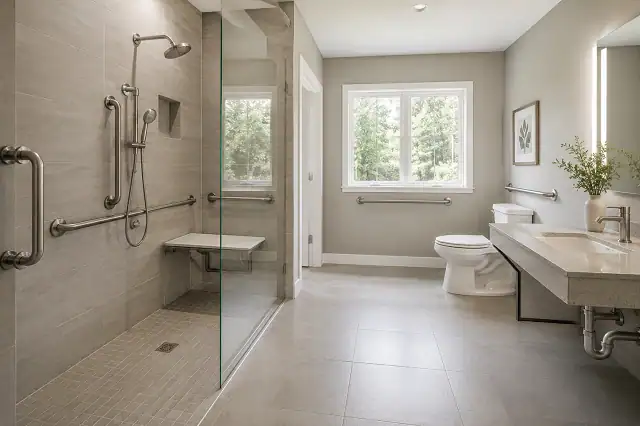
What Bathroom Accessibility Grants May Cover
Accessibility programs generally focus on work that removes barriers, improves safety, supports independent living, or addresses an approved health or accessibility need. An improvement listed below is not automatically covered by every program. For projects that go beyond accessibility modifications, homeowners should check whether a broader home renovation program allows the proposed work.
| Bathroom Improvement | Common Purpose | Possible Eligibility |
|---|---|---|
| Roll-in shower | Wheelchair and mobility access | Often, when program rules are met |
| Walk-in shower | Safer bathing and easier entry | Often |
| Walk-in bathtub | Reduced step-over height | Program dependent |
| Grab bars | Balance and transfer support | Often |
| Comfort-height toilet | Easier sitting and standing | Program dependent |
| Accessible sink | Wheelchair or seated use | Often when accessibility-related |
| Non-slip flooring | Fall-risk reduction | Often when safety-related |
| Wider doorway | Mobility-device access | Often when accessibility-related |
| Accessible faucets | Easier operation | Program dependent |
| Improved lighting | Visibility and safety | Program dependent |
Typical Bathroom Accessibility Costs in 2026
Bathroom modification costs vary by location, materials, plumbing changes, structural work, labor rates, permits, and project complexity. The figures below are planning ranges, not guaranteed grant amounts. If you are comparing a large project with available funding, our guide to how a $10,000 home repair project can be funded explains how homeowners can combine appropriate funding methods.
| Project | Planning Cost Range |
|---|---|
| Grab bar installation | $150–$700 |
| Comfort-height toilet | $400–$1,200 |
| Wheelchair-accessible sink | $700–$2,000 |
| Non-slip flooring | $1,000–$4,500 |
| Walk-in shower conversion | $4,000–$12,000+ |
| Roll-in accessible shower | $8,000–$20,000+ |
| Complete accessible bathroom remodel | $12,000–$35,000+ |
Do not treat these figures as program limits. A funding agency may approve only specific work, use its own cost standards, require contractor estimates, or impose a maximum award. Verify eligible costs before making a financial commitment. Homeowners should also understand why postponing necessary work can increase financial pressure; our cost of delayed home repairs statistics article covers that issue separately.
Federal Programs That May Help
Several federal programs can be relevant to accessibility work, but they serve different groups and operate under different rules. The main programs to investigate include USDA Section 504, HUD-funded local rehabilitation programs, VA housing adaptation grants for eligible veterans, and Medicaid home and community-based services in states where environmental modifications are covered.
USDA Section 504 Home Repair Program
The USDA Section 504 program can provide assistance to eligible very-low-income homeowners in eligible rural areas. It includes loans for repairs and grants for eligible homeowners who meet the program’s grant requirements and need to remove health and safety hazards. Bathroom accessibility work may be relevant when it meets the program’s rules and addresses an eligible need.
Check the current USDA rules for income, property location, ownership, occupancy, age, funding, and application requirements. For a broader explanation of rural assistance, see our guide to home repair grants for rural homeowners. For detailed information about the USDA program itself, see our Section 504 Home Repair Grants guide.
HUD-Funded Local Rehabilitation Programs
HUD does not operate one nationwide bathroom accessibility grant that homeowners apply for directly. HUD funding, including Community Development Block Grants, can support eligible local housing and rehabilitation activities administered by states, counties, cities, and other eligible entities. Our state home repair grants guide can help you identify the state and local agencies that may administer assistance.
HUD materials describe accessibility activities such as ramps and grab bars as examples of housing improvements that may be supported through eligible community development activities. HUD Community Development Resources. Homeowners should contact their local housing or community development agency to ask whether accessibility rehabilitation assistance is available.
VA Housing Adaptation Grants
Veterans and service members with qualifying service-connected disabilities may have access to VA housing adaptation grants. The Specially Adapted Housing and Special Home Adaptation programs can help eligible applicants buy, build, or modify a home to accommodate a qualifying disability. Veterans looking for the wider funding landscape can also review our broader home repair grants for veterans guide.
For fiscal year 2026, VA states that the maximum SAH grant is $126,526 and the maximum SHA grant is $25,350. These are program maximums for eligible applicants, not automatic bathroom awards. VA Disability Housing Grants.
VA also provides application requirements for adapted housing grants. VA How to Apply for an Adapted Housing Grant. Veterans with qualifying disabilities can also review our $12,500 Home Repair Grants for Disabled Veterans article for additional context, while remembering that VA’s official rules control VA eligibility and funding.
Medicaid Home and Community-Based Services
Medicaid does not provide one nationwide bathroom remodeling grant. Some state Medicaid programs, however, use Home and Community-Based Services programs that can include environmental modifications or related services for eligible beneficiaries. Homeowners receiving SSI can also review our home repair grants for SSI recipients guide, while checking the separate eligibility rules of each funding source.
CMS explains that states can offer environmental modifications through certain HCBS authorities, subject to state-defined criteria and approved services. Availability and covered work therefore vary by state. Medicaid Home and Community-Based Services and Medicaid 1915(i) HCBS.
State, County, and Local Bathroom Assistance
Local housing rehabilitation programs can be especially important for disabled homeowners because accessibility work is often administered at the state, county, or city level. Funding may come from federal housing programs, state appropriations, housing trust funds, local rehabilitation programs, or other public sources. Start with our guide to finding hidden home repair grants in your state when a basic online search does not reveal a suitable program.
Where to Look First
- City or county housing rehabilitation office
- State housing agency or housing finance agency
- County community development department
- Center for Independent Living
- Area Agency on Aging when age-related services are relevant
- State Medicaid agency for HCBS options
- State vocational rehabilitation agency when applicable
- USDA Rural Development office for eligible rural properties
- VA housing assistance for eligible veterans
Virginia’s Emergency Home and Accessibility Repair Program is one example of a state-level program supporting qualifying accessibility and emergency repairs through participating organizations. Virginia EHARP. If the bathroom problem is urgent because of a serious health or safety hazard, see our emergency home repair grants guide.
Nonprofit and Community Assistance
Nonprofits can provide another route to help when a government program does not cover the entire project. Depending on the organization and local affiliate, assistance may include critical repairs, accessibility work, volunteer labor, referrals, or coordination with other resources. Our nonprofit home repair grants guide explains how this type of assistance fits into the wider funding landscape.
| Organization | Potential Help | Official Resource |
|---|---|---|
| Rebuilding Together | Critical home repairs and accessibility-related work through local affiliates | Rebuilding Together |
| Habitat for Humanity | Home repair and accessibility assistance through participating local programs | Habitat for Humanity |
| Centers for Independent Living | Independent-living support, accessibility information, and local referrals | ACL Center for Independent Living Directory |
Nonprofit availability is local, and not every organization provides direct cash grants. Contact the organization or local affiliate before assuming that a particular bathroom project is covered.
Can You Combine Multiple Funding Sources?
Sometimes. A homeowner may be able to coordinate more than one source of assistance, but programs can have rules about duplicate benefits, eligible costs, contractor requirements, and approval order. Tell each funding agency about other assistance you are receiving and ask how the sources can legally be coordinated.
- Federal housing assistance
- State or county rehabilitation funding
- VA housing adaptation benefits for eligible veterans
- Medicaid HCBS assistance when available
- Nonprofit assistance
- Local charitable assistance
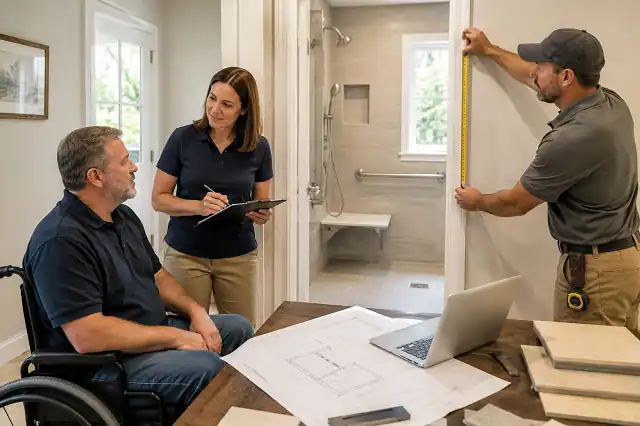
Who Qualifies for Bathroom Accessibility Assistance?
Eligibility depends on the funding source. Common factors include disability or functional need, household income, homeownership, occupancy, property location, type of repair, and whether the proposed work is necessary for health, safety, accessibility, or independent living. Low-income homeowners can also review our home repair grants for low-income families guide when household income is a major part of the eligibility question.
| Eligibility Factor | What Programs May Check |
|---|---|
| Homeownership | Whether the applicant owns and occupies the property |
| Disability or functional need | Whether there is a documented need for accessibility modifications |
| Income | Whether household income falls within program limits |
| Property condition | Whether the home requires eligible safety or accessibility work |
| Location | Whether the property is in the program’s service area or eligible rural area |
| Project need | Whether the requested work meets the program’s purpose |
| Prior approval | Whether construction must be approved before work begins |
Homeowners Who May Be Considered
- People who use wheelchairs or other mobility devices
- People with long-term mobility limitations
- Veterans with qualifying service-connected disabilities
- Low-income homeowners with documented accessibility needs
- Older homeowners who need accessibility improvements
- People receiving SSI or SSDI when the applicable program recognizes the benefit or disability status
- People recovering from serious injuries
- Homeowners with documented conditions affecting safe bathroom use
Meeting one of these descriptions does not guarantee funding. The actual program rules control eligibility and award decisions. Homeowners who are older or have multiple eligibility factors can also review our home repair grants for seniors guide.
Documents to Prepare Before Applying
A complete application can be easier to review when documents are prepared in advance. The exact list varies, but the following are commonly useful. For a broader application strategy, review our home repair grant application guide.
| Document | Why It May Be Needed |
|---|---|
| Photo identification | Identity verification |
| Proof of homeownership | Property and applicant eligibility |
| Income documentation | Income eligibility |
| Benefit statements | Verification of applicable benefits |
| Disability or medical documentation | Evidence supporting the accessibility need |
| Bathroom photographs | Documentation of existing hazards or barriers |
| Contractor estimates | Project scope and cost |
| Accessibility assessment | Documentation of recommended modifications when required |
Application Checklist
- Proof of ownership and occupancy
- Income documents when required
- Disability or medical documentation when required
- Photographs of bathroom hazards
- Written contractor estimates when required
- Program-specific forms
- Copies of all submitted documents
How Medical Documentation Can Help
Some accessibility programs require evidence that a requested modification addresses a disability-related or medically necessary need. When accepted by the program, documentation from a physician, occupational therapist, rehabilitation professional, or other qualified professional can explain the functional problem and recommended modification.
A useful statement should identify the current limitation, the bathroom barrier, the recommended improvement, and how the improvement is expected to support safety or independent living. Homeowners who also need broader disability-related repairs should consider whether other eligible repairs can be included in the same rehabilitation application.
Common Application Mistakes
| Mistake | Why It Can Cause Problems | Better Approach |
|---|---|---|
| Starting work before approval | Unauthorized work may not be reimbursable | Get written approval first |
| Incomplete application | Missing information can delay review | Use the agency’s checklist |
| Assuming every upgrade qualifies | Programs limit eligible work | Confirm each proposed improvement |
| Ignoring local programs | Many accessibility programs are local | Contact city, county, and state agencies |
| Using outdated grant amounts | Funding limits change | Verify current amounts with the official agency |
| Applying to only one program | Other eligible assistance may be missed | Research multiple programs without duplicating costs |
How to Apply for Bathroom Accessibility Grants
- Identify the accessibility problems. List the barriers affecting bathing, toileting, transfers, mobility, or independent use.
- Research suitable programs. Check federal, state, local, nonprofit, Medicaid, and veteran resources as applicable.
- Confirm eligibility. Review income, disability, ownership, occupancy, location, and project requirements.
- Gather documentation. Prepare ownership, income, disability, medical, property, and project documents.
- Obtain estimates. Get written estimates from qualified contractors when required.
- Request an assessment. Obtain professional accessibility documentation when appropriate.
- Submit complete applications. Follow instructions and deadlines.
- Wait for written approval. Do not begin covered work before authorization.
- Complete approved work. Follow contractor, inspection, invoicing, and documentation rules.
If you are unsure which application route to take first, contact the administering agency and ask which program should be evaluated for your bathroom accessibility project. Verify the final eligibility and application requirements directly with that agency.
How Long Can Approval Take?
There is no universal processing timeline. Public housing programs may require income verification, property inspections, environmental reviews, contractor estimates, funding approvals, or waiting-list processing. Nonprofit programs can have different procedures.
| Stage | What May Happen |
|---|---|
| Initial screening | Basic eligibility and service-area review |
| Documentation review | Income, ownership, disability, and other records are checked |
| Property inspection | The agency evaluates the home and proposed work |
| Cost review | Estimates and eligible expenses are reviewed |
| Funding decision | The agency approves, denies, or requests more information |
| Construction | Approved work is completed under program rules |
Can Renters Receive Accessibility Assistance?
Some disability and nonprofit programs may assist renters, but many home-rehabilitation programs are limited to owner-occupied properties. Renters may also need written permission from the property owner before accessibility work can be completed. Ask the local disability organization or housing agency whether renter assistance is available in your area.
Bathroom Accessibility and Broader Home Repair Needs
A bathroom project may be only one part of a larger rehabilitation plan. If the home also needs roof, structural, electrical, heating, plumbing, or other essential repairs, homeowners should first identify which repairs are essential and then check whether the same rehabilitation program can address multiple eligible needs.
Bathroom Upgrades Versus Accessibility Modifications
This article focuses specifically on disability-related bathroom accessibility. For broader bathroom renovation and upgrade assistance that is not limited to accessibility needs, see our Bathroom Upgradation Grants for Disabled Homeowners article. The two pages should remain separate: this guide focuses on accessibility, mobility, safety, and independent living, while the December article addresses the broader bathroom-upgrade intent.
Frequently Asked Questions
Are bathroom accessibility grants really free?
Some programs provide grants that do not require repayment when program conditions are satisfied. Others provide forgivable loans, low-interest loans, direct services, or partial assistance. Always read the specific funding agreement.
Can I receive assistance if I am not a veteran?
Yes. Many state, local, nonprofit, Medicaid, and other programs serve non-veteran homeowners who meet their eligibility requirements.
Will grants pay for a walk-in or roll-in shower?
A walk-in or roll-in shower may qualify when it is an eligible accessibility or safety improvement under the program. The funding agency decides whether the proposed work meets its rules.
Can I apply after remodeling has started?
You may be able to apply to some programs, but many require inspection and written approval before construction. Starting work first can make expenses ineligible.
Do accessibility programs pay for luxury bathroom remodeling?
Most programs focus on eligible accessibility, safety, rehabilitation, or medically necessary work rather than luxury or purely cosmetic improvements.
Can renters receive assistance?
Some nonprofit or disability-related programs may help renters, but many home-rehabilitation programs are limited to homeowners and may require landlord permission.
Where should I begin?
Start with your city or county housing rehabilitation office, state housing agency, Center for Independent Living, USDA Rural Development office when applicable, Medicaid agency for HCBS options, or VA housing assistance for eligible veterans. The best starting point depends on your disability-related needs, income, location, and the type of bathroom modification you need.
Why You Can Trust This Information
Last Updated: August 2026
Reviewed By: Housing Assistance Research Team
- Official sources: Program information is checked against official USDA, HUD, VA, Medicaid, CDC, and other government sources when applicable.
- 2026 review: Funding limits and eligibility rules can change, so applicants should confirm current requirements with the administering agency.
- Clear guidance: General accessibility information is separated from program-specific eligibility.
- Homeowner-focused: The guide explains where to look, what documents may be requested, and why prior approval matters.
- Editorial integrity: This guide is educational and does not guarantee eligibility, approval, funding, or a particular award amount.
Conclusion
Bathroom accessibility assistance can help eligible disabled homeowners reduce the cost of modifications that make bathing, toileting, transfers, and daily routines safer. The best funding source depends on disability-related needs, income, location, property, veteran status, and the type of modification requested.
Start by identifying the accessibility problems, checking federal and local programs, preparing documentation, and obtaining estimates when required. USDA Section 504 may be relevant to eligible rural homeowners, local HUD-funded rehabilitation programs may offer accessibility assistance, VA housing grants may help eligible veterans, and some Medicaid HCBS programs may support approved environmental modifications.

Arthur Pendelton is a senior housing policy researcher and public welfare analyst with over eight years of experience tracking federal, state, and non-profit residential repair programs. He specializes in statutory grant frameworks, including USDA Section 504 Rural Housing, the Department of Energy’s Weatherization Assistance Program (WAP), and municipal HUD Community Development Block Grants (CDBG). Arthur systematically audits Federal Register publications and Title 7/42 CFR regulatory updates to provide low-income homeowners, seniors, and military veterans with accurate, barrier-free application guidance.
1 thought on “Free Bathroom Accessibility Grants for Disabled Homeowners”