
Unexpected roof failures, leaking water heaters, and broken electrical boxes force working families to face contractor bills topping $10,000. Managing major repair costs strains household savings and pushes families toward predatory credit cards. Learning how to pay for a $10,000 home repair through verified public programs helps homeowners secure direct grant capital, weatherization upgrades, and 1% loans without toxic debt. Qualifying homeowners often consult the comprehensive home repair grants guide to compare federal and state aid rules before hiring contractors. These statutory programs provide direct capital from $1,500 to $25,000 to eliminate health and safety risks safely.
Federal housing laws establish specific rules for each public assistance channel. The USDA Section 504 repair program operates under 7 CFR Part 3550 to protect very-low-income rural homeowners. Municipal housing departments manage local rehabilitation programs under 24 CFR Part 570 Community Development Block Grants. The U.S. Department of Energy provides whole-house insulation work under 10 CFR Part 440. These statutory programs require proof of property ownership, tax records, and verified physical building hazards.
For the 2026 fiscal cycle, USDA Rural Development maintains the standard Section 504 grant cap at $10,000 for rural seniors, with up to $15,000 for qualifying disaster damage. The Weatherization Assistance Program provides average energy retrofits exceeding $8,000 per home. Municipal CDBG agencies commit owner-occupied repair funds on a first-come, first-served basis until annual allocations expire.
Commercial contractor advertisements often promise universal government vouchers for home remodeling projects. These marketing claims mislead families facing urgent structural issues. Legitimate public assistance operates through statutory channels that require income verification, property deed checks, and physical inspections. Property owners seeking local help frequently use eligibility screening tools in the home repair program finder to locate municipal housing offices accepting applications. Understanding statutory requirements protects property equity while helping families secure vital home preservation awards.
Municipal housing departments and state housing finance agencies routinely record deferred mortgage covenants or soft second liens against recipient property deeds. If you sell, refinance, or transfer ownership before satisfying the mandatory 5-to-10-year residency covenant, the administering agency will demand immediate lump-sum grant repayment. Always request a written lien forgiveness schedule from intake evaluators before signing contractor agreements.
Approved project scopes cover essential repairs when inspectors identify health and safety hazards. Licensed contractors replace leaking water heaters, upgrade hazardous electrical panels, and rebuild rotted roof framing. Crews install synthetic underlayment, seal air drafts, and add insulation. These measures resolve dangerous housing defects and reduce monthly utility bills for low-income families.
Rural property owners applying for Section 504 direct grant or loan assistance must complete the standardized federal intake questionnaire. Download Official USDA Form RD 410-4 Repair Application (PDF) and submit the completed package to your regional USDA Rural Development service center.
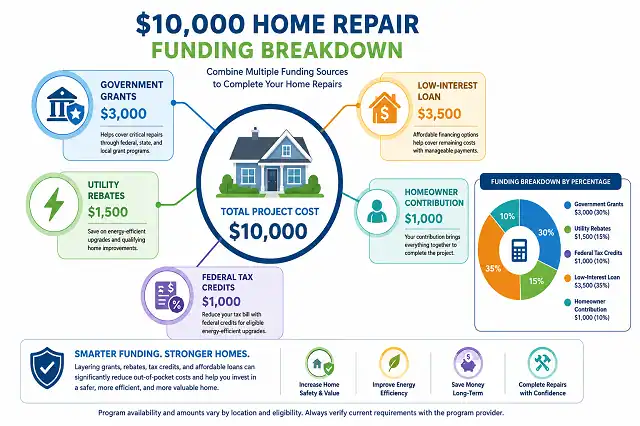
Budget Allocation Matrix: How to Pay for a $10,000 Home Repair
Public repair assistance divides across separate government agencies and utility offices. No single program covers every home improvement project. Homeowners must build their budget around confirmed funding categories. This prevents shortfalls by subtracting dollars only after verifying program eligibility.
Use this multi-tier capital allocation matrix to plan project funding systematically:
| Funding Stage | Governing Authority | Verification Requirement | Maximum Assistance | Budget Impact |
|---|---|---|---|---|
| Initial Project Scope | Licensed General Contractor | Itemized bid separating materials and labor | $10,000 Total Cost | Baseline project expense |
| USDA Section 504 Grant | USDA Rural Development | Homeowner age 62+ earning below 50% AMI | Up to $10,000 Grant | Covers eligible hazard repairs |
| Municipal CDBG Rehab | City Housing Department | Household income below 80% AMI | Up to $25,000 Forgivable Loan | Subsidizes major structural work |
| Weatherization (WAP) | U.S. Department of Energy | Earnings at or below 200% Poverty Line | Direct Services (No Cash) | Reduces out-of-pocket insulation costs |
| Utility Efficiency Rebates | Electric and Gas Utilities | Certified high-efficiency equipment installation | $500 to $2,000 Rebate | Direct credit applied post-installation |
| Remaining Project Balance | Property Owner / USDA 1% Loan | Calculated after subtracting confirmed awards | Variable Net Amount | Personal savings or 1% financing |
Matching specific repair components to appropriate programs creates a sound financial strategy. Families needing help can explore targeted subsidies for home repair grants for low-income families to find open intake windows. This structured approach prevents funding shortfalls before signing binding contractor agreements.
USDA Section 504: Rural Grants and 1 Percent Financing
The USDA Section 504 program provides vital support for eligible rural homeowners. Authorized by Title V of the Housing Act of 1949, this program funds structural repairs, modernization, and hazard mitigation. Rural residents can explore dedicated agricultural preservation funding through home repair grants for rural homeowners to check county eligibility boundaries.
Section 504 provides repair funding through three primary mechanisms:
- Direct Home Repair Grants: Seniors aged 62 and older can receive up to $10,000 in lifetime grant funds. Applicants must demonstrate that household earnings cannot support a loan.
- Low-Interest Repair Loans: Very-low-income homeowners of any age can borrow up to $40,000 at a fixed 1.0% interest rate over 20 years. A $10,000 loan results in monthly payments around $46.
- Combination Grant and Loan Packages: Eligible seniors can combine a $10,000 outright grant with low-interest loan financing to address extensive structural repairs.
Properties must be located within designated rural areas, defined as open country or towns with populations below 20,000. Household earnings must fall strictly below 50% of the county Area Median Income.
| USDA Section 504 Rule | Current Statutory Limit | What It Means for a $10,000 Project | Repayment Term | Core Qualification Condition |
|---|---|---|---|---|
| Standard Repair Grant | $10,000 Lifetime Cap | Covers the entire $10,000 project if approved | Non-repayable unless sold within 3 years | Age 62+; income below 50% AMI |
| Disaster Repair Grant | $15,000 Cap | Provides surplus capacity for storm-damaged homes | Non-repayable grant aid | Presidentially declared disaster areas |
| Direct 1% Repair Loan | $40,000 Maximum | Finances the entire $10,000 project cost | 20-year term at 1% fixed interest | Homeowner of any age unable to obtain credit |
| Combined Grant and Loan | $50,000 Maximum | Enables phased repairs exceeding $10,000 | Blended grant and 1% loan terms | Senior applicants with partial repayment ability |
Applicants must demonstrate that repairs eliminate verified health and safety hazards. Published limits represent program ceilings rather than guaranteed payouts. Intake evaluators review household debt, property equity, and local budget availability before approving applications.
Municipal Rehabilitation: HUD Community Development Block Grants
Urban and suburban homeowners can access municipal housing rehabilitation funds through HUD Community Development Block Grants. Local housing authorities use CDBG appropriations to preserve older housing in designated target neighborhoods. Homeowners can review regional housing finance agency allocations in the state home repair grants guide to identify active programs.
Local authorities structure municipal repair assistance into three practical options:
- Emergency Minor Repair Grants: Rapid-response grants from $2,500 to $7,500 address sudden mechanical failures, such as burst water lines or broken heating systems.
- Deferred Forgivable Loans: For repairs reaching $10,000 or more, cities provide 0% interest deferred loans up to $25,000. The principal balance forgives after 5 to 10 years of primary residency.
- Accessibility Modification Funds: Programs provide dedicated funds to widen doorways, install wheelchair ramps, and adapt bathrooms for disabled occupants.
Understanding how to pay for a $10,000 home repair through municipal agencies requires applying during open intake periods. Securing written approval before work begins ensures full eligibility.
Energy Upgrades: Weatherization Assistance and Utility Rebates
When repairs involve heating systems, insulation, or thermal building envelopes, homeowners can combine public energy programs with utility rebates. The Weatherization Assistance Program (WAP) delivers free energy retrofits under 10 CFR Part 440 to lower household utility costs.
Weatherization providers evaluate properties using diagnostic building science procedures:
| Energy Project Component | Governing Authority | Primary Funding Channel | Eligible Measures | Pre-Approval Verification |
|---|---|---|---|---|
| Attic & Wall Insulation | U.S. Department of Energy | DOE Weatherization (WAP) | Blown cellulose, dense-pack fiberglass | Blower-door depressurization test required |
| Air Sealing & Weatherstripping | Community Action Agencies | State Energy Offices | Caulking, door sweeps, foam sealing | Income below 200% federal poverty level |
| Heat Pump Water Heater | Electric Utility Companies | Utility Rebate Programs | ENERGY STAR certified hybrid units | Invoice matching approved equipment list |
| Heating System Upgrades | State Energy Offices | Home Energy Rebates (HEEHRA) | High-efficiency heat pumps | State program launch and income rules |
Homeowners replacing water heaters should explore plumbing efficiency incentives for water heater replacement grants alongside local utility rebates. Checking rebate requirements before purchasing equipment ensures full compliance with program standards.
The Internal Revenue Service confirms that the Section 25C Energy Efficient Home Improvement Credit does not apply to property placed in service after December 31, 2025. The Section 25D Residential Clean Energy Credit has also expired. Homeowners must rely on direct utility rebates and public assistance programs rather than federal tax credits in 2026.
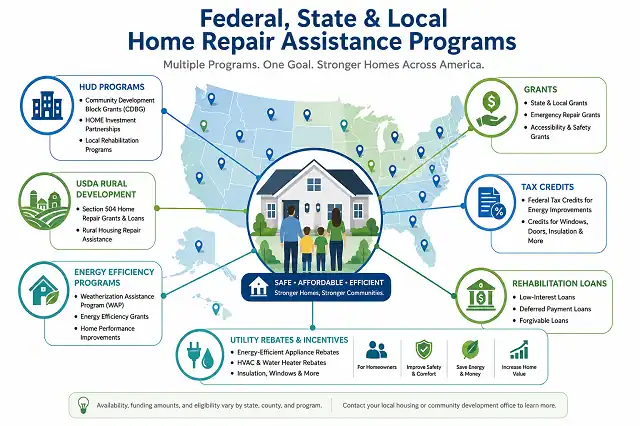
Ineligible Scopes: What These Programs Do NOT Cover
Understanding program limitations prevents wasted application efforts and unrealistic budgets. Public home preservation programs restrict funding strictly to structural, safety, and health repairs. Cosmetic updates and luxury renovations are automatically excluded.
Review standard program restrictions before preparing project estimates:
| Assistance Program | Governing Agency | Statutory Mandate | Ineligible Project Scopes | Administrative Denial Trigger |
|---|---|---|---|---|
| USDA Section 504 | USDA Rural Development | 7 CFR Part 3550 | Cosmetic landscaping, swimming pools, luxury upgrades | Work lacking documented health and safety impact |
| Municipal CDBG | Local Housing Departments | 24 CFR Part 570 | New room additions, custom cabinets, unvetted labor | Bids from uncertified or non-SAM.gov contractors |
| Weatherization (WAP) | Department of Energy | 10 CFR Part 440 | General roof replacements, kitchen remodeling, cash gifts | Measures failing SIR energy savings test |
| FEMA Housing Aid | Federal Emergency Management | 44 CFR Part 206 | Deferred maintenance, pre-existing wear, insured damage | Duplication of private insurance benefits |
| VA HISA Grant | Veterans Health Administration | 38 CFR Part 17 | Routine maintenance, decorative trim, luxury finishes | Work lacking clinical physician prescription |
Homeowners must follow official application filing procedures detailed in how to apply for home repair grants to ensure project bids comply with local program rules. Submitting clean scopes of work prevents intake delays.
Application Timing: When to Apply for Home Repair Funding
Planning the timing of funding requests is critical when assembling assistance for a $10,000 project. Most public housing agencies require written approval before any construction begins. Starting repairs early permanently disqualifies the project from receiving grant funds.
Follow this project timeline to coordinate inspections, contractor bids, and program approvals:
| Project Phase | Mandatory Action | Required Documentation | Compliance Benchmark | Fatal Timing Error |
|---|---|---|---|---|
| Initial Damage Assessment | Document hazards and separate repair components | Date-stamped photographs, damage notes | Clear physical hazard evidence | Tearing out materials before photo documentation |
| Contractor Bid Solicitation | Obtain itemized quotes from licensed builders | Written bids, contractor license, insurance | Active SAM.gov status for federal projects | Accepting vague single-line bids |
| Agency Application Filing | Submit intake packages to local housing offices | Tax returns, W-2s, property deed, utility bills | Income verified below program AMI caps | Missing income records for adult occupants |
| Pre-Construction Approval | Await written Notice of Award from evaluator | Signed grant agreement, funding commitment | Formal written authorization in hand | Authorizing work on verbal promises |
| Final Inspection & Closeout | Agency inspects work before contractor payout | Signed completion certificate, lien waivers | Repairs meet local building code standards | Paying contractor in cash before inspection |
When physical hazards threaten immediate safety, families should explore immediate health and safety protections in the emergency home repair grants guide. Acting quickly preserves eligibility while resolving hazardous conditions.
Repair-Specific Funding Strategies for a $10,000 Project
Funding strategies vary depending on the specific home system requiring repair. Matching the repair type to appropriate statutory programs improves approval rates:
Roof Damage and Structural Framing
Replacing deteriorated shingles and rotted plywood decking often costs around $10,000. Rural seniors should prioritize USDA Section 504 grants, while suburban homeowners can seek municipal CDBG funds. Homeowners can review structural carpentry allocations outlined in the roof repair and roof replacement grants manual for program-specific rules.
Window Replacement and Air Sealing
Failing windows cause air leaks and high heating bills. Homeowners can combine Weatherization Assistance with thermal envelope upgrades for window replacement grants to lower out-of-pocket costs.
Water Heater and Plumbing Failures
Replacing failed water heaters can be financed by combining municipal emergency repair funds with local electric utility heat pump incentives.
Electrical Hazards and Breaker Upgrades
Outdated fuse boxes create fire hazards. Municipal housing authorities prioritize 200-amp service upgrades to meet modern building codes.
Disability Accessibility Modifications
Veterans with service-connected conditions can use VA HISA grants for wheelchair ramps and roll-in showers. Non-veterans can utilize municipal CDBG accessibility grants.
Delaying repairs increases project costs over time. Homeowners can avoid compounding expenses by reviewing preventing severe compounding expenses by analyzing the cost of delayed home repairs before conditions worsen.
Document Intake Checklist: Organizing Your Filing Packet
Preparing a complete document package accelerates agency review and prevents application rejections. Program evaluators require verified documentation for all household members.
Assemble these records before submitting your application packet:
- Proof of Ownership: Copy of the recorded warranty deed or property tax statement showing no ownership disputes.
- Household Income Records: Federal tax returns (IRS Form 1040) for the past two years, W-2s, 1099s, and benefit award letters for all adult occupants.
- Primary Residency Verification: Utility bills from the past three months matching government-issued photo identification.
- Detailed Contractor Estimates: Written bids breaking down labor, materials, permits, and specific equipment models.
- Photographic Hazard Evidence: Date-stamped photos showing active water leaks, rotted framing, or hazardous electrical panels.
- Homeowners Insurance Policy: Insurance declaration page or written denial confirmation for casualty claims.
Keeping copies of all submitted documents and correspondence protects your application file throughout the review process.
Managing the Remaining Balance on a $10,000 Project
A funding plan remains effective even if a single grant does not cover the full $10,000 cost. Homeowners can combine multiple public programs, utility rebates, and low-cost financing to cover project expenses.
Review these options to address remaining balances after primary grants are applied:
| Balance Strategy | Administering Entity | Statutory Framework | Financial Terms | Best Application Fit |
|---|---|---|---|---|
| Secondary Program Grant | Municipal Housing Authority | 24 CFR Part 570 (CDBG) | 0% interest deferred grant | Separate structural repair scope |
| Weatherization Service | Local Community Action Agency | 10 CFR Part 440 (WAP) | Direct mechanical services | Insulation and thermal envelope work |
| Utility Equipment Rebate | Electric & Gas Utilities | State PUC Regulations | Post-purchase cash rebate | High-efficiency heat pumps or water heaters |
| USDA Section 504 Loan | USDA Rural Development | 7 CFR Part 3550 | 1% fixed rate over 20 years | Remaining balance for rural homeowners |
| Phased Construction | Property Owner & Contractor | Local Building Code Compliance | Staged out-of-pocket payments | Repairs that can be completed in stages |
When financing a remaining balance, avoid high-interest credit cards. Compare terms from non-profit credit unions and statutory programs like the USDA Section 504 1% loan to keep monthly payments manageable.
Frequently Asked Questions
Can I fund a $10,000 home repair without paying out of pocket?
Yes. Low-income seniors qualifying for USDA Section 504 grants and homeowners receiving municipal CDBG assistance can secure awards covering up to 100% of approved repair costs.
How do I qualify for a USDA Section 504 home repair grant?
Applicants must be at least 62 years old, own and occupy a home in an eligible rural area, earn below 50% of the county Area Median Income, and show an inability to repay a loan.
Can I combine multiple repair grants for a single $10,000 project?
Yes, provided different programs fund separate, non-overlapping components of the project. Programs cannot reimburse the same repair expense under federal duplication of benefits rules.
Can Weatherization Assistance cover a complete $10,000 roof replacement?
No. WAP provides direct energy-efficiency retrofits like insulation and air sealing. Incidental roof patching is permitted only when leaks directly compromise newly installed insulation.
Are federal energy tax credits available for home repairs in 2026?
No. The IRS confirmed that Section 25C and Section 25D residential energy credits expired on December 31, 2025. Homeowners should utilize direct utility rebates and state programs in 2026.
What happens if I sell my home after receiving a repair grant?
USDA Section 504 grants must be repaid if the property is sold within 3 years. Municipal CDBG programs place deferred liens requiring primary residency for 5 to 10 years before the loan is forgiven.
Public home repair programs operate strictly under Title V of the Housing Act of 1949 (7 CFR Part 3550), Title I of the Housing and Community Development Act of 1974 (24 CFR Part 570), and the Energy Conservation and Production Act (10 CFR Part 440). Government housing offices never collect upfront filing fees or contractor application retainers. Homeowners must avoid private firms requesting cash deposits to file public grant claims.
Next Steps: Building Your $10,000 Home Repair Plan
Organizing a practical funding plan protects your home and family without accumulating expensive debt. Start by obtaining an itemized contractor bid that separates labor, materials, and equipment. Rural seniors should contact their local USDA Rural Development office to request Form RD 410-4. Urban homeowners should reach out to their municipal community development department to verify open CDBG intake windows. Gathering tax returns, deeds, and photo documentation early positions your application for timely review before annual program funding caps are exhausted.
Why You Can Trust This Guide
Last Updated: October 2026
Reviewed By: Arthur Pendelton, Senior Public Housing Policy Analyst
Experience: Our editorial research team has analyzed federal housing programs, state housing finance agency matrices, and municipal repair initiatives across all 50 states for over a decade.
Expertise: All statutory thresholds, regulatory citations, and program guidelines are derived directly from Title V of the Housing Act of 1949 (7 CFR Part 3550), Title I of the Housing and Community Development Act (24 CFR Part 570), and published HUD and USDA manuals.
Authoritativeness: All Fiscal Year 2026 funding caps ($10,000 for USDA grants, $25,000 for CDBG awards, $15,000 for disaster caps) are cross-referenced against active Federal Register notices and agency administrative circulars.
Trustworthiness: HomePropertyGrants.com operates with complete editorial independence. We accept zero financial compensation, contractor kickbacks, or sponsored placements from manufacturers or private lenders.
Helpful Decision Support: We translate complex statutory housing regulations into clear American English, providing direct links to official .gov intake documents to help families maintain safe and stable housing.

Arthur Pendelton is a senior housing policy researcher and public welfare analyst with over eight years of experience tracking federal, state, and non-profit residential repair programs. He specializes in statutory grant frameworks, including USDA Section 504 Rural Housing, the Department of Energy’s Weatherization Assistance Program (WAP), and municipal HUD Community Development Block Grants (CDBG). Arthur systematically audits Federal Register publications and Title 7/42 CFR regulatory updates to provide low-income homeowners, seniors, and military veterans with accurate, barrier-free application guidance.