
How to Fund a $10,000 Home Repair Project: Grants, Loans & Rebates
Surprise roof leaks, broken water heaters, and bad electrical boxes can cost families over $10,000. Paying for big fixes drains a family’s savings and pushes them to use bad credit cards. Learning how to pay for a $10,000 home repair through real public programs helps you find free grant money, weather fixes, and cheap 1% loans without getting stuck in debt. Smart homeowners check the home repair grants guide to compare federal and state rules before they hire a builder. These government programs give out between $1,500 and $25,000 to safely fix health and safety dangers.
Federal housing laws set strict rules for each help program. The USDA Section 504 program follows Title 7 rules to protect country homeowners who make very little money. City housing offices run local repair programs using Title 24 Community Development Block Grants. The U.S. Department of Energy pays to seal up your whole house using Title 10 rules. These official programs must check your house deed, your tax papers, and the real damage in your home.
For the 2026 budget year, the USDA keeps the grant limit at $10,000 for rural seniors, and up to $15,000 for homes damaged in a disaster. The Weatherization Assistance Program gives free energy fixes that usually cost around $8,000 per house. City CDBG offices give repair money to whoever applies first until the money is gone for the year.
Builder ads often promise free government tickets for general home remodeling. These ads trick families who have real house damage. Real public help follows strict rules that require office workers to check your income, your land deed, and the physical damage to your home. Homeowners looking for local help often use the eligibility screening tools in the home repair program finder to find city offices that are taking forms right now. Knowing the rules protects your house while helping your family get important repair money.
City housing offices and state programs often put a hold on your house deed. If you sell your house or change your loan before 5 to 10 years, the office will make you pay all the grant money back at once. Always ask the office for the written rules about your deed before you sign anything with a builder.
Approved project plans cover important repairs after an inspector finds a real health or safety danger. Licensed builders put in new water heaters, fix bad electric panels, and rebuild rotten roof wood. Workers lay down strong roof paper, stop cold drafts, and add thick insulation. These fixes stop dangerous house problems and lower power bills for low-income families.
Country homeowners asking for a Section 504 grant or loan must fill out the official federal form. You can download the official USDA Form RD 410-4 Repair Application (PDF) and send the finished papers to your local USDA office.
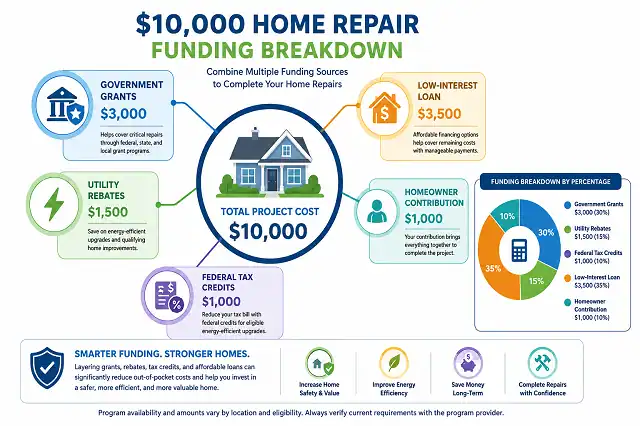
Money Plan: How to Pay for a $10,000 Home Repair
Public repair money is split between different government offices and power companies. No single program pays for every single fix in your house. Homeowners must build a money plan using different confirmed programs. This stops you from running out of money by only subtracting dollars after a program says yes.
Use this step-by-step chart to plan how to pay for your project:
| Funding Step | Office in Charge | What You Must Show | Most Money Given | How It Helps Your Bill |
|---|---|---|---|---|
| Initial Project Price | Licensed Builder | Written price breaking down parts and labor | $10,000 Total Cost | The starting cost of the job |
| USDA Section 504 Grant | USDA Rural Development | Homeowner age 62+ making very low income | Up to $10,000 Grant | Pays to fix allowed safety dangers |
| City CDBG Loan | City Housing Department | Family income below the county limit | Up to $25,000 Loan That Goes Away | Pays for big wood and structure repairs |
| Weatherization (WAP) | U.S. Department of Energy | Income at or below 200% of Poverty Line | Free Service (No Cash) | Lowers the cost of new insulation |
| Power Company Money Back | Electric and Gas Companies | Proof you bought approved energy-saving machines | $500 to $2,000 Discount | Money taken off the bill after the job is done |
| Remaining Cost to Pay | Homeowner / USDA 1% Loan | The math left after subtracting all the grant money | The Final Amount Left | Paid with your savings or a cheap 1% loan |
Matching the right repair to the right program creates a smart money plan. Families who need help can look at targeted subsidies for home repair grants for low-income families to find open programs. This smart plan stops you from running out of money before you sign a paper with a builder.
USDA Section 504: Country Grants and Cheap 1% Loans
The USDA Section 504 program gives important help to country homeowners who follow the rules. Made by a federal housing law, this program pays to fix broken wood, update old parts, and stop safety hazards. People living in the country can check dedicated agricultural preservation funding through home repair grants for rural homeowners to see if their town is eligible.
Section 504 gives repair money in three main ways:
- Free Home Repair Grants: Seniors aged 62 and older can get up to $10,000 in free money. You must prove your family does not make enough money to pay back a regular loan.
- Cheap Repair Loans: Very-low-income homeowners of any age can borrow up to $40,000 for 20 years at a tiny 1.0% interest rate. A $10,000 loan means you pay about $46 a month.
- Mixed Grant and Loan Deals: Seniors who qualify can mix a free $10,000 grant with a cheap loan to pay for really big house repairs.
Your house must sit in an approved country area, which means open land or towns with less than 20,000 people. Your family income must be strictly below 50% of the county limit.
| USDA Section 504 Rule | Current Legal Limit | What It Means for a $10,000 Job | Repayment Rule | Main Rule to Meet |
|---|---|---|---|---|
| Normal Repair Grant | $10,000 Lifetime Limit | Pays for the whole $10,000 job if they say yes | Free money unless you sell within 3 years | Age 62+; income below 50% of the county limit |
| Disaster Repair Grant | $15,000 Limit | Gives extra money for houses hit by a storm | Totally free disaster money | Live in an approved disaster area |
| Direct 1% Repair Loan | $40,000 Maximum | Pays for the whole $10,000 job cost | 20-year loan at a 1% interest rate | Homeowner of any age who cannot get a bank loan |
| Mixed Grant and Loan | $50,000 Maximum | Helps pay for jobs that cost more than $10,000 | Mix of a free grant and a 1% loan | Seniors who can pay a little bit each month |
You must prove the repairs will fix real health and safety dangers. The dollar limits are just the most they can give, not a promise of what you will get. Office workers check your family debt, your house value, and the local budget before saying yes to your form.
City Help: HUD Community Development Block Grants
City and suburban homeowners can get city housing money through HUD Community Development Block Grants. Local city offices use CDBG money to fix old houses in certain neighborhoods. Homeowners can check the regional housing finance agency allocations in the state home repair grants guide to find open programs.
Local city offices break up their repair money into three helpful programs:
- Fast Minor Repair Grants: Fast money from $2,500 to $7,500 fixes sudden broken machines, like a burst water pipe or a broken heater.
- Loans That Go Away: For fixes that cost $10,000 or more, cities give loans up to $25,000 with 0% interest. The loan completely goes away if you stay in the house for 5 to 10 years.
- Accessibility Money: Programs give special money to make doorways wider, build wheelchair ramps, and change bathrooms for disabled people.
Knowing how to pay for a $10,000 home repair through a city office means you must apply while the window is open. Getting a written “yes” before work begins makes sure you follow the rules.
Energy Fixes: Weather Help and Power Company Discounts
When you need to fix a heater, add insulation, or seal up your house, you can mix public energy programs with power company discounts. The Weatherization Assistance Program (WAP) gives free energy fixes under Title 10 rules to lower your monthly power bills.
Weather workers check houses using smart building tools:
| Energy Job | Office in Charge | Main Money Source | Allowed Fixes | Rule to Check Before Work |
|---|---|---|---|---|
| Attic & Wall Insulation | U.S. Department of Energy | DOE Weatherization (WAP) | Blown-in paper bits, thick fiberglass | Must pass a big fan test on the door |
| Air Sealing & Draft Stopping | Community Action Offices | State Energy Offices | Caulking, door rubber, foam spray | Income below 200% of the poverty line |
| Heat Pump Water Heater | Electric Power Companies | Power Company Discounts | ENERGY STAR approved machines | Receipt must match the approved list |
| Heating System Upgrades | State Energy Offices | Home Energy Discounts | High-efficiency heat pumps | Check state start dates and income rules |
Homeowners getting a new water heater should look at plumbing efficiency incentives for water heater replacement grants and local power company rebates. Reading the rebate rules before you buy the machine makes sure you follow the program rules completely.
The IRS says the old home energy tax credits ended on December 31, 2025. In 2026, homeowners cannot use federal tax credits to pay for repairs. You must use power company discounts and public grant money instead.
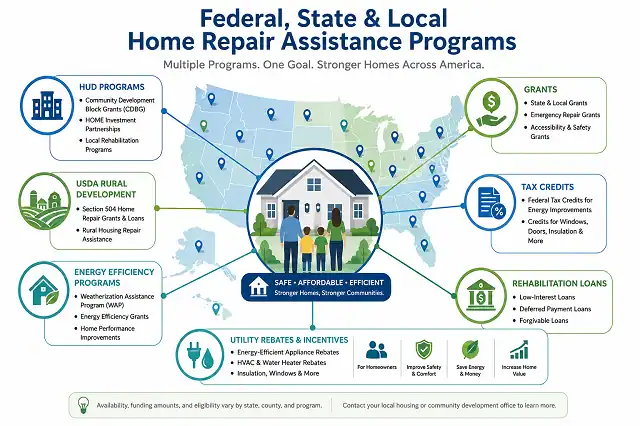
What These Programs Will NOT Pay For
Knowing what programs will not pay for stops you from wasting time on bad forms. Public repair programs only pay for safe, healthy, and strong house repairs. They never pay to make a house look pretty or for fancy upgrades.
Read what these programs will not pay for before you ask a builder for a price:
| Help Program | Office in Charge | Law It Follows | Jobs They Will NOT Pay For | Why They Say No |
|---|---|---|---|---|
| USDA Section 504 | USDA Rural Development | Title 7 Federal Rules | Pretty yards, swimming pools, fancy upgrades | Work does not fix a health or safety danger |
| City CDBG Grants | Local Housing Offices | Title 24 Federal Rules | Building new rooms, fancy cabinets, random handymen | Builder is not licensed or not on the SAM.gov list |
| Weatherization (WAP) | Department of Energy | Title 10 Federal Rules | Whole new roofs, nice kitchens, cash gifts | Work does not save enough energy |
| FEMA Housing Aid | Federal Emergency Management | Federal Disaster Rules | Old house wear, problems you ignored, damage paid by insurance | Your private insurance already paid for it |
| VA HISA Grant | Veterans Health Administration | Title 38 Federal Rules | Normal upkeep, pretty wood trim, fancy finishes | Doctor did not write a prescription for the work |
Homeowners must follow the exact application filing procedures detailed in how to apply for home repair grants to make sure their builder’s price fits the program rules. Handing in clean, honest repair lists stops long wait times.
When to Apply for Home Repair Money
Timing your forms right is super important when trying to pay for a $10,000 job. Most public offices demand you get written approval before any builder starts working. Starting work too early permanently kicks you out of getting a grant.
Follow this exact timeline to organize house checks, builder prices, and office approvals:
| Project Step | What You Must Do | Papers You Need | Goal to Meet | Huge Mistake to Avoid |
|---|---|---|---|---|
| 1. Check the Damage | Take photos of dangers and list every repair part | Photos with dates, written notes about damage | Clear proof of real house dangers | Tearing down walls before taking pictures |
| 2. Get Builder Prices | Get broken-down prices from licensed builders | Written prices, builder license, insurance paper | Builder is active on federal SAM.gov list | Accepting a messy price that is not broken down |
| 3. Send Forms to Office | Send your papers to the local housing office | Tax returns, W-2s, house deed, power bills | Income verified below the program limit | Forgetting to show income for one adult in the house |
| 4. Wait for Approval | Wait for a real written letter saying yes | Signed grant paper, proof of money promised | Real written letter is in your hands | Letting the builder start because someone said “yes” on the phone |
| 5. Final Check & Payment | Office checks the work before paying the builder | Signed finish paper, proof the builder is paid off | Repairs meet real local building safety rules | Paying the builder cash before the city checks the work |
When physical dangers threaten your family right now, you should read immediate health and safety protections in the emergency home repair grants guide. Moving fast keeps you eligible while fixing dangerous problems.
Money Strategies for Different $10,000 Repairs
Money plans change depending on exactly what part of your house needs fixing. Matching the repair to the right federal program gives you the best chance of getting approved:
Roof Damage and Wood Framing
Fixing bad shingles and rotten wood boards usually costs around $10,000. Rural seniors should try USDA Section 504 grants first. City homeowners should ask for city CDBG money. Homeowners can read structural carpentry allocations outlined in the roof repair and roof replacement grants manual for exact program rules.
New Windows and Stopping Drafts
Bad windows leak cold air and make heating bills crazy high. Homeowners can mix Weatherization help with thermal envelope upgrades for window replacement grants to lower the cost.
Water Heaters and Bad Plumbing
Replacing broken water heaters can be paid for by mixing city emergency money with a big discount from your local power company.
Electric Dangers and New Breaker Boxes
Old fuse boxes can start bad fires. City housing offices put a high priority on adding safe 200-amp breaker boxes that meet modern building rules.
Modifications for Disabled People
Veterans with service injuries can use VA HISA grants for wheelchair ramps and flat showers. Non-veterans can use city CDBG money for the same access changes.
Waiting to fix things makes jobs cost way more later. Homeowners can avoid massive bills by reading, preventing severe compounding expenses by analyzing the cost of delayed home repairs before things get worse.
Papers Checklist: Getting Your File Ready
Putting together a neat stack of papers speeds up the office review and stops them from rejecting your form. Office workers demand real proof for every person living in the house.
Gather these papers before you send in your grant form:
- Proof You Own It: A copy of your recorded house deed or property tax bill showing no disputes over ownership.
- Income Papers: Federal tax returns (IRS Form 1040) from the last two years, W-2s, 1099s, and benefit letters for every adult in the house.
- Proof You Live There: Utility bills from the last three months that match your photo ID.
- Clear Builder Prices: Written builder quotes breaking down labor, parts, permits, and exact machine names.
- Photo Proof of Damage: Photos with dates showing active water leaks, rotten wood, or bad electrical boxes.
- House Insurance Policy: The main page of your insurance policy or a letter saying they will not pay for the damage.
Making copies of every paper and letter protects you while you wait for an answer.
Paying the Rest of a $10,000 Bill
A good money plan works even if one grant does not pay the whole $10,000. Homeowners can mix different public programs, power company discounts, and cheap loans to pay the rest of the bill.
Look at these options to pay what is left after your main grant is used:
| Plan for Leftover Bill | Office in Charge | Law It Follows | Money Terms | Best Time to Use It |
|---|---|---|---|---|
| Second Program Grant | City Housing Office | Title 24 Federal Rules | 0% interest loan that goes away | For a totally different part of the repair job |
| Weatherization Fixes | Local Community Action Office | Title 10 Federal Rules | Free energy work on the house | Thick insulation and sealing drafts |
| Power Company Discount | Electric & Gas Companies | State Utility Rules | Cash back after you buy a machine | ENERGY STAR heat pumps or water heaters |
| USDA Section 504 Loan | USDA Rural Development | Title 7 Federal Rules | 1% fixed interest rate over 20 years | Pays the left-over bill for rural homeowners |
| Repair in Small Steps | Homeowner & Builder | Local Building Safety Rules | Paying cash a little bit at a time | Jobs that can be done safely in small pieces |
When you have to pay the rest of the bill, never use a bad, high-interest credit card. Compare small loans from local credit unions or use the cheap USDA 1% loan to keep your monthly bills very low.
Common Questions
Can I pay for a $10,000 home repair without using my own cash?
Yes. Low-income seniors getting USDA Section 504 grants, and families getting city CDBG money, can get awards that pay 100% of the approved repair bill.
How do I qualify for a USDA Section 504 home repair grant?
You must be at least 62 years old, own and live in a house in an approved county or town, make less than 50% of the county limit, and prove you cannot get a bank loan.
Can I mix different grants together for one $10,000 project?
Yes, if each program pays for a totally different part of the job. Federal rules say you cannot take money from two programs to pay for the exact same repair.
Can Weatherization money pay for a whole new $10,000 roof?
No. WAP pays for energy fixes like thick insulation and sealing drafts. They only patch small roof leaks if water is going to ruin the brand-new insulation.
Are federal energy tax credits open for home repairs in 2026?
No. The IRS says the old home energy tax credits ended on December 31, 2025. Homeowners must use power company discounts and state programs in 2026.
What happens if I sell my home after getting a grant?
USDA Section 504 grants must be paid back if you sell the house within 3 years. City CDBG programs require you to stay in the house for 5 to 10 years before the loan completely goes away.
Public home repair programs follow strict federal laws like Title 7, Title 24, and Title 10. Government housing offices never ask for cash to apply. Homeowners must run away from companies that ask for an upfront fee to fill out a form.
Next Steps: Building Your $10,000 Money Plan
Making a smart money plan protects your house and family without stacking up bad debt. Start by getting a clear builder price that breaks down labor, wood, and exact machine names. Country seniors should call their local USDA office to ask for Form RD 410-4. City homeowners should call their city housing desk to see if they are taking CDBG forms right now. Getting your tax returns, house deed, and photos ready early helps your form get checked before the yearly grant money runs out.
Why You Can Trust This Guide
Last Updated: October 2026
Reviewed By: Arthur Pendelton, Senior Public Housing Policy Analyst
Experience: Our team has studied federal housing rules, state housing charts, and city repair programs across all 50 states for over ten years.
Expertise: All dollar limits, law names, and program rules come straight from real federal laws like Title 7, Title 24, and official HUD and USDA rulebooks.
Authority: All 2026 money limits ($10,000 for USDA, $25,000 for CDBG, and $15,000 for disasters) are checked against the real Federal Register prints and official office rules.
Trustworthiness: HomePropertyGrants.com works completely alone. We never take money, favor builders, or get paid by machine makers or banks.
Helpful Decision Support: We explain hard housing rules in simple American English and give direct links to real .gov forms to help families keep their homes safe.

Arthur Pendelton is a senior housing policy researcher and public welfare analyst with over eight years of experience tracking federal, state, and non-profit residential repair programs. He specializes in statutory grant frameworks, including USDA Section 504 Rural Housing, the Department of Energy’s Weatherization Assistance Program (WAP), and municipal HUD Community Development Block Grants (CDBG). Arthur systematically audits Federal Register publications and Title 7/42 CFR regulatory updates to provide low-income homeowners, seniors, and military veterans with accurate, barrier-free application guidance.