
Attic insulation can make a major difference in how much energy a home uses, but paying for insulation can be difficult for homeowners with limited income. Fortunately, some federal, state, local, utility, and tribal programs can help eligible households receive insulation and other weatherization improvements at little or no direct cost.
The most important starting point is the Weatherization Assistance Program (WAP), which is administered through state and local providers. Depending on the household and the home, approved work may include attic insulation, air sealing, energy-related repairs, and health and safety improvements.
This article explains how free attic insulation assistance works, who may qualify, what programs to check, how 2026 income guidelines affect eligibility, what homeowners should prepare, and how to apply without confusing a grant with a rebate, loan, or tax credit.
Quick answer: Low-income homeowners may be able to receive attic insulation through weatherization and other energy-efficiency programs. The Weatherization Assistance Program (WAP) uses income and household criteria, gives priority to certain vulnerable households, and is delivered through state and local providers. The exact insulation work, waiting time, and out-of-pocket cost depend on the local program and the home’s energy needs.
Free Attic Insulation for Low-Income Homeowners: What Help Is Available?
There is not one nationwide program called a “free attic insulation grant” that automatically pays every homeowner’s insulation bill. Instead, several types of assistance can help reduce or eliminate the cost.
For low-income households, weatherization assistance is usually the most relevant starting point. Other options include state energy rebates, utility programs, local housing assistance, rural housing repair programs, and certain Home Energy Rebates programs.
Important: Do not assume that every program advertised as an “insulation grant” provides cash directly to homeowners. Some programs pay approved contractors, provide weatherization services, reimburse eligible expenses, or offer rebates after qualifying work is completed.
Why attic insulation matters
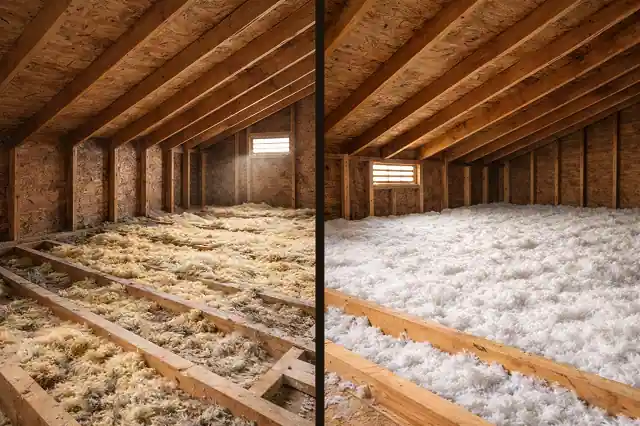
Attic insulation helps slow heat transfer between the living space and the roof area. When a home has insufficient insulation or significant air leakage, heating and cooling equipment may need to operate longer to maintain comfortable indoor temperatures.
Weatherization programs look at the home as a system rather than automatically approving one particular product. An energy assessment can identify insulation deficiencies, air leakage, ventilation concerns, and other improvements that may provide better value.
For homeowners considering several improvements, related resources on home insulation upgrades after roof leaks and weatherproofing grants for older homes can help explain how insulation fits into a broader repair strategy.
Grant, service, rebate, or loan?
| Assistance type | How it generally works | Best starting point |
| Weatherization assistance | Eligible households may receive approved energy-efficiency and health-and-safety services through a local provider. | Low-income households |
| Home Energy Rebates | State, territory, or Tribal programs may provide rebates for qualifying energy upgrades, including certain insulation and air-sealing work. | Households meeting state program requirements |
| Utility rebate | A utility may reimburse part of an eligible insulation or efficiency project. | Customers of participating utilities |
| USDA Section 504 | Eligible rural homeowners may receive repair loans, while qualifying elderly homeowners may receive grants for health and safety hazards. | Very-low-income rural homeowners |
| Home improvement loan | The homeowner borrows money and repays it under the loan terms. | Applicants who do not qualify for grants or services |
For a broader explanation of how insulation fits into home improvement funding, see Home Improvement Grants for Homeowners in 2026.
The Main Sources of Attic Insulation Assistance
Weatherization Assistance Program
The U.S. Department of Energy’s Weatherization Assistance Program is the primary federal weatherization program for low-income households. DOE provides funding to states, territories, and Tribes, which then work through local organizations to deliver services.
DOE states that households at or below 200% of the federal poverty guidelines, or households receiving Supplemental Security Income, are considered eligible under DOE guidelines. States may also use an alternative income test based on 60% of state median income. Priority can be given to elderly households, households with members with disabilities, families with children, high-energy users, and households with a high energy burden.
For the current application process, homeowners should use the official Weatherization Assistance Program (WAP) information before submitting documents or paying a contractor.
2026 program fact: The U.S. Department of Energy says the Weatherization Assistance Program has helped more than 7 million families since 1976, and eligible households save an average of $372 or more per year according to DOE’s current energy-efficiency resources.
Home Energy Rebates
The federal Home Energy Rebates initiative is administered by states, territories, and Tribes rather than through one nationwide homeowner application. Depending on the local program, rebates may support insulation, air sealing, ventilation, and other energy improvements.
The U.S. Department of Energy says the Home Energy Rebates programs include the Home Owner Managing Energy Savings program and the High-Efficiency Electric Home Rebate program. Availability and application rules vary by location.
Check the official Home Energy Rebates Program page before assuming that a particular rebate is active in your state.
Homeowners can also learn about home energy assistance programs for low-income families when their immediate problem involves both high energy bills and needed efficiency improvements.
Utility company programs
Some electric and natural-gas utilities offer insulation, air-sealing, energy audits, or home-efficiency rebates. These programs can have different income thresholds and may require the homeowner to use participating contractors.
Check the utility’s official website or customer-service department before paying for an audit or installation. Ask whether the program requires pre-approval before work begins.
USDA rural housing assistance
The USDA Section 504 Home Repair Loans and Grants program serves eligible very-low-income rural homeowners. The program provides loans for repairs, improvements, or modernization and grants to qualifying homeowners age 62 or older when the purpose is to remove health and safety hazards.
The USDA currently lists a maximum loan of $40,000 and a maximum grant of $10,000 under the standard program, with special disaster-related limits in some circumstances. Insulation should not be assumed to qualify automatically; the project must meet the program’s rules, and the property must be in an eligible rural area.
See the official USDA Section 504 Home Repair program information for current requirements.
For related assistance, see home improvement grants for low-income families and home insulation costs and grants.
How Household Income Affects Eligibility
Income is one of the most important eligibility factors for weatherization assistance, but there is no single income number that applies to every insulation program.
For WAP, DOE guidelines use 200% of the federal poverty guidelines or allow states to use 60% of state median income. Individual states can have additional requirements, so the table below is a screening tool rather than a guarantee of eligibility.
2026 federal poverty guideline reference
The 2026 HHS poverty guideline for the 48 contiguous states and the District of Columbia is $15,960 for one person, with $5,680 added for each additional household member. The following table shows 200% of those figures.
| Household size | 2026 poverty guideline | 200% guideline |
| 1 | $15,960 | $31,920 |
| 2 | $21,640 | $43,280 |
| 3 | $27,320 | $54,640 |
| 4 | $33,000 | $66,000 |
| 5 | $38,680 | $77,360 |
| 6 | $44,360 | $88,720 |
| 7 | $50,040 | $100,080 |
| 8 | $55,720 | $111,440 |
The official 2026 HHS Poverty Guidelines should be checked for Alaska and Hawaii figures and for the most current information.
Do not use the table as an approval decision. WAP eligibility can depend on state rules, household circumstances, income definitions, categorical eligibility, and funding availability. A local provider makes the actual eligibility determination.
Priority households
DOE identifies several groups that can receive priority under weatherization rules. These can include elderly households, households with a member who has a disability, families with children, high-energy users, and households with a high energy burden.
Priority does not necessarily mean automatic approval. It means the household may receive preference under applicable state or local procedures.
When an Attic May Qualify for Insulation Work
A low household income alone does not mean that every insulation project will be approved. Weatherization providers generally assess the property and determine which measures are cost-effective and permitted by the program.
Insufficient existing insulation
An attic with inadequate insulation may be identified during the home’s energy assessment. The recommended level depends on the building, climate, existing assembly, program rules, and applicable energy-efficiency standards.
Air leakage
Air sealing can be important because insulation alone does not necessarily stop uncontrolled air movement. A weatherization assessment may identify gaps, penetrations, or other leakage points that should be addressed.
Moisture or ventilation problems
Moisture problems should be addressed before insulation is installed. Adding insulation over an unresolved roof leak can trap moisture and create additional building problems.
Homeowners dealing with this situation can review home insulation assistance after roof leaks before beginning work.
Energy-efficiency opportunities
Weatherization is designed to identify improvements that reduce energy waste while meeting program requirements. The final scope may include insulation, air sealing, duct improvements, or health and safety measures rather than insulation alone.
What the Assistance May Pay For
| Potential improvement | How it may relate to attic weatherization |
| Attic insulation | May be installed or upgraded when the assessment supports the measure. |
| Air sealing | May address air leakage around penetrations, openings, or other areas. |
| Ventilation work | May be considered when necessary for a safe and effective weatherization project. |
| Duct-related work | May be included when it meets program requirements and improves energy performance. |
| Health and safety measures | Some measures may be required before or during weatherization to protect occupants. |
Programs do not necessarily pay for every item a homeowner requests. The local provider determines the approved scope of work.
For other energy upgrades, see energy-efficient upgrades through home improvement programs and energy-efficient window assistance that can reduce energy bills.
Who May Receive Priority for Free Insulation?
Several groups can receive special consideration under weatherization and related programs. The exact priority order depends on the program and state.
| Household group | Why it may receive priority |
| Low-income households | Income eligibility is central to WAP and many other assistance programs. |
| Older adults | DOE identifies elderly households as a priority category under WAP guidelines. |
| Households with disabilities | Households with a member with a disability may receive priority under WAP procedures. |
| Families with children | Families with children are among the priority groups identified by DOE. |
| High-energy-burden households | Households spending a large share of income on energy may receive priority. |
Homeowners looking for related demographic assistance can also explore home improvement assistance for seniors, home improvement assistance for veterans, and energy-efficiency assistance for disabled homeowners.
Where to Find Attic Insulation Assistance in Your State
WAP is federally funded but locally administered. DOE directs applicants to identify their state weatherization administrator and then locate the local provider serving their area.
State weatherization agencies
Start with your state’s WAP office. The state website should identify local agencies, community action organizations, or other approved providers.
Community action agencies
Many local weatherization services are delivered through community-based organizations. Ask whether the agency currently accepts applications and whether it has a waiting list.
State energy offices
State energy offices are especially useful for finding Home Energy Rebates and other energy-efficiency programs.
Utility providers
Ask your electric or gas utility whether it offers insulation rebates, energy audits, weatherization assistance, or income-qualified efficiency programs.
Rural Development offices
Rural homeowners should also check USDA eligibility and local Rural Development contacts if their home may qualify for Section 504 assistance.
For broader options, see Texas home improvement assistance or use the site’s broader home repair program finder to identify other possible starting points.
What Homeowners Should Prepare Before Applying
Preparing documents before contacting an agency can make the application process easier. Requirements vary, but DOE says local providers may request proof of income and other household information.
Application checklist
- Proof of household income
- Recent pay statements or benefit statements, when applicable
- Proof of homeownership or occupancy
- Recent utility bills
- Government-issued identification, if requested
- Information about the property
- Documentation supporting priority status, if applicable
- Information about existing insulation or known roof and moisture problems
Application tip: Ask the provider whether you must receive approval before hiring a contractor. For many assistance and rebate programs, doing work first can make the project ineligible.
Why Some Applications Do Not Result in Free Insulation
Even households with financial need may not receive a free installation. Weatherization programs have limited budgets, technical requirements, and rules governing which measures can be installed.
| Possible reason | What it means |
| Income is above the applicable limit | The household may need to use rebates, utility programs, or other financing instead. |
| Funding is limited | The household may be placed on a waiting list. |
| Property does not meet program rules | Ownership, occupancy, location, or building requirements may prevent approval. |
| Another repair must be addressed first | Roof leaks, moisture, electrical hazards, or other issues can affect the scope of work. |
| Insulation is not the highest-priority measure | The assessment may identify another improvement that provides greater program value. |
If you are slightly over the income limit, do not assume that no assistance exists. Look for utility incentives, state programs, Home Energy Rebates, and local housing assistance.
Homeowners with other repair needs can also review exterior home improvement assistance and mobile home improvement programs.
How Much Can Attic Insulation Cost?
Attic insulation prices vary significantly by home size, insulation material, existing conditions, labor rates, accessibility, moisture problems, and whether old insulation must be removed.
Rather than presenting a single national “grant amount,” homeowners should separate three numbers: the normal project cost, the amount a particular program will cover, and the homeowner’s final out-of-pocket amount.
| Cost factor | Why it changes the price |
| Attic size | Larger areas generally require more labor and material. |
| Existing insulation | Removal or remediation can increase the project cost. |
| Insulation material | Fiberglass, cellulose, and spray foam have different material and installation costs. |
| Air sealing | Additional sealing work can increase the project scope. |
| Moisture or roof problems | Repairs may be necessary before insulation can safely be installed. |
| Attic accessibility | Difficult access can increase labor time. |
For a separate cost-focused resource, see energy-efficiency upgrade cost information and compare the funding options before accepting a contractor quote.
What the Energy-Savings Evidence Shows
Energy savings from insulation are not identical for every home. Climate, heating fuel, existing insulation, air leakage, household behavior, and equipment efficiency all matter.
DOE has reported that earlier evaluations of weatherized homes found average energy savings in the range of roughly 10% to 20%, although those studies examined particular groups of homes and should not be treated as a guarantee for a new project.
DOE’s current consumer resources also report that households eligible for WAP save an average of $372 or more per year. Individual results can be substantially different.
| Energy-saving measure | Potential benefit |
| Attic insulation | Reduces heat transfer through the ceiling/roof assembly. |
| Air sealing | Reduces uncontrolled air movement through gaps and penetrations. |
| Duct improvements | Can reduce energy losses from poorly sealed or inefficient duct systems. |
| Health and safety improvements | Can address conditions that must be corrected for safe weatherization. |
Understanding Attic R-Values
R-value measures resistance to heat flow. A higher R-value generally means greater resistance to heat transfer, but the appropriate target depends on climate zone and construction details.
DOE materials referencing the 2021 International Energy Conservation Code show ceiling insulation requirements for an uninsulated attic ranging from R-30 in climate zone 1 to R-60 in many colder climate zones.
| Climate zone | 2021 IECC ceiling R-value reference for an uninsulated attic |
| 1 | R-30 |
| 2 | R-49 |
| 3 | R-49 |
| 4 except marine | R-60 |
| 5 and marine 4 | R-60 |
| 6 | R-60 |
| 7 and 8 | R-60 |
These are code references, not a promise that a particular weatherization provider will install exactly that R-value. The provider’s approved work specifications and the home’s existing construction control the actual project.
Homeowners should not select insulation solely by R-value. Moisture control, ventilation, air sealing, installation quality, and the condition of the attic assembly also matter.
Home Energy Rebates and the 2026 Tax Credit Difference
One of the most important corrections to older information about attic insulation is the treatment of the federal Energy Efficient Home Improvement Credit.
2026 warning: Do not rely on articles claiming that homeowners can receive the former 30% federal Energy Efficient Home Improvement Credit for attic insulation installed in 2026. The Internal Revenue Service states that Section 25C is not allowed for qualifying property placed in service after December 31, 2025.
The former credit allowed qualifying insulation and air-sealing expenses to receive a 30% credit, subject to the applicable limits and requirements. That provision was accelerated to end after 2025.
For historical and tax-year information, homeowners can review the official Energy Efficient Home Improvement Credit (25C) information from the Internal Revenue Service.
For 2026 projects, homeowners should instead investigate active state and local rebates, utility incentives, WAP services, and the Home Energy Rebates program where available.
How to Apply for Free Attic Insulation Assistance
The application process is usually more effective when homeowners start with the program administrator rather than an independent contractor.
Seven-step application checklist
- Check your household income and basic eligibility.
- Identify your state weatherization administrator or local provider.
- Ask whether applications are currently open and whether there is a waiting list.
- Gather income, ownership, occupancy, and utility documents.
- Complete the application and any required eligibility review.
- Allow the approved provider to conduct the required home or energy assessment.
- Complete only the work that the program approves and arrange installation through the required provider or contractor.
Start with the state or local weatherization provider
DOE specifically directs applicants to identify their state weatherization administrator and then contact the local provider serving their area. The official application instructions explain that local providers generally determine eligibility and manage the service process.
Prepare for a home assessment
If you are found eligible, the provider may place you on a waiting list before your home is selected. Once selected, an energy auditor can assess the property and identify appropriate measures.
Do not hire first and ask questions later
This is particularly important for grant and rebate programs. A homeowner who installs insulation before receiving required program approval may lose eligibility for assistance.
How to Avoid Insulation Grant Scams
Legitimate programs normally identify the administering agency, eligibility rules, application process, and approved providers. Be cautious when a company promises guaranteed government money without reviewing your household or property eligibility.
Warning signs:
- A contractor demands a large upfront payment to “unlock” a government grant.
- The company guarantees approval before checking eligibility.
- You are told to provide sensitive financial information through an unverified website.
- The contractor refuses to identify the government agency funding the project.
- You are pressured to sign a contract before receiving program approval.
Verify the program through a government agency, state energy office, utility, or recognized local provider before sending money or signing an agreement.
Attic Insulation Assistance vs. Other Home Improvement Help
| Program category | Primary purpose | Could insulation be relevant? |
| Weatherization assistance | Improve energy efficiency and address eligible health and safety conditions for qualifying households. | Yes, when approved by the local program. |
| Home Energy Rebates | Support qualifying energy-efficiency and electrification improvements through state, territory, or Tribal programs. | Yes, depending on the active local program. |
| USDA Section 504 | Repair, improve, or modernize eligible rural homes; grants address qualifying health and safety hazards for elderly homeowners. | Potentially, if the project meets program rules. |
| General home improvement grants | Address broader repair, safety, accessibility, or housing needs. | Sometimes, depending on the program. |
| Utility incentives | Reduce energy use through customer efficiency programs. | Often, depending on the utility. |
For broader assistance, homeowners can also review HUD-related home improvement assistance and HUD home improvement resources. HUD programs generally operate through states and local governments rather than providing one nationwide attic-insulation grant directly to homeowners.
Frequently Asked Questions About Free Attic Insulation
Can low-income homeowners get free attic insulation?
Yes, some eligible low-income households can receive attic insulation as part of weatherization services. The local provider determines eligibility and the specific measures approved for the home. Free installation is not guaranteed simply because a household has a low income.
What government program helps with attic insulation?
The Weatherization Assistance Program is one of the most important federal programs to check. It is administered through state and local providers and can support energy-efficiency improvements for eligible households.
Does weatherization pay for attic insulation?
It can. Attic insulation may be included when the home’s assessment identifies it as an eligible and appropriate weatherization measure. The final scope depends on program rules, funding, the property, and the assessment.
Can seniors receive free attic insulation?
Older households can receive priority under WAP guidelines, but senior status alone does not guarantee free insulation. Seniors should also check USDA Section 504 if they own an eligible rural property and meet the program’s income and age requirements.
Can disabled homeowners qualify for insulation assistance?
Yes. Households with a member with a disability are among the priority categories identified by DOE for weatherization. Other local housing and energy programs may also provide assistance.
Are manufactured or mobile homes eligible?
Some weatherization programs can serve manufactured or mobile homes, but eligibility depends on state and local rules and the home’s condition. Ask the local provider before arranging an inspection or installation.
Can I combine a grant with a rebate?
Possibly, but stacking rules differ by program. Some programs restrict duplicate funding for the same expense. Always ask the administering agency or utility whether the funding sources can be combined before starting work.
Expert Review and EEAT
Last Updated: August 2026
Reviewed By: Homepropertygrants Editorial Team
Program verification: Federal program information in this article was checked against current U.S. Department of Energy and USDA Rural Development materials.
2026 eligibility review: The income discussion uses the 2026 HHS poverty guidelines and explains that WAP eligibility can also depend on state median income rules and local procedures.
Tax-credit accuracy: The article specifically distinguishes 2026 assistance from the former Section 25C Energy Efficient Home Improvement Credit, which ended for property placed in service after December 31, 2025.
Consumer protection: The article explains why homeowners should verify program approval before hiring a contractor and why government or utility sources should be used to confirm current requirements.
Practical guidance: The application checklist is designed around the federal WAP process while making clear that local agencies determine the final eligibility and project scope.
Official source check: Program rules, funding levels, income limits, rebate availability, and application procedures can change. Homeowners should confirm the current rules with the administering agency before applying or signing a contractor agreement.
Conclusion
Free attic insulation is possible for some low-income homeowners, but it usually comes through a specific weatherization or energy-efficiency program rather than a universal federal grant paid directly to the homeowner.
The best first step is to check the Weatherization Assistance Program through your state and local provider. If you do not qualify or your area has a waiting list, check Home Energy Rebates, utility incentives, USDA rural housing assistance, and local housing programs.
Use the correct 2026 income guidelines, prepare your documents, and do not begin work until you know whether the program requires pre-approval. Most importantly, do not rely on outdated claims about a 30% federal insulation tax credit for 2026 work—the former Section 25C credit ended after 2025.
For broader home upgrade funding, return to Home Improvement Grants for Homeowners in 2026 to compare attic insulation with other repair and upgrade assistance options.

Arthur Pendelton is a senior housing policy researcher and public welfare analyst with over eight years of experience tracking federal, state, and non-profit residential repair programs. He specializes in statutory grant frameworks, including USDA Section 504 Rural Housing, the Department of Energy’s Weatherization Assistance Program (WAP), and municipal HUD Community Development Block Grants (CDBG). Arthur systematically audits Federal Register publications and Title 7/42 CFR regulatory updates to provide low-income homeowners, seniors, and military veterans with accurate, barrier-free application guidance.