
Damaged or missing roof shingles can turn into much bigger problems when rain reaches the roof deck, attic, insulation, walls, or ceilings. If you are searching for roof repair grants for damaged or missing shingles, the best approach is not to apply randomly for every program that mentions home repairs. The better strategy is to identify why your shingles are damaged and then match that problem with the grant program designed for your situation. A damaged roof does not automatically qualify for a grant. The repair must also fit the program’s purpose, and the homeowner must meet the program’s income, property, location, age, disaster, or other eligibility requirements.
A qualifying rural senior homeowner may have a strong federal option through the USDA Section 504 Home Repair Grant. A homeowner whose roof was damaged by a qualifying disaster may need to investigate FEMA or USDA disaster grants. A homeowner in a city or county may find a local housing rehabilitation grant funded through HUD programs. Veterans with qualifying service-connected disabilities may have access to VA housing grants when the requested work meets disability-related housing requirements.
This article answers one primary question: Which legitimate grants should homeowners check when roof shingles are damaged or missing, and how can they determine which grant is the best fit?
Quick answer: There is no single nationwide government grant that automatically pays every homeowner to replace missing shingles. The strongest option depends on the cause of the damage, household income, age, location, property type, disaster status, and the rules of the specific program. For eligible rural senior homeowners, USDA Section 504 is an important grant to investigate. Disaster-damaged roofs may qualify for FEMA or USDA disaster grants. Local housing agencies may offer rehabilitation grants. Veterans with qualifying disabilities should investigate VA housing grants when the roofing work is part of an eligible housing adaptation.
This article is deliberately narrower than our roof repair and roof replacement grants guide. The broader pillar covers complete roof repair and replacement funding. This page focuses specifically on damaged shingles, missing shingles, roof leaks, partial roofing repairs, and the grants that may help pay for them.
When damaged or missing shingles may qualify for a grant
A missing shingle by itself does not create an automatic right to government funding. Grant programs normally require the homeowner and the repair to meet specific conditions.
The reason the shingles are damaged can be especially important. A roof damaged by a declared disaster may be considered under a different program from a roof that has deteriorated slowly over many years.
| Roof problem | Potential grant pathway | Evidence to collect |
| Shingles blown off by severe wind | Insurance, disaster grants, or local repair grants | Photos, date of event, inspection, insurance records |
| Roof damaged by a qualifying disaster | FEMA or USDA disaster grants | Disaster information, photographs, inspection, repair estimate |
| Long-term roof deterioration creating a health or safety hazard | USDA Section 504 or local rehabilitation grants | Inspection, income documents, ownership records |
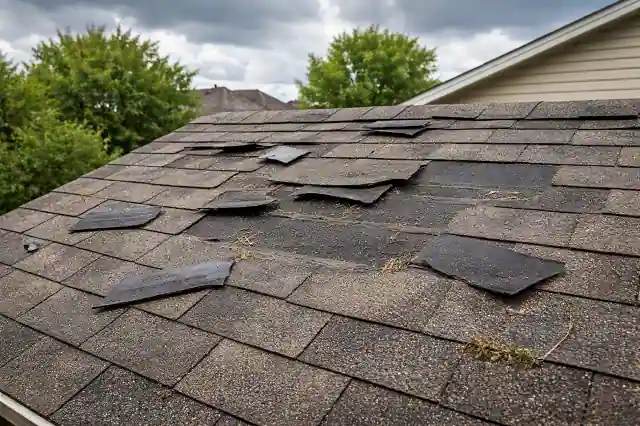
| Several cracked, lifted, or missing shingles | Local emergency or rehabilitation grants | Photos and written roofing assessment |
| Old roof with no active leak or safety problem | Grant eligibility may be limited | Professional assessment of actual condition |
| Roof damage combined with other urgent repairs | Local housing rehabilitation programs | Complete scope of work and eligibility documents |
The strongest applications establish a clear connection between the roof condition, the need for repair, the homeowner’s eligibility, and the purpose of the grant. If a missing or damaged shingle has already caused a small roof leak, homeowners should also address the leak quickly to prevent the problem from becoming more extensive. Our grants for fixing small roof leaks resource explains additional funding options for this type of problem.
Best Program for Your Situation
There is no universal “best roof grant.” The right starting point depends on your circumstances.
| Your situation | Program to investigate first | Why it may fit |
| Very-low-income homeowner age 62 or older in an eligible rural area | USDA Section 504 Home Repair Grant | Designed for eligible elderly very-low-income rural homeowners who need to remove health and safety hazards. |
| Very-low-income rural homeowner under age 62 | USDA Section 504 Home Repair Loan | The Section 504 grant has an age requirement, but qualifying homeowners may still investigate the repair-loan portion. |
| Roof damaged by a qualifying declared disaster | FEMA or USDA disaster grant | These programs can address eligible disaster-related housing damage. |
| Homeowner in a city or county with a rehabilitation program | Local CDBG-funded repair grant | Local governments can use CDBG funding for eligible residential rehabilitation. |
| Veteran with a qualifying service-connected disability | VA housing adaptation grant | Eligible veterans may receive grants for qualifying disability-related housing modifications. |
| Low-income homeowner facing an urgent roof problem | Local emergency or nonprofit repair grant | Some programs prioritize health and safety repairs that cannot reasonably be delayed. |
Best starting rule: Before applying, ask the agency whether its current grant can specifically cover roof repair, missing shingles, roof leaks, or partial shingle replacement. Do not assume that every home-repair program covers roofing.
If your household has limited income but does not fit the USDA rural senior grant requirements, our low-income home repair grants resource provides a broader set of options.
USDA Section 504 Home Repair Grant
The Single Family Housing Repair Loans and Grants Program, commonly called Section 504, is one of the most important federal programs to investigate for qualifying rural homeowners.
The U.S. Department of Agriculture Rural Development (USDA) states that Section 504 provides loans to very-low-income homeowners to repair, improve, or modernize their homes. Grants are available to eligible elderly very-low-income homeowners to remove health and safety hazards.
This makes the program particularly relevant when damaged or missing shingles create a roof leak or another condition that threatens the safety of the home.
Current Section 504 grant and loan limits
| Program feature | Current USDA information |
| Maximum standard grant | Up to $10,000 |
| Maximum repair loan | Up to $40,000 |
| Grant age requirement | Generally age 62 or older |
| Income requirement | Household income must meet the applicable very-low-income limit |
| Property requirement | Home must be in an eligible rural area |
| Grant purpose | Removal of health and safety hazards |
| Standard loan interest rate | Fixed at 1% under the program terms |
Under the applicable USDA disaster provision, the Section 504 grant maximum can reach $15,000 for eligible repairs to a home damaged in a presidentially declared disaster area.
Can USDA pay for damaged or missing shingles?
Potentially. The important question is whether the roof repair qualifies as an eligible repair under Section 504 and whether the homeowner meets all of the program requirements.
The U.S. Department of Agriculture Rural Development published a 2026 success story about a New Jersey family with a failing roof. The agency reported that the family received a $10,000 grant and a $6,460 loan through the Section 504 Home Repair program to repair the failing roof.
This is useful official evidence that roofing work can fit the Section 504 program. It does not mean every homeowner with missing shingles will receive the same amount.
USDA decision rule: If you are 62 or older, have very low household income, own an eligible rural home, and the damaged shingles or leaking roof create a health or safety hazard, Section 504 should be one of your first federal grant checks.
For senior homeowners specifically, our roof repair and replacement grants for seniors resource provides additional context.
USDA disaster grants for damaged rural homes
Rural homeowners whose roofs were damaged by a qualifying disaster should also investigate USDA’s separate disaster program rather than assuming the standard Section 504 limits apply.
The Single Family Housing Disaster Assistance Fund Program provides grants and loans for eligible disaster-related housing repairs. The U.S. Department of Agriculture Rural Development (USDA Disaster Program) currently lists a maximum grant of $32,420.
The program has its own eligibility rules and funding requirements. The maximum should therefore never be treated as a guaranteed payment.
| USDA program | Primary purpose | Roof relevance |
| Section 504 Home Repair Grant | Removal of health and safety hazards for qualifying elderly very-low-income rural homeowners | Missing shingles or roof leaks may be relevant when they create an eligible hazard. |
| Single Family Housing Disaster Assistance Fund Program | Repair homes damaged by qualifying disasters | Potentially relevant when shingles or roofing were damaged by the disaster. |
Important: Do not combine USDA program limits. The standard Section 504 grant, its disaster-related provision, and the separate USDA disaster program have different rules and limits.
FEMA grants for disaster-damaged shingles
If wind, hail, flooding, a fallen tree, or another event associated with a qualifying disaster caused your missing shingles, FEMA may be a more relevant option than an ordinary home repair grant.
The Federal Emergency Management Agency (FEMA) provides Individual Assistance after qualifying disasters. FEMA’s current Home Repair Assistance guidance identifies roof damage as a type of disaster-related home damage that may qualify when the applicable requirements are met.
FEMA assistance is designed to help eligible disaster survivors restore their primary residence to a safe and functional condition. It is not a general grant for a roof that has simply aged.
What FEMA may consider
- The home is located in an eligible declared disaster area.
- You own the home.
- The home is your primary residence.
- The roof damage resulted from the disaster.
- An inspection confirms eligible damage.
- The repair is necessary to make the home safe or functional.
- Insurance or another source does not already cover the same eligible loss.
Warning: Do not rely on websites promising a fixed FEMA roof grant amount. FEMA benefits depend on the disaster, eligible damage, inspection findings, insurance, and current program rules.
If your roof problem is urgent because water is entering your home, see our emergency roof tarp grants resource to learn about temporary roof protection after storm damage. You can also review our emergency home repair grants resource for broader repair-funding options.
HUD-funded local roof repair grants
The U.S. Department of Housing and Urban Development (HUD) funds programs that can support housing rehabilitation through eligible local governments and other participating entities.
Community Development Block Grant funding can support eligible residential rehabilitation activities. However, there is no single nationwide CDBG roof grant with one standard application, award amount, or eligibility test.
Your city, county, or participating housing agency may operate an owner-occupied rehabilitation program, emergency repair program, senior repair program, or another local grant that includes roofing work.
Our HUD home improvement grants resource can help you explore the broader HUD-related housing programs.
What to ask your local housing agency
Ask this specific question:
“Do you currently offer an owner-occupied housing rehabilitation grant that covers roof repair, missing shingles, roof leaks, or emergency roofing work?”
Then ask about income limits, property requirements, waiting lists, inspection requirements, contractor rules, maximum project amounts, and whether applications are currently open.
VA housing grants for veterans
Veterans may have access to legitimate housing grants, but VA programs should not be described as universal free roof grants.
The U.S. Department of Veterans Affairs (VA) offers disability housing grants to eligible veterans and service members with qualifying disabilities. These programs can help eligible applicants buy, build, or modify permanent housing to accommodate qualifying disabilities.
For fiscal year 2026, VA lists a maximum Specially Adapted Housing grant of $126,526.
That is the maximum SAH grant for an eligible applicant. It is not a general $126,526 roof repair grant.
Ordinary missing shingles caused by age or routine maintenance should not automatically be presented as a VA housing-grant project. The requested work needs to fit the applicable disability-related housing requirements.
For broader veteran-specific options, see our home repair grants for veterans resource.
Roof repair grants for disabled homeowners
Disabled homeowners may qualify for several categories of home repair funding, but disability alone does not guarantee a roof grant.
The reason for the repair still matters. A local rehabilitation program may prioritize disabled homeowners, while a VA program may require a qualifying service-connected disability and a specific housing adaptation.
For a more targeted comparison, see our roof replacement grants for disabled homeowners resource.
Important distinction: A disability can strengthen eligibility for some housing programs, but the program still needs to cover the requested roofing work. Do not assume that every accessibility grant can pay for missing shingles.
What these roof repair grants do NOT cover
Knowing what a grant does not cover can be just as important as knowing what it can cover.
| Program | What it does NOT automatically cover |
| USDA Section 504 Home Repair Grant | It is not an automatic grant for every old roof. The grant is tied to eligibility and removal of health and safety hazards. |
| USDA Disaster Assistance Fund | It is not ordinary maintenance funding for roof deterioration unrelated to an eligible disaster. |
| Local CDBG-funded grant | There is no nationwide standard award amount or guarantee that every local CDBG program covers roofing. |
| FEMA | It is not routine roof-maintenance funding and cannot duplicate benefits available from insurance or another source. |
| VA housing grants | They are not general roof-maintenance grants; qualifying disability-related requirements apply. |
| Weatherization programs | They are not general cash grants for replacing missing shingles. |
Remember: “My roof needs repair” and “I qualify for a roof repair grant” are two separate questions. You must satisfy both the repair requirements and the program’s eligibility requirements.
Insurance versus roof repair grants
If your shingles were damaged by wind, hail, a falling tree, or another event that may be covered by homeowners insurance, review your policy before assuming that a government grant is the first option.
Insurance and government grants can interact, particularly after disasters. Keep your claim documents and disclose other sources of payment when required.
| Situation | Recommended first step |
| Recent storm caused missing shingles | Photograph the damage and contact your insurer. |
| Insurance covers part of the repair | Keep the settlement and ask whether an eligible grant can address an uncovered need. |
| Insurance denies the claim | Keep the written denial and investigate eligible grant programs. |
| Roof is deteriorating from age | Look for health-and-safety or rehabilitation grants rather than disaster grants. |
State and local roof repair grants
Some of the most useful roofing grants are administered by states, counties, cities, community action agencies, or nonprofit organizations rather than directly through a federal homeowner application.
Local programs may prioritize low-income homeowners, seniors, disabled homeowners, veterans, disaster survivors, or homes with urgent health and safety problems.
Our state home repair grants resource is a useful next step when you want to move from federal programs to state and local opportunities.
If your roof is on a manufactured home, property-type rules may be different. See our mobile home improvement grants resource before applying.
Nonprofit roof repair grants
Government grants are not the only option. Some nonprofit organizations provide direct repairs, materials, volunteer labor, or financial assistance to homeowners who meet their eligibility requirements.
Nonprofit programs can be particularly useful when a homeowner does not qualify for a federal grant or when a local emergency repair program has limited funding.
Our nonprofit home repair grants resource explains how this category differs from federal and local government programs.
Weatherization grants and damaged roofs
The U.S. Department of Energy (DOE) operates the Weatherization Assistance Program (WAP) to help eligible low-income households improve energy efficiency while addressing health and safety concerns.
DOE reports that WAP provides weatherization services to approximately 32,000 homes each year. DOE also reports average annual household savings of $372 or more based on a national evaluation.
These are program-wide statistics. They do not mean that every homeowner receives a roof repair grant or a $372 payment.
Our weatherproofing grants for older homes resource can help homeowners understand where weatherization may fit into a larger repair strategy.
Use WAP for the right reason: If your roof problem is part of a broader energy-efficiency or health-and-safety issue, ask your local weatherization provider what services are available. Do not treat WAP as a general cash grant for replacing ordinary shingles.
How to apply for a roof repair grant
Document the damaged shingles
Take clear photographs from safe locations. Photograph missing shingles, cracked or lifted shingles, visible openings, roof leaks, ceiling stains, water damage, and related problems.
Determine the cause
Record whether the damage resulted from wind, hail, a qualifying disaster, falling debris, age, deterioration, or another cause. Accuracy matters because disaster programs require disaster-related damage.
Get a written roof inspection
A written inspection can establish whether you need a few replacement shingles, a partial roof repair, or a complete replacement.
Check insurance
If the damage may be covered, file the appropriate claim and keep the claim number, inspection report, settlement, or denial.
Match your situation to the right grant
Check USDA Section 504 if you meet the rural and senior requirements. Check local housing rehabilitation programs for CDBG-funded grants. Check FEMA after an eligible disaster. Check the USDA disaster program when applicable. Veterans should review VA housing grants when the requested work fits the qualifying disability-related rules.
Prepare your documents
Gather ownership records, income documents, photographs, inspection reports, estimates, insurance records, disaster information, and any program-specific documentation.
Get approval before major work
Do not assume that a grant will reimburse work started before approval. Ask the program administrator whether emergency work completed before application can qualify before signing a major roofing contract.
Roof repair grant application checklist
Before submitting an application, check that you have:
- Proof of homeownership
- Proof that the property is your primary residence
- Household income documentation, when required
- Government-issued identification
- Photographs of damaged or missing shingles
- Roof inspection report
- Written contractor estimate
- Insurance claim information
- Insurance settlement or denial letter, when applicable
- Disaster information, when applicable
- Age documentation, when required
- Veteran or disability documentation, when required
- Property records requested by the program
What happens after you apply?
Submitting a grant application does not mean that the roof repair has been approved. Many programs use several stages before work can begin.
| Stage | What may happen |
| Eligibility review | The agency checks income, ownership, occupancy, age, location, disaster status, or other requirements. |
| Property inspection | The roof and related damage may be inspected. |
| Scope of work | The agency determines which repairs are eligible. |
| Cost review | Estimates or bids may be reviewed for eligible costs. |
| Grant agreement | The homeowner may need to sign an agreement containing program conditions. |
| Roof repair | The approved work is completed according to program requirements. |
| Final inspection | The agency may inspect the completed project before closing the grant. |
Roof repair grant statistics and official evidence
Official evidence is more reliable than websites that advertise a guaranteed amount for every homeowner.
| Program or evidence | Supported information |
| USDA Section 504 | Maximum standard grant is $10,000 and maximum repair loan is $40,000. |
| USDA Section 504 disaster provision | Maximum grant can reach $15,000 for repairing a home damaged in a presidentially declared disaster area under the applicable rules. |
| USDA Disaster Assistance Fund Program | Maximum grant is currently listed as $32,420 for eligible disaster-related home repairs. |
| USDA 2026 roof-repair example | A New Jersey family received a $10,000 grant and $6,460 loan through Section 504 to repair a failing roof. |
| HUD CDBG | HUD identifies residential rehabilitation as an eligible CDBG activity, with local governments establishing their own programs and priorities. |
| DOE Weatherization Assistance Program | Approximately 32,000 homes receive weatherization services each year, and DOE reports average annual savings of $372 or more from a national evaluation. |
| VA SAH | Maximum SAH grant for FY2026 is $126,526 for eligible applicants; the benefit is designed for qualifying disability-related housing adaptations. |
How to avoid roof repair grant scams
Homeowners who urgently need a roof are vulnerable to contractors and websites that promise guaranteed government money.
Warning signs:
- Someone guarantees that you will receive a government roof grant.
- You are asked for a large upfront payment to access government funding.
- You are asked to pay using gift cards, cryptocurrency, or unusual payment methods.
- A contractor tells you to exaggerate storm damage.
- You are told that every homeowner qualifies.
- You are pressured to sign an insurance assignment immediately.
- You are directed to an unofficial website instead of the government agency.
Verify the program directly with the agency or local organization administering it. A contractor can provide an estimate, but a contractor cannot guarantee government grant approval.
Official sources for verifying roof grant information
| Official source | What to verify |
| U.S. Department of Agriculture Rural Development (USDA) | Section 504 eligibility, rural requirements, income rules, grant limits, and application process |
| USDA Rural Development Disaster Assistance Fund Program (USDA Disaster Program) | Disaster eligibility, current grant limits, eligible repairs, and funding availability |
| U.S. Department of Housing and Urban Development (HUD) | CDBG and other housing rehabilitation programs |
| Federal Emergency Management Agency (FEMA) | Disaster eligibility and Home Repair Assistance requirements |
| U.S. Department of Veterans Affairs (VA) | SAH, SHA, and other disability housing grant requirements |
| U.S. Department of Energy (DOE) | Weatherization Assistance Program eligibility and available services |
Frequently asked questions
Is there a government grant for missing roof shingles?
There can be government grants that cover eligible roof repairs, but there is no universal federal grant specifically for every missing-shingle problem. USDA, local housing rehabilitation programs, disaster grants, and certain veteran housing grants each have different requirements.
What is the best roof repair grant for seniors?
For a qualifying senior homeowner with very low income and an eligible rural property, the USDA Section 504 Home Repair Grant is one of the most important programs to investigate. USDA grants are intended to help eligible elderly very-low-income rural homeowners remove health and safety hazards.
Can USDA pay for missing shingles?
Potentially. Section 504 grants can be used to remove health and safety hazards for qualifying elderly very-low-income rural homeowners. If missing shingles or roof leaks create an eligible hazard, the repair may fit the program, but approval is not automatic.
Can CDBG pay for roof repairs?
Potentially. HUD identifies residential rehabilitation as an eligible CDBG activity. However, local governments establish their own programs, priorities, eligibility rules, and application processes.
Does FEMA give homeowners a roof repair grant?
FEMA can provide Home Repair Assistance for eligible disaster-caused damage when the applicable disaster and homeowner requirements are satisfied. It should not be treated as routine funding for an old or deteriorating roof.
Can veterans get a roof repair grant from VA?
VA provides housing grants for eligible veterans and service members with qualifying disabilities. Those grants are designed around qualifying housing adaptations and should not be presented as general grants for ordinary missing-shingle repairs.
Can I get a roof grant if my insurance denied my claim?
Possibly. An insurance denial does not automatically make you eligible for a government grant, but the denial can document the remaining financial need when you investigate qualifying local, USDA, disaster, or nonprofit programs.
Expert review and limitations
Last Updated: August 17, 2026
Reviewed By: Housing Assistance & Government Grant Research Team
Editorial review standards:
- Major federal program claims are checked against official government information.
- Unsupported universal roof-grant amounts have been removed.
- Grant and loan amounts are clearly separated.
- Disaster grants are separated from ordinary roof repair grants.
- VA housing grants are not presented as general roof-maintenance grants.
- HUD programs are presented as locally administered opportunities.
- Weatherization funding is not presented as a general shingle-replacement grant.
- Program limitations are explained instead of implying guaranteed approval.
- Internal links are selected for reader value and topical relevance rather than a fixed quota.
Grant availability, funding, income limits, disaster declarations, and local application requirements can change. Verify current requirements with the agency administering the grant before spending money or starting major repairs.
Final takeaway
If you need roof repair grants for damaged or missing shingles, begin with the cause of the damage and your eligibility rather than a generic search for “free roof grants.” A qualifying rural senior homeowner should investigate USDA Section 504. A homeowner affected by a qualifying disaster should investigate FEMA and, where applicable, USDA disaster grants. Homeowners in cities and counties should check local housing rehabilitation grants. Veterans with qualifying disabilities should examine VA housing grants when the requested work fits the disability-related requirements.
Before applying, photograph the damaged shingles, establish the cause of the problem, check insurance, obtain a written roof inspection, and gather the documents required by the program.
Bottom line: The right roof repair grant depends on your roof’s condition, the cause of the damage, your location, household circumstances, and the purpose of the specific grant. Verify the program through its official administering agency, document the damage carefully, and never rely on a website that guarantees government roof money without showing the actual program requirements.

Arthur Pendelton is a senior housing policy researcher and public welfare analyst with over eight years of experience tracking federal, state, and non-profit residential repair programs. He specializes in statutory grant frameworks, including USDA Section 504 Rural Housing, the Department of Energy’s Weatherization Assistance Program (WAP), and municipal HUD Community Development Block Grants (CDBG). Arthur systematically audits Federal Register publications and Title 7/42 CFR regulatory updates to provide low-income homeowners, seniors, and military veterans with accurate, barrier-free application guidance.