
A rotten exterior door can become a serious home repair problem when wood decay, water damage, failed hardware, air leakage, or a damaged frame affects the safety, security, or condition of the home. For homeowners who cannot afford the repair, several government-funded programs may help with eligible work. You can also review our Home Repair Grants 2026 guide for broader assistance options.
There is no single nationwide federal program specifically called a rotten exterior door replacement grant. Instead, assistance may be available through broader home repair, housing rehabilitation, weatherization, accessibility, or disaster programs. Whether a complete door replacement qualifies depends on the program, the condition of the property, household eligibility, and local funding rules.
Quick Answer: A rotten exterior door may qualify for assistance when it creates a health, safety, structural, accessibility, security, or energy-efficiency problem. Eligible rural homeowners should check the Single Family Housing Repair Loans and Grants program first. Low-income households should also check the Weatherization Assistance Program and local housing rehabilitation programs funded through HUD.
For a broader overview of federal, state, and local door assistance, see our Door Replacement Grants 2026 guide.
Why a Rotten Exterior Door May Qualify for Assistance
Exterior doors protect a home from weather, moisture, pests, unwanted entry, and outdoor temperatures. When the door or surrounding frame begins to rot, the problem can go beyond appearance.
Severe deterioration can make a door difficult to close or lock. Gaps around the door can increase air leakage. Water can enter through deteriorated wood or failed seals and may damage the frame, wall, flooring, or other building materials.
A repair program is more likely to consider a deteriorated door when the homeowner can show a clear health, safety, structural, accessibility, security, or energy-related need rather than a simple desire to upgrade an old door.
Important: Do not describe a cosmetic replacement as an emergency repair. Explain the actual problem, such as water intrusion, rotten framing, an unsafe lock, severe air leakage, accessibility difficulty, or another documented condition.
Signs That an Exterior Door May Need Replacement
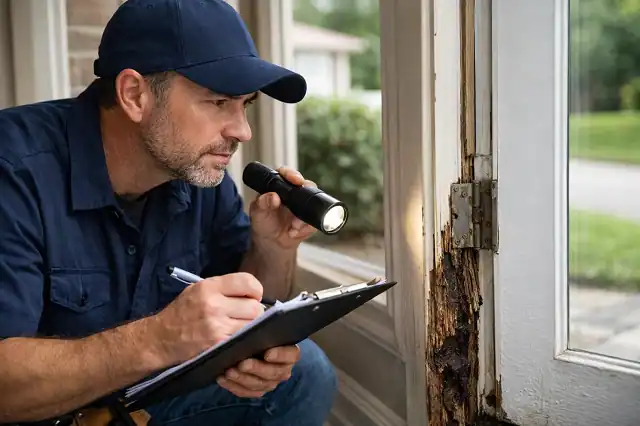
A program may first determine whether the door needs complete replacement or whether a smaller repair can solve the problem. Look for these warning signs:
- Soft, crumbling, or visibly rotten wood.
- Water stains or moisture around the door.
- A deteriorated jamb, sill, threshold, or frame.
- A door that does not close or latch correctly.
- A lock or deadbolt that cannot operate safely.
- Large gaps around the door.
- Visible daylight around the closed door.
- Damage that allows rain or wind into the home.
- Damage that creates an accessibility problem.
- Damage caused by a qualifying storm or other disaster.
If rot is limited to a small area, the appropriate solution may be repair rather than full replacement. If the deterioration affects the structural parts of the entryway, replacement may be more practical.
Government Programs That May Help Replace a Rotten Exterior Door
The most useful programs depend on why the door needs replacement and where the homeowner lives. USDA assistance is particularly relevant to eligible rural homeowners. Weatherization assistance may be relevant when energy efficiency and health and safety are involved. Local housing rehabilitation programs may provide another route for qualifying homeowners.
| Program or funding source | Potential fit | Important point |
|---|---|---|
| USDA Section 504 Home Repair Program | Eligible very-low-income rural homeowners | Loans can fund repairs and grants can address qualifying health and safety hazards. |
| Weatherization Assistance Program | Eligible low-income households | Local agencies determine which energy and health-and-safety measures qualify. |
| Community Development Block Grant programs | Homeowners served by participating local programs | Local governments determine eligible activities and program rules. |
| Local housing rehabilitation programs | Income-qualified homeowners | Funding, income limits, and eligible repairs vary by community. |
| Disaster assistance | Homeowners with qualifying disaster damage | The damage and property must satisfy the applicable disaster program requirements. |
USDA Section 504 Home Repair Loans and Grants
The U.S. Department of Agriculture (USDA) administers the Single Family Housing Repair Loans and Grants program, commonly known as Section 504. It is one of the most important federal repair programs for eligible rural homeowners.
The program provides loans to very-low-income homeowners for repairs, improvements, or modernization. Qualifying homeowners age 62 or older who cannot afford to repay a loan may qualify for grants to remove health and safety hazards.
According to current U.S. Department of Agriculture Rural Development information, the maximum Section 504 loan is $40,000 and the standard maximum grant is $10,000. For an eligible home damaged in a presidentially declared disaster area, the maximum grant can be $15,000. Loans and grants may be combined for up to $50,000 in standard cases or $55,000 in qualifying presidentially declared disaster areas.
2026 USDA funding example: USDA Rural Development currently lists a maximum $40,000 Section 504 loan and a maximum $10,000 standard grant. A homeowner does not automatically receive these maximum amounts. The actual assistance depends on eligibility, approved work, funding, and program requirements.
Who May Qualify for Section 504
Applicants generally must own and occupy the property, have household income within the applicable very-low-income limit, and be unable to obtain affordable credit elsewhere. The property must also satisfy USDA geographic eligibility requirements.
- The applicant owns and occupies the home.
- Household income is within the applicable very-low-income limit.
- The applicant cannot obtain affordable credit elsewhere.
- The property is in an eligible rural area.
- For the grant component, the homeowner is generally age 62 or older.
Homeowners can check an address using the official USDA Eligibility Site before contacting USDA Rural Development.
Can Section 504 Pay for a Rotten Door?
A rotten exterior door may be considered when the proposed work addresses an eligible health or safety hazard. The program does not automatically approve every door replacement.
For example, a deteriorated door may be more relevant when it cannot be secured, allows substantial water intrusion, has unsafe structural deterioration, or creates another qualifying hazard.
The agency determines whether the proposed work is eligible and what scope of repairs can be approved.
Weatherization Assistance for Drafty or Deteriorated Doors
The U.S. Department of Energy (DOE) administers the Weatherization Assistance Program.
The Weatherization Assistance Program (WAP) helps eligible low-income households reduce energy costs by improving energy efficiency while addressing health and safety concerns.
DOE reports that WAP provides weatherization services to approximately 32,000 homes each year using DOE funds. The department also reports average annual household savings of $372 or more based on a national evaluation.
Supported statistic: DOE reports that the Weatherization Assistance Program has helped more than 7.2 million families since it began in 1976 and currently provides weatherization services to approximately 32,000 homes each year using DOE funds.
When WAP May Help With a Door
A door may be considered when it contributes to significant air leakage or another energy-related deficiency. Health and safety considerations can also affect the measures selected by the local weatherization agency.
However, WAP does not guarantee a free replacement door for every applicant. The local agency evaluates the home and determines which improvements are appropriate under the program’s rules.
Homeowners should use the official DOE information and contact the weatherization organization serving their area rather than assuming that a particular door product will qualify.
HUD-Funded Housing Rehabilitation Programs
The U.S. Department of Housing and Urban Development (HUD) provides funding through programs that are administered by states, cities, counties, and other eligible organizations.
The Community Development Block Grant (CDBG) program can fund eligible activities, including rehabilitation of residential structures. Local governments establish their own program priorities and eligibility requirements within federal rules.
This means a homeowner should not expect one nationwide HUD application for a rotten door. Instead, contact the city, county, or state housing agency and ask whether it operates an owner-occupied housing rehabilitation or home repair program.
Better search strategy: Instead of searching only for “HUD rotten door grants,” search for your city or county plus owner-occupied rehabilitation, housing rehabilitation, home repair program, or CDBG housing rehabilitation.
Can Disaster Assistance Help With a Rotten Exterior Door?
If the door was damaged by a qualifying flood, wildfire, hurricane, tornado, or other declared disaster, disaster-specific assistance may provide another option.
The USDA Single Family Housing Disaster Assistance Fund Program currently provides grants and loans to eligible low- and very-low-income homeowners whose homes have been damaged by qualifying declared disasters.
USDA currently lists a maximum grant of $32,420 for this disaster assistance program. Applications are accepted until September 30, 2026, while funding remains available.
Warning: Disaster assistance is not a general-purpose door replacement grant. The property damage must satisfy the applicable disaster and program requirements, and duplication-of-benefits rules may apply.
Rotten Door Frame Repair and Replacement
Rot often affects more than the door slab. Moisture can damage the jamb, sill, threshold, surrounding framing, trim, or nearby wall materials.
If the frame is structurally damaged, replacing only the door may not correct the underlying problem. An inspector or contractor may recommend replacing or repairing several components as one project.
Take photographs of the complete entryway instead of photographing only the door panel.
- Door slab.
- Jambs.
- Threshold.
- Sill.
- Frame connections.
- Surrounding trim.
- Interior signs of water intrusion.
- Lock and hardware condition.
Include framework in the contractor estimate if the frame is also deteriorated.
Can a Rotten Back Door Qualify?
Assistance is not necessarily limited to front entry doors. A damaged back door may also be considered when it is an exterior entry point, and the proposed work addresses an eligible health, safety, structural, accessibility, or energy concern.
The important issue is the condition of the door and the purpose of the repair, not simply whether the door is located at the front or back of the home.
Rotten Exterior Door Assistance for Senior Homeowners
Senior homeowners may have additional options when a deteriorated exterior door creates a health, safety, or accessibility problem.
The Section 504 grant component is particularly relevant to qualifying homeowners age 62 or older who meet the program’s income, property, and other requirements.
For senior-specific door assistance, see our door replacement grants for seniors guide.
Rotten Door Replacement for Disabled Homeowners
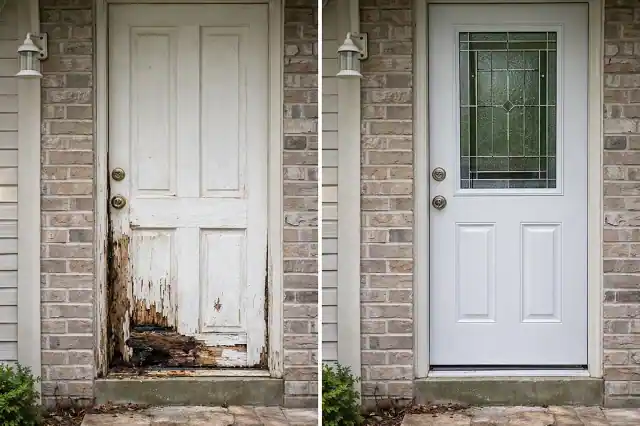
A deteriorated exterior door can create an additional problem for homeowners with mobility limitations or other disabilities. A difficult-to-open door, narrow entryway, damaged threshold, or unsafe hardware can make entering and leaving the home harder.
Some housing rehabilitation and accessibility programs may consider modifications that improve safe access. Requirements vary by program.
For broader assistance options, see our home repair grants for disabled homeowners guide.
Income Requirements for Rotten Exterior Door Assistance
Income limits vary by program. USDA uses applicable county income limits, while local housing rehabilitation programs may use income standards such as Area Median Income.
| Program type | Typical eligibility focus | What varies |
|---|---|---|
| USDA Section 504 | Very-low-income eligible rural homeowners | Income, property, credit, age, and location requirements |
| Weatherization | Eligible low-income households | Income rules and eligible measures |
| CDBG-funded rehabilitation | Households served by local housing programs | Local income limits, funding, and repair priorities |
| Accessibility programs | Eligible homeowners with accessibility needs | Disability and project requirements |
| Disaster assistance | Eligible homeowners affected by qualifying disasters | Disaster declaration, damage, income, and property rules |
How Much Does Rotten Exterior Door Replacement Cost?
The cost depends on the door material, size, frame condition, hardware, labor, accessibility modifications, and the extent of water or structural damage.
| Cost factor | Why it matters |
|---|---|
| Door material | Wood, steel, fiberglass, and specialty doors have different material costs. |
| Frame condition | Rotten jambs, sills, or framing can require additional repair. |
| Labor | Complex openings and structural repairs can increase installation time. |
| Hardware | Locks, handles, closers, and accessibility hardware add to the project cost. |
| Moisture damage | Hidden damage can require additional work before the new door is installed. |
| Energy improvements | Insulation, sealing, and weatherproofing can affect the final project price. |
When applying for assistance, request an itemized estimate rather than submitting only a single total. The estimate should identify the door, labor, removal, disposal, framework, threshold work, weatherproofing, and other necessary repairs.
Housing Cost Statistics and Why Repair Assistance Matters
Unexpected repairs can be difficult for households that already have high housing costs. The U.S. Census Bureau’s American Community Survey tracks housing costs, income, homeownership, and other characteristics used to understand housing conditions across the country.
For 2024, the Census Bureau reported median monthly owner costs of $2,035 for homeowners with a mortgage. This figure includes selected housing expenses and illustrates why an unexpected repair can place additional pressure on a household budget.
Statistics note: Housing-cost statistics describe national conditions and do not determine individual grant eligibility. Eligibility is determined by the rules of the specific assistance program.
How an Inspector May Evaluate a Rotten Exterior Door
An inspection can help determine whether the proposed repair is necessary and whether the requested scope is reasonable.
- Severity of wood deterioration.
- Evidence of water intrusion.
- Condition of the frame and threshold.
- Ability of the door to close and lock.
- Security concerns.
- Accessibility concerns.
- Air leakage or energy-related deficiencies.
- Evidence of hidden damage.
- Whether repair or replacement is the appropriate solution.
Inspection tip: Photograph the entire entryway and explain how the damage affects the home. Clear documentation is more useful than simply stating that the door is old.
How to Apply for Rotten Exterior Door Replacement Assistance
The exact application process depends on the program, but the following steps can help you prepare.
- Document the damage with clear photographs.
- Identify whether the problem involves safety, water intrusion, accessibility, energy loss, or disaster damage.
- Check the program’s income and property requirements.
- Confirm that the property is within the program’s service area.
- Gather proof of ownership and income.
- Obtain an itemized contractor estimate when required.
- Complete any required inspection.
- Wait for written approval before beginning work if the program requires prior approval.
Application warning: Do not assume that submitting an application means you can immediately start the project. Ask the administering agency whether inspection, approval, contractor selection, or written authorization must occur before work begins.
Documents to Prepare
Application checklist
- Government-issued identification.
- Proof of homeownership.
- Recent income documentation.
- Property records when required.
- Photographs of the rotten door and frame.
- Contractor estimates.
- Inspection reports when available.
- Insurance information for disaster-related damage.
- Accessibility documentation when specifically required.
- Copies of previous applications or agency correspondence.
What Can Cause an Application to Be Denied?
A denial does not necessarily mean that no assistance is available. It may mean that the particular program is not the right funding source or that the proposed work does not satisfy its rules.
- Household income exceeds the program limit.
- The property is outside the service area.
- The applicant does not meet ownership or occupancy requirements.
- The damage is considered cosmetic rather than an eligible repair.
- The program does not cover the proposed work.
- Required documents are missing.
- The project estimate is incomplete.
- Funding is currently unavailable.
- Work began before required approval.
- Another source of assistance already covers the same damage.
What to Do After a Denial
Ask the agency why the application was denied and whether the decision can be reconsidered or corrected. If the problem was missing documentation, provide the requested information and ask whether you can reapply.
If the program does not cover exterior door replacement, look for another housing rehabilitation, weatherization, accessibility, emergency repair, nonprofit, or disaster program.
For broader application guidance, see our how to apply for home repair grants guide.
How to Find Door Assistance in Your State
State and local programs may not use the phrase “rotten door replacement grant.” Similar assistance can be described as owner-occupied rehabilitation, housing preservation, emergency home repair, weatherization, accessibility modification, or home improvement assistance.
When searching for local programs, combine your state, county, or city name with terms such as:
- Owner-occupied rehabilitation.
- Housing rehabilitation.
- Home repair program.
- Emergency home repair.
- Weatherization assistance.
- Accessibility modification.
- CDBG housing rehabilitation.
- Home preservation program.
For broader state-level guidance, use our state home repair grants guide.
Emergency Help for a Dangerous Exterior Door
If an exterior door cannot lock, cannot close properly, allows severe water intrusion, or creates an immediate security or safety problem, contact your local housing or emergency repair agency and explain the urgency.
Emergency repair programs may have different eligibility requirements and application procedures from ordinary housing rehabilitation programs.
You can also review our emergency home repair grants guide for additional assistance options.
Safety warning: If the door creates an immediate security or emergency-exit problem, take reasonable steps to protect household members while you pursue assistance. A grant application should not be treated as an emergency safety response.
Frequently Asked Questions About Rotten Exterior Door Replacement Grants
Can I get a free exterior door replacement?
Possibly. Some eligible homeowners may receive grant-funded or fully subsidized repair work through housing rehabilitation, weatherization, accessibility, or other assistance programs. There is no universal federal grant that guarantees a free exterior door to every homeowner.
Does USDA Section 504 cover rotten exterior doors?
A rotten exterior door may qualify when the proposed work addresses an eligible health or safety hazard, and the homeowner and property meet USDA requirements. The administering office determines the eligible scope of work.
Can seniors receive help replacing a rotten door?
Eligible homeowners age 62 or older may qualify for the USDA Section 504 grant component when they satisfy the program’s income, property, rural-area, and other requirements. Other senior repair programs may also be available locally.
Can Weatherization Assistance pay for a new exterior door?
A local weatherization agency may consider door-related work when it is an appropriate energy-efficiency or health-and-safety measure. The agency determines which improvements are eligible.
Can a rotten door frame be included?
A damaged frame may be included when it is part of an eligible repair project. Ask the agency or inspector whether jamb, sill, threshold, and surrounding structural work can be included before finalizing the estimate.
Do renters qualify for exterior door replacement grants?
Many homeowner repair programs require the applicant to own and occupy the property. Renters should contact their landlord or local housing agency about repair responsibilities and available tenant assistance.
How long does approval take?
There is no universal approval period. Processing time depends on the program, funding availability, application volume, inspections, local staffing, and whether the application is complete.
Why This Guide Is Reliable
Last Updated: August 2026
Reviewed By: Home Property Grants Research Team
This guide uses current information from official federal sources, including the U.S. Department of Agriculture, U.S. Department of Energy, U.S. Department of Housing and Urban Development, and U.S. Census Bureau.
Program rules, income limits, funding availability, application periods, and eligible repairs can change. Homeowners should confirm current requirements directly with the agency administering the program before beginning work.
Conclusion
A rotten exterior door can become a legitimate home repair concern when deterioration affects safety, security, structural condition, accessibility, water protection, or energy performance.
For eligible rural homeowners, the USDA Section 504 Home Repair Program is an important program to investigate. Low-income households should also check the Weatherization Assistance Program when energy efficiency or health and safety is involved. Homeowners in cities and counties should investigate locally administered housing rehabilitation programs, including programs supported by HUD funding.
The best approach is to document the damage, identify the program that matches the problem, verify income and property eligibility, obtain a detailed estimate, and confirm whether approval is required before starting the work.

Arthur Pendelton is a senior housing policy researcher and public welfare analyst with over eight years of experience tracking federal, state, and non-profit residential repair programs. He specializes in statutory grant frameworks, including USDA Section 504 Rural Housing, the Department of Energy’s Weatherization Assistance Program (WAP), and municipal HUD Community Development Block Grants (CDBG). Arthur systematically audits Federal Register publications and Title 7/42 CFR regulatory updates to provide low-income homeowners, seniors, and military veterans with accurate, barrier-free application guidance.