
Hispanic homeowners in Connecticut may qualify for roof repair or replacement assistance in 2026 through federal housing programs, Connecticut housing rehabilitation programs, municipal initiatives, state-supported rehabilitation financing, weatherization services, and nonprofit organizations. Most of these programs do not make Hispanic ethnicity a separate eligibility requirement. Instead, they generally consider household income, homeownership, property location, roof condition, age, disability, and documented health or safety needs.
There is no single Connecticut program that guarantees a free roof replacement to every Hispanic homeowner. The best option depends on the homeowner’s circumstances, the condition of the roof, where the property is located, and the requirements of the available program.
Featured Snippet: Can Hispanic homeowners get roof replacement grants in Connecticut in 2026?
Hispanic homeowners in Connecticut may qualify for roof replacement assistance through USDA Section 504, Connecticut CDBG-funded housing rehabilitation, CT Home Funds, municipal programs, and nonprofit organizations. Eligibility is generally based on income, homeownership, property location, roof condition, age, disability, and health or safety needs rather than Hispanic ethnicity alone.
For the broader national overview, see our Roof Repair and Roof Replacement Grants for Homeowners 2026 guide.
Connecticut Roof Replacement Assistance Programs in 2026
Connecticut homeowners should view roof assistance as several different funding pathways rather than one universal grant. Some programs provide grants, while others provide loans, forgivable assistance, rehabilitation financing, or specific repair services.
| Program or Funding Source | Potentially Best For | Roof-Related Assistance |
|---|---|---|
| USDA Section 504 | Very-low-income homeowners in eligible rural areas | Eligible repairs involving health and safety hazards |
| Connecticut CDBG Small Cities | Eligible low- and moderate-income households through participating municipalities | Housing rehabilitation and eligible critical repairs |
| Connecticut Home Improvement Program | Eligible Connecticut homeowners needing rehabilitation financing | Qualifying roof repair and replacement work |
| Time To Own Rehabilitation | Eligible homeowners who previously received Time To Own assistance | Forgivable rehabilitation assistance that can include a new roof |
| Weatherization Assistance Program | Eligible low-income households | Energy-efficiency and eligible health and safety measures; not routine roof replacement |
| Municipal housing rehabilitation | Homeowners in participating communities | Critical repairs and rehabilitation |
| Nonprofit organizations | Homeowners meeting individual organization requirements | Repair assistance, labor, materials, referrals, or other support |
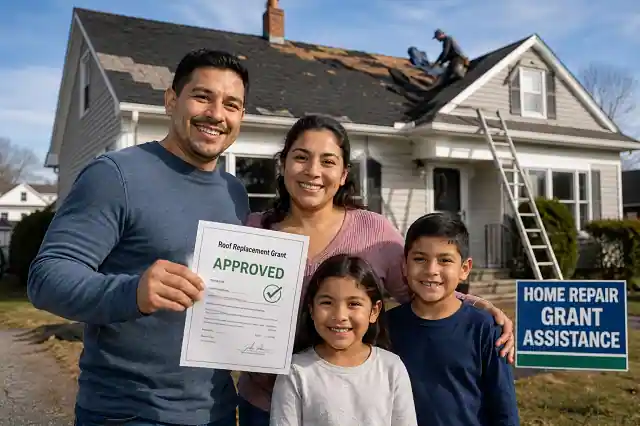
Do Hispanic Homeowners Qualify for Connecticut Roof Replacement Grants?
Hispanic ethnicity by itself generally does not qualify a homeowner for a separate Connecticut roof replacement grant.
Most programs use factors such as household income, homeownership, property location, age, disability, housing condition, and health or safety needs. A Hispanic homeowner therefore generally applies under the same program rules as another homeowner with similar financial and housing circumstances.
Hispanic homeowners may, however, benefit from Spanish-language information, bilingual housing counseling, community organizations, and local housing counselors. These resources can make it easier to understand program requirements and complete applications correctly.
The important distinction is that Hispanic homeowners are the audience for this guide, while the actual eligibility for roof assistance comes from the requirements of the individual program.
For broader demographic assistance, our Hispanic homeowner assistance resource provides related information, but this article remains focused specifically on Connecticut roof replacement.
What Roof Problems May Support an Assistance Application?
A deteriorating roof can allow water into the home and create additional structural, health, and safety problems. Connecticut homeowners also face snow, ice, freezing temperatures, heavy rain, wind, and seasonal storms.
Common problems that may require professional evaluation include:
- Active roof leaks.
- Missing or damaged shingles.
- Damaged flashing.
- Rotting roof decking.
- Moisture damage.
- Structural deterioration.
- Storm damage.
- Unsafe roofing conditions.
A homeowner should determine whether the property needs a repair or complete replacement before applying. A limited leak may require a repair, while widespread deterioration may justify replacement.
If the problem is a smaller leak rather than a complete roof failure, see our roof leak repair assistance guide.
Homeowners should also obtain photographs, an inspection when appropriate, and a written estimate describing the proposed roofing work.
USDA Section 504 Roof Repair and Replacement Assistance
The U.S. Department of Agriculture Rural Development (USDA) Section 504 Home Repair program is one of the most important federal options for qualifying rural homeowners.
Section 504 is not a Hispanic-specific program. Hispanic homeowners must meet the same USDA eligibility requirements as other applicants.
Who May Qualify for USDA Section 504?
Applicants generally must own and occupy the home, live in an eligible rural area, meet the applicable income requirements, and satisfy other USDA conditions.
Section 504 grants generally target homeowners age 62 or older who cannot afford to repair or remove health and safety hazards. Loans may be available to eligible homeowners who need repairs or improvements but do not qualify for a grant.
How Much Can Section 504 Provide?
| Assistance Type | Standard Maximum |
|---|---|
| Section 504 loan | Up to $40,000 |
| Section 504 grant | Up to $10,000 |
| Combined loan and grant | Up to $50,000 |
USDA currently lists loans of up to $40,000 and grants of up to $10,000 under the standard Section 504 program. Special disaster-related rules may apply in qualifying situations.
Can USDA Section 504 Help With a Roof?
A roof project may qualify when the proposed work fits the program’s eligible repair purposes, including correction of a health or safety hazard. Homeowners should not assume that every roof replacement will qualify.
USDA evaluates the homeowner, property, proposed work, and applicable program requirements before assistance is approved.
For another roof-specific explanation of Section 504 and safety-related repairs, see our USDA Section 504 roof safety assistance guide.
Homeowners with limited income can also review our roof replacement grants for low-income homeowners guide.
Connecticut CDBG Housing Rehabilitation for Roof Replacement
The Connecticut Community Development Block Grant (CDBG) Small Cities Program provides funding and technical support for eligible community and economic development activities. The program principally benefits low- and moderate-income residents and is available to eligible Connecticut municipalities.
The Connecticut Department of Housing (DOH) administers the Connecticut CDBG Small Cities Program using funding from the U.S. Department of Housing and Urban Development (HUD).
Homeowners generally do not request an individual roof grant directly from HUD. Instead, they should determine whether their city or town operates a CDBG-funded housing rehabilitation program.
Can CDBG Support Roof Work?
Housing rehabilitation is an eligible CDBG activity when the project meets the applicable program requirements and national objectives. The exact repairs available to a homeowner depend on the local program and approved project scope.
Connecticut announced $10.7 million in 2026 CDBG Small Cities grants to five municipalities for projects intended to modernize and rehabilitate housing and improve local infrastructure.
How to Find a Local CDBG Roof Program
Contact the housing, community development, or economic development office in the city or town where the property is located. Ask whether an owner-occupied housing rehabilitation program is accepting applications and whether roof repair or replacement is an eligible expense.
For broader state and federal roof assistance, see our federal and state roof replacement grants guide.
CT Home Funds for Roof Repair and Replacement
Connecticut’s CT Home Funds provide another pathway for homeowners who need housing rehabilitation assistance.
Connecticut Home Improvement Program
The Connecticut Home Improvement Program provides rehabilitation financing for eligible Connecticut homeowners. Qualifying rehabilitation can include roof repair and replacement, subject to current program requirements.
This is not a universal free-roof grant. Homeowners should review the current income, property, financing, contractor, and other requirements before applying.
Time To Own Rehabilitation Program
The Time To Own Rehabilitation Program is designed for eligible homeowners who previously received assistance through Connecticut’s Time To Own homeownership program.
The program can provide forgivable rehabilitation assistance for qualifying repairs, and a new roof can be an eligible improvement under the applicable program rules.
Homeowners who want to compare other national roof-replacement pathways can also review our roof replacement grants guide.
Connecticut Weatherization Assistance and Roof Repairs
The Weatherization Assistance Program (WAP) can help eligible low-income households improve energy efficiency and address eligible health and safety issues. It should not be presented as a standard roof replacement grant.
Connecticut currently uses 60% of State Median Income as the WAP income threshold and gives priority to vulnerable households, including older adults, people with disabilities, families with children, and high-energy users.
The Connecticut Department of Energy and Environmental Protection (DEEP) states that WAP services are delivered through Community Action Agencies and local nonprofit organizations.
Does WAP Pay for a Complete Roof Replacement?
No. Connecticut’s weatherization barrier-remediation program identifies certain energy-related roof repairs that may be considered with pre-approval but specifically distinguishes those repairs from complete roof replacement.
Therefore, a homeowner with an old or failing roof should pursue a roof-specific rehabilitation or assistance program rather than assuming WAP will pay for a new roof.
If a roof leak has affected insulation, our home insulation assistance after roof leaks guide may provide useful related information.
Homeowners can also review our attic insulation assistance resource when an eligible energy-efficiency project is part of the repair plan.
Emergency and Storm-Damaged Roof Assistance
A severely leaking or storm-damaged roof may require immediate attention. Emergency situations can include major leaks, fallen-tree damage, structural damage, and conditions that create a health or safety hazard.
When a roof is damaged by a storm, homeowners should photograph the damage, contact their insurer when applicable, and retain inspection reports, estimates, invoices, and receipts for temporary work.
For temporary protection after severe storm damage, see our emergency roof tarp grants guide.
Homeowners dealing with older properties can also review our weatherproofing grants for older homes resource when the work fits the program’s eligibility requirements.
Local and Nonprofit Roof Replacement Assistance
Local housing organizations and nonprofits may help when government assistance does not cover the entire roofing project.
Potential sources include:
- Habitat for Humanity affiliates.
- NeighborWorks organizations.
- Community Action Agencies.
- Local housing nonprofits.
- Community development organizations.
- Faith-based organizations.
Not every nonprofit provides direct roof replacement grants. Some organizations may provide labor, materials, rehabilitation services, referrals, counseling, or application assistance.
Homeowners should ask whether an organization currently serves their Connecticut community and whether roof repair or replacement is included in its current programs.
Who Qualifies for Connecticut Roof Replacement Assistance?
Each program has its own eligibility rules, but common factors include:
- Household income.
- Homeownership.
- Primary residence occupancy.
- Property location.
- Age.
- Disability status.
- Veteran status where specifically relevant.
- Severity of the roof problem.
- Health and safety concerns.
- Available program funding.
Hispanic ethnicity generally does not replace these requirements. Hispanic homeowners should identify programs that fit their actual financial and housing circumstances and use Spanish-language or bilingual resources when available.
Age can matter for certain roof assistance programs. Homeowners can compare related eligibility information in our roof replacement grants for seniors guide.
Disability can also affect eligibility for some housing assistance programs. See our roof replacement grants for disabled homeowners guide for related information.
Veterans may have additional housing assistance pathways in certain circumstances. Our roof replacement grants for veterans guide covers those options separately.
Documents Needed for Connecticut Roof Assistance
Preparing documentation before applying can make the process easier.
- Proof of homeownership.
- Proof of household income.
- Property tax information.
- Home insurance information.
- Roof inspection report.
- Photographs of roof damage.
- Written contractor estimate.
- Medical or disability documentation when relevant.
- Disaster documentation when relevant.
- Other documents required by the specific program.
Program requirements vary, so applicants should request the current document checklist from the agency or organization handling the application.
How to Apply for Connecticut Roof Replacement Assistance
- Document the roof condition. Take clear photographs and arrange an inspection when necessary.
- Determine whether repair or replacement is needed. A qualified contractor or inspector can help identify the appropriate scope of work.
- Check rural eligibility. If the property is rural and the household has very low income, investigate USDA Section 504.
- Check local housing rehabilitation. Contact the city or town about CDBG-funded or other housing rehabilitation programs.
- Check CT Home Funds. Determine whether the Connecticut Home Improvement Program or Time To Own Rehabilitation Program applies.
- Check weatherization when appropriate. Contact the local provider if the project includes qualifying energy-efficiency needs.
- Contact nonprofit organizations. Ask about current roof repair, rehabilitation, labor, material, or referral assistance.
- Gather documentation. Organize ownership, income, property, insurance, inspection, and contractor information.
- Submit the application. Follow the specific program’s application and inspection process.
- Wait for approval before starting work when required. Some programs will not cover work that began before authorization.
- Keep all records. Save applications, estimates, approval letters, contracts, invoices, and receipts.
Important: Do not begin a major roof replacement simply because you expect assistance. Confirm the program’s approval and construction requirements first.
Connecticut Roof Replacement Assistance by Homeowner Situation
| Homeowner Situation | Best Starting Point |
|---|---|
| Very-low-income homeowner in an eligible rural area | USDA Section 504 |
| Low- or moderate-income homeowner in a participating municipality | Local CDBG or housing rehabilitation program |
| Connecticut homeowner needing rehabilitation financing | Connecticut Home Improvement Program |
| Previous Time To Own recipient needing a new roof | Time To Own Rehabilitation Program |
| Low-income household with qualifying weatherization needs | Weatherization Assistance Program |
| Storm-damaged roof | Insurance and applicable disaster assistance |
| Funding gap after government assistance | Local nonprofit and community resources |
Can Connecticut Roof Assistance Programs Be Combined?
Sometimes. Different programs may be able to address different eligible parts of a project, but homeowners must follow the rules of every funding source involved.
For example, a rehabilitation program could potentially address eligible roof work while another program handles a separate qualifying energy-efficiency measure.
Do not assume that the same roofing expense can be submitted to multiple programs. Disclose other assistance when required and ask each administrator whether funding can be combined.
What If Your Roof Assistance Application Is Denied?
A denial from one program does not necessarily mean that every roof assistance option is unavailable.
First, determine why the application was denied. Common reasons include:
- Income above the program limit.
- Property outside the eligible area.
- Roof work not covered by the program.
- Missing documentation.
- Insufficient evidence of the repair need.
- Funding being unavailable.
- Work beginning before approval.
After identifying the reason, look for another program whose eligibility and purpose better match the property and roof problem.
Frequently Asked Questions About Connecticut Roof Replacement Grants
Can Hispanic homeowners receive special roof replacement grants in Connecticut?
Hispanic ethnicity alone generally does not create a separate statewide roof replacement grant. Hispanic homeowners may qualify for federal, state, municipal, and nonprofit programs under the applicable income, property, repair, and other eligibility requirements.
Does Connecticut have roof replacement grants in 2026?
Connecticut has several funding pathways that may support eligible roof repair or replacement, including municipal housing rehabilitation, CT Home Funds, USDA Section 504 for eligible rural homeowners, and nonprofit assistance. Not every program is a grant, and availability varies.
Can USDA Section 504 help replace a roof?
A roof project may qualify when it meets USDA’s eligible repair purposes, including correction of a health or safety hazard. The homeowner and property must meet USDA requirements, and USDA determines whether the proposed work is eligible.
How much can USDA Section 504 provide?
The standard Section 504 program currently lists loans of up to $40,000 and grants of up to $10,000 for qualifying applicants. Special disaster-related rules may apply in eligible areas.
Can Connecticut CDBG funds pay for a new roof?
CDBG funding can support eligible housing rehabilitation through participating Connecticut municipalities. Whether a homeowner receives roof assistance depends on the local program, eligibility requirements, available funding, and approved scope of work.
Can CT Home Funds help with roof replacement?
Yes. Eligible CT Home rehabilitation assistance can support qualifying roof work, subject to the applicable program rules. The Time To Own Rehabilitation Program can also include a new roof for eligible homeowners who previously received Time To Own assistance.
Does Connecticut Weatherization Assistance replace roofs?
No. WAP is primarily designed for energy-efficiency and eligible health and safety measures. Connecticut’s current weatherization barrier program allows certain energy-related roof repairs with pre-approval but does not cover complete roof replacements.
Can I apply for more than one Connecticut roof assistance program?
You can investigate multiple programs, but each has its own rules. Disclose other assistance when required and confirm that the same roofing expense is not being funded twice.
How long does roof assistance take in Connecticut?
There is no single statewide processing time. Timing can depend on the program, inspections, documentation, available funding, contractor requirements, and whether the project is an emergency.
Why This Guide Is Reliable
Last Updated: August 2026
Reviewed By: HomePropertyGrants Housing Assistance Research Team
- Connecticut roof assistance programs are separated from broader national home repair programs.
- Hispanic ethnicity is not presented as an automatic eligibility category where official program rules do not establish one.
- USDA Section 504 is presented as a rural housing repair program rather than a Hispanic-specific grant.
- Connecticut CDBG assistance is explained as a municipal housing rehabilitation pathway rather than a guaranteed direct homeowner grant.
- CT Home Funds are distinguished from traditional grants because applicable assistance can be structured as rehabilitation financing or forgivable assistance.
- Weatherization is not presented as an automatic roof replacement program.
- Applicants are encouraged to confirm current eligibility, funding, and construction requirements with the administering organization before beginning work.
Conclusion
Hispanic homeowners in Connecticut may have several ways to reduce the cost of a necessary roof repair or replacement in 2026, but there is no universal roof replacement grant based solely on Hispanic ethnicity.
The strongest starting point depends on the homeowner’s circumstances. Very-low-income rural homeowners should investigate USDA Section 504. Homeowners in participating municipalities should ask about CDBG-funded housing rehabilitation. Connecticut homeowners should also investigate CT Home Funds, particularly applicable rehabilitation financing and the Time To Own Rehabilitation Program when eligible.
Weatherization can help eligible households with qualifying energy-efficiency and health-and-safety measures, but it should not be treated as a guaranteed roof replacement program. Homeowners with storm-damaged roofs should also check insurance and applicable disaster assistance.
The most effective approach is to document the roof condition, identify the program that matches the property and repair need, gather the required records, obtain a detailed roofing estimate, and secure approval before work begins when prior authorization is required.
For Hispanic homeowners, the strongest strategy is to search according to income, homeownership, property location, roof condition, age, disability, and program eligibility while using Spanish-language or bilingual resources when available.