
Exterior home improvements can protect a house from weather, moisture, structural damage, and safety hazards, but the cost can be difficult for many homeowners to afford. Depending on location, income, property type, and the reason for the repair, homeowners may find help through federal programs, state and local housing rehabilitation programs, weatherization services, disaster assistance, nonprofit organizations, and other housing resources.
This article focuses specifically on exterior home improvements rather than repeating the broader information in our Home Repair Grants 2026: Complete Guide to Free Home Repair Assistance. It covers siding, exterior walls, porches, decks, doors, entryways, accessibility improvements, weatherproofing, and disaster-related exterior repairs.
Important: There is no single nationwide government application for “free exterior home improvement grants.” Programs have different rules, funding limits, property requirements, and application procedures. Some programs provide grants, while others provide loans, tax benefits, or direct repair services.
Free Grants for Exterior Home Improvements in 2026
Exterior home improvement grants are financial assistance programs that may help eligible homeowners pay for necessary repairs or improvements to the outside of their homes. Depending on the program, assistance may address safety hazards, structural problems, accessibility barriers, energy efficiency, weatherization, or disaster damage.
Common exterior projects include siding repairs, exterior wall repairs, porch and deck repairs, exterior doors, ramps, railings, walkways, insulation, air sealing, and other work needed to keep a home safe and weather-resistant.
Featured answer:
Exterior home improvement grants in 2026 may help eligible homeowners pay for necessary repairs such as damaged siding, unsafe porches, exterior structural problems, accessibility modifications, weatherization, and disaster-related damage. Funding can come through USDA, HUD-funded local programs, DOE weatherization providers, FEMA disaster assistance, state agencies, local governments, and nonprofits.
If your repair involves more than the exterior of your property, our broader Home Repair Grants 2026 guide covers additional repair categories and assistance options.
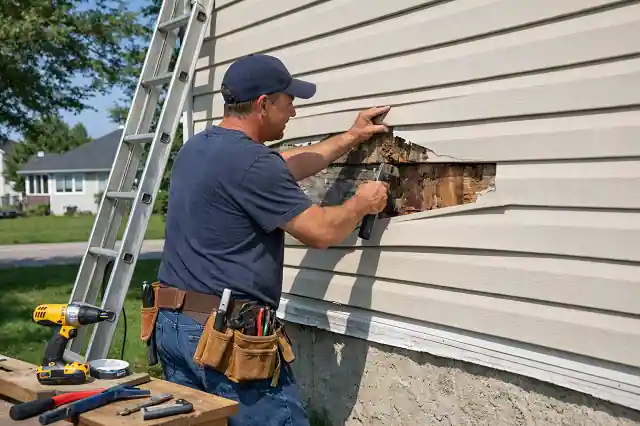
What Exterior Home Improvements Can Grants Cover?
Eligibility depends on the specific program. A repair that qualifies under one local housing rehabilitation program may not qualify under another. In general, programs are more likely to prioritize work connected to health, safety, structural stability, accessibility, energy efficiency, or disaster recovery than cosmetic remodeling.
Siding Replacement and Exterior Wall Repairs
Damaged siding can allow water and air to reach the underlying wall system. Loose, cracked, rotted, or missing siding may therefore be treated differently from a simple cosmetic request.
Potentially eligible work may include repairing damaged siding, replacing deteriorated exterior materials, correcting moisture problems, or repairing structural components behind the siding when those repairs are necessary under the program’s rules.
Homeowners looking specifically for replacement assistance can also review our window replacement assistance for low-income homeowners when windows and exterior wall problems are connected.
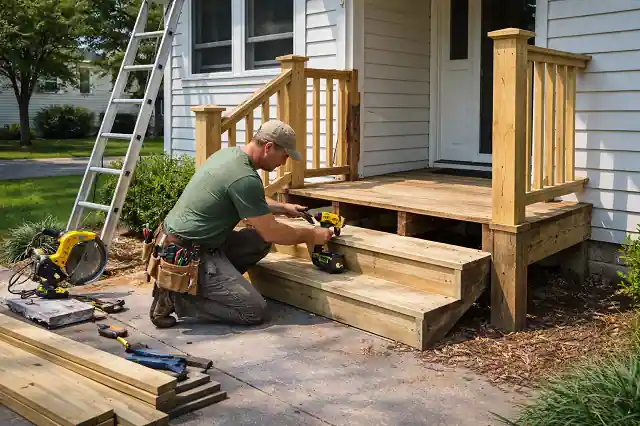
Porch, Deck, and Exterior Stair Repairs
Porches, decks, steps, railings, and entry platforms can become safety hazards when wood rots, supports weaken, or stairs become unstable.
Some housing rehabilitation programs may prioritize these repairs when they are necessary to keep the home safe or accessible. A local program may require an inspection before approving the work.
For a more focused resource, see our article on deck repair and home safety assistance.
Exterior Door Replacement
Exterior doors can affect security, weather resistance, accessibility, and energy performance. A door that is badly damaged, unsafe, difficult to operate, or no longer protects the home from weather may receive more favorable consideration than a purely decorative upgrade.
Homeowners dealing with rotting frames can also review our resource on rotten exterior door replacement assistance.
For low-income households dealing with air leakage around an entry door, our article on drafty front door replacement assistance provides another relevant starting point.
Exterior Accessibility Improvements
Accessibility work can include exterior ramps, handrails, safer steps, improved entryways, accessible pathways, and other modifications that help a homeowner enter and leave the property safely.
Some programs give priority to older adults or people with disabilities, particularly when the work is needed to remove a health or safety barrier.
Homeowners with broader accessibility needs can also review our home repair assistance for disabled homeowners.
Weatherproofing and Energy-Efficiency Improvements
Weatherproofing can involve measures that reduce air leakage, moisture intrusion, or heat loss. Depending on the program, eligible work may include insulation, air sealing, weatherstripping, and other energy-efficiency measures.
For older homes, see our resource on weatherproofing assistance and home insulation.
Attic and building-envelope work may also connect to weatherization programs. Our attic insulation assistance resource covers that narrower repair category.
Storm and Disaster-Related Exterior Repairs
Exterior damage caused by a declared disaster can follow a different assistance path from ordinary maintenance. Depending on the disaster and the program, assistance may address necessary repairs to an owner-occupied primary residence when the damage was caused by the disaster and other eligibility requirements are met.
For major flooding, wind, or storm-related damage, homeowners should also investigate home elevation assistance where elevation is an appropriate mitigation strategy.
Why Exterior Repairs Matter for Older Homes
Exterior repair needs are not limited to a small group of homeowners. The U.S. housing stock is relatively old, which means many properties have exterior components that have been exposed to decades of weather.
According to the U.S. Census Bureau’s 2023 American Community Survey, the median year a U.S. housing structure was built was 1981. The median year for owner-occupied housing was even earlier in the detailed tenure data. The Census Bureau also reports more than 142 million housing units in the 2023 5-year estimates, with roughly 71.9 million built before 1980. That works out to about 50.5% of the housing stock represented in that table.
Source: U.S. Census Bureau American Community Survey (ACS).
Housing-stock statistic
The 2023 Census data show that about half of the nation’s housing units were built before 1980. Older housing does not automatically qualify for assistance, but age can help explain why siding, roofs, windows, doors, foundations, porches, and insulation are common repair concerns.
When exterior problems are ignored, a small defect can sometimes become a much larger repair. Homeowners who are already dealing with expensive repair needs can review statistics and assistance related to delayed home repairs.
Who Qualifies for Exterior Home Improvement Grants?
There is no universal eligibility test. Each program establishes its own rules. Common factors include household income, homeownership, occupancy, property location, rural eligibility, age, disability, veteran status, disaster damage, and whether the repair is necessary.
Low-Income Homeowners
Income-based housing programs often give priority to households with lower incomes. Some use local income limits, Area Median Income standards, federal poverty guidelines, or program-specific definitions.
For broader income-based assistance, see our resource on home repair grants for low-income families.
Seniors and Older Homeowners
Older homeowners may qualify for programs that prioritize health and safety repairs. USDA Section 504 is one important example because its grant component is specifically for eligible very-low-income homeowners who are age 62 or older and need assistance removing health and safety hazards.
See our dedicated resource on home repair assistance for seniors for additional options.
Veterans and Military Families
Veterans may qualify for certain housing or accessibility programs based on disability, service-connected needs, income, property requirements, or the specific purpose of the repair.
For additional veteran-focused resources, see federal and state home repair assistance for veterans.
Rural Homeowners
Rural homeowners may have access to USDA Rural Development programs and local housing rehabilitation programs. USDA’s Section 504 program is particularly important because rural eligibility is one of its requirements.
See our resource on home repair grants for rural homeowners for additional rural assistance options.
Homeowners With Disaster Damage
Disaster-related eligibility is different from ordinary home improvement eligibility. FEMA assistance generally requires a qualifying declared disaster and disaster-caused needs, and FEMA determines the appropriate assistance based on the circumstances.
Warning: Do not assume that being low-income, elderly, disabled, a veteran, or a rural homeowner automatically qualifies you for a grant. These characteristics may help you meet a program’s eligibility criteria, but the repair, property, income, location, funding availability, and other requirements still apply.
Best Programs That May Help Pay for Exterior Home Improvements
The most important improvement to this article is understanding what each program actually does. Some federal programs fund local governments rather than giving a direct check to homeowners. Others provide services rather than cash grants. Disaster assistance has separate rules.
| Program or resource | Type of help | Exterior-repair relevance | Important limitation |
| USDA Section 504 Home Repair Program | Loans and grants | Health and safety repairs for eligible rural homeowners | Grant component is for eligible homeowners age 62+ and is limited to removing health and safety hazards |
| HUD Community Development Block Grant | Local housing and community-development funding | Can support residential rehabilitation through participating communities | No single nationwide homeowner grant amount |
| DOE Weatherization Assistance Program | Weatherization services | Energy-efficiency and health-and-safety improvements | Administered through states, tribes, territories, and local providers |
| FEMA Individuals and Households Program | Disaster housing assistance | May help with eligible disaster-damaged home repairs | Requires qualifying disaster-related circumstances and other eligibility requirements |
| HUD HOME Investment Partnerships Program | Funding to states and local jurisdictions | Can support affordable housing rehabilitation | Local governments decide how HOME funds are used within program rules |
| USDA Single-Family Housing Disaster Assistance Fund | Disaster-related grants | May help eligible homeowners with disaster-related repair expenses | Available only in eligible disaster areas and subject to funding availability |
USDA Section 504 Home Repair Program
The U.S. Department of Agriculture Single Family Housing Repair Loans and Grants Program (Section 504) is one of the clearest federal options for eligible rural homeowners.
USDA states that the program provides loans to very-low-income homeowners to repair, improve, or modernize homes. Grants are available to eligible elderly homeowners for removing health and safety hazards.
The current USDA program information lists a maximum loan of $40,000 and a maximum grant of $10,000. USDA also states that the maximum grant can be $15,000 when repairing a home damaged in a presidentially declared disaster area.
Section 504 facts
- The homeowner must occupy the property.
- The household must meet USDA’s very-low-income requirements.
- The property must be in an eligible rural area.
- The applicant must be unable to obtain affordable credit elsewhere.
- The grant component is for eligible homeowners age 62 or older.
- Grant funds must address health and safety hazards.
That means a senior homeowner with a dangerous exterior staircase or another qualifying safety problem may have a stronger case than someone seeking a purely cosmetic siding upgrade.
HUD Community Development Block Grant Program
The U.S. Department of Housing and Urban Development Community Development Block Grant Program (CDBG) is not a single nationwide homeowner grant. HUD provides CDBG funding to eligible communities and states, and those jurisdictions establish programs and priorities within federal rules.
HUD identifies rehabilitation of residential structures as an eligible CDBG activity. Local programs may therefore use CDBG funding for housing rehabilitation, including certain exterior repairs.
Do not use a nationwide “typical CDBG grant” figure. Local CDBG-funded repair programs can have different income limits, eligible repairs, grant or loan structures, assistance caps, deferred-payment rules, liens, and application procedures. Always check the local administrator for the current terms.
Homeowners looking for HUD-related assistance can also review our HUD home improvement assistance resource.
Weatherization Assistance Program
The U.S. Department of Energy Weatherization Assistance Program (WAP) is designed to reduce energy costs and improve health and safety for low-income households.
WAP is especially relevant when the exterior project is connected to energy efficiency, air leakage, insulation, or weatherization. However, it should not be described as a general cash grant for replacing siding or remodeling a home’s exterior.
DOE says WAP is administered at the state and local level. Eligible households may receive weatherization services through local providers rather than receiving a direct cash payment.
DOE reports that WAP provides weatherization services to approximately 32,000 homes each year using DOE funds and that participating households save an average of $372 or more annually according to a national evaluation.
Source: U.S. Department of Energy Weatherization Assistance Program (WAP statistics).
How WAP applications work
DOE says households should identify their state weatherization administrator, locate the local provider, and complete the provider’s application process. Under DOE guidelines, households at or below 200% of the federal poverty guidelines or households receiving Supplemental Security Income are considered eligible, although states and territories may use other permitted eligibility criteria.
For current application instructions, see the U.S. Department of Energy Weatherization Assistance Program application page (WAP application instructions).
FEMA Disaster Assistance
The Federal Emergency Management Agency Individuals and Households Program (IHP) can provide assistance to eligible individuals and households affected by a declared disaster.
FEMA’s current policy explains that Home Repair Assistance can apply when a FEMA inspection determines that the repair is necessary for the health or safety of occupants or to make the component or residence functional, and the damage was caused by the disaster.
For exterior work, the important point is not whether an item is simply “outside.” The key questions are whether the component was functional before the disaster, whether the disaster caused the damage, whether the repair is necessary, and whether other sources such as insurance cover the loss.
FEMA’s official materials also recognize certain accessibility needs, including repairs such as exterior ramps and paved paths in qualifying circumstances.
FEMA warning: FEMA is not a general exterior remodeling grant. It is disaster assistance. A homeowner normally needs a qualifying disaster, an affected primary residence, disaster-caused damage, and other required eligibility conditions.
HUD HOME Investment Partnerships Program
The U.S. Department of Housing and Urban Development HOME Investment Partnerships Program (HOME) provides formula grants to states and localities. Participating jurisdictions can use HOME funds for affordable housing activities, including rehabilitation of housing.
HOME is therefore useful when researching local or state housing rehabilitation programs, but homeowners should not assume they can apply directly to HUD for a standard exterior repair grant.
Local jurisdictions may structure assistance as grants, loans, loan guarantees, or other permitted forms of assistance. The local program determines the actual homeowner requirements.
USDA Single-Family Housing Disaster Assistance Fund
The USDA Single-Family Housing Disaster Assistance Fund (Disaster Assistance Fund) is another program worth checking in eligible disaster areas.
USDA currently lists disaster-related home repair expenses as an eligible use and lists a maximum grant of $32,420, subject to program eligibility and funding availability. The program is separate from the ordinary Section 504 grant.
Because disaster programs change based on designated areas and available funding, homeowners should verify eligibility with USDA Rural Development before relying on a published amount.
Exterior Home Improvement Grants by State and Local Area
Local programs are especially important because many actual homeowner repair grants are administered at the city, county, state, or community level.
| Where to search | What to look for | Why it matters |
| State housing agency | Housing rehabilitation, homeowner repair, emergency repair, accessibility programs | State programs may serve areas not covered by a federal direct program |
| City housing department | Owner-occupied rehabilitation, exterior repair, code correction, accessibility programs | Local governments may administer CDBG or HOME-funded activities |
| County housing or community development office | Home repair, rehabilitation, disaster recovery, weatherization | County-level programs can differ from city programs |
| USDA Rural Development | Section 504 and other rural housing assistance | Important for eligible rural homeowners |
| Local weatherization provider | Insulation, air sealing, energy-efficiency and health-and-safety work | WAP is delivered through state and local providers |
| Nonprofit housing organizations | Critical repairs, volunteer labor, materials, accessibility work | Some assistance is provided outside government grant programs |
Our state home repair grants resource can help you identify the types of programs to investigate in your state.
You can also use our resource for finding local and less-publicized home repair programs when a basic state search does not produce a useful result.
How Much Can Exterior Home Improvement Assistance Pay?
There is no reliable nationwide grant amount for exterior home improvements. The amount depends on the program, the type of repair, the homeowner’s eligibility, the cost of the work, local funding, and whether assistance is structured as a grant, loan, deferred loan, reimbursement, or direct service.
| Program | Current official amount or funding structure | What homeowners should understand |
| USDA Section 504 | Up to $10,000 grant; up to $40,000 loan | Grant is for eligible elderly very-low-income homeowners and health/safety hazards; rural eligibility applies |
| USDA Section 504 disaster grant | Up to $15,000 in qualifying presidentially declared disaster circumstances | Special disaster rule; eligibility still applies |
| USDA Disaster Assistance Fund | Maximum grant currently listed at $32,420 | Only for eligible disaster areas and subject to funding availability |
| CDBG-funded local programs | Varies by community | HUD does not establish one nationwide homeowner grant amount |
| HOME-funded local programs | Varies by participating jurisdiction and assistance structure | May be delivered through grants, loans, or other permitted assistance |
| WAP | Service-based assistance | Homeowners generally receive approved weatherization work rather than a direct cash grant |
| FEMA IHP | Determined under disaster-specific rules | Assistance depends on eligible disaster-caused needs and other factors |
Do not assume that a large advertised amount is available to every homeowner. A program may have a maximum award but still approve less based on eligible costs, income, repair scope, property rules, or available funding.
For homeowners trying to build a realistic repair budget, our article on how a $10,000 home repair project can be funded provides a useful budgeting framework.
How to Apply for Exterior Home Improvement Grants
The best application strategy is to identify the repair first, then find programs that specifically allow that type of work. Do not start by applying randomly to every program that uses the word “grant.”
Identify the Exact Exterior Problem
Write down the problem in specific terms. For example, “rotted porch steps creating a fall hazard” is more useful than “I need exterior remodeling.”
Take photographs and, when appropriate, obtain a contractor estimate or inspection report.
Check Your Eligibility
Review income, ownership, occupancy, location, rural eligibility, age, disability, veteran status, and disaster status.
Search Federal, State, and Local Programs
Start with the program administrator rather than a third-party advertisement. Our home repair program finder can also help organize your search.
Contact the Program Before Starting Work
Many programs require an inspection, approval, written authorization, or contractor process before work begins. Starting a project first can make assistance more difficult or impossible to obtain.
Gather Your Documents
Keep ownership, income, identification, property, insurance, repair, and disaster documents together.
Submit the Application
Follow the administrator’s instructions exactly. If a program uses a local agency, submit the application to that agency rather than assuming HUD, USDA, DOE, or FEMA will process every homeowner application directly.
Keep Copies and Track the Application
Save the application, supporting documents, estimates, photographs, inspection reports, emails, and approval letters.
Application checklist
- ☐ Identify the exact exterior repair needed
- ☐ Take clear photos of the damage or safety problem
- ☐ Confirm that you own and occupy the home if required
- ☐ Check income and property eligibility
- ☐ Confirm rural or disaster eligibility when applicable
- ☐ Contact the program before beginning work
- ☐ Gather proof of income and ownership
- ☐ Obtain estimates or inspections when required
- ☐ Submit the complete application
- ☐ Keep copies of everything submitted
For additional application advice, see how to apply for home repair grants without getting rejected.
Documents You May Need to Apply
| Document | Why it may be requested |
| Proof of homeownership | Confirms that the applicant owns the property |
| Government-issued identification | Confirms applicant identity |
| Income documentation | Determines whether the household meets program income limits |
| Property tax or assessment records | Helps verify property information |
| Repair estimates | Shows the expected cost and scope of work |
| Photographs | Documents the exterior condition or damage |
| Insurance information | Important for disaster-related assistance and duplication-of-benefits checks |
| Disaster documentation | May be required for disaster-related programs |
| Contractor information | May be required when the program uses approved contractors |
How to Find Exterior Home Improvement Grants Near You
Local research is often more valuable than searching for a generic “free exterior grant.” Start with the agencies that actually administer housing programs in your area.
Check Your State Housing Agency
Look for homeowner rehabilitation, emergency repair, accessibility, weatherization, housing preservation, and disaster recovery programs.
Check Your City or County Housing Department
Search for owner-occupied rehabilitation programs, housing preservation programs, code correction assistance, accessibility modifications, and CDBG-funded repair programs.
Check Local Community Action Agencies
Community action agencies and nonprofit organizations may administer weatherization and other assistance programs.
Check USDA Rural Development
If your property is rural, use USDA’s official eligibility tools and state office information before assuming that a program applies to your address.
Check the Local Weatherization Provider
DOE’s WAP application process directs applicants toward state administrators and local providers. This is particularly useful when the exterior project involves insulation, air leakage, or energy efficiency.
Check Disaster Assistance
If the repair resulted from a declared disaster, investigate FEMA and relevant state, county, city, and USDA disaster programs instead of treating it as an ordinary remodeling project.
For urgent safety problems, our emergency home repair assistance resource is a useful next step.
Exterior Repairs That May Not Qualify for Grants
Government-funded housing programs are generally designed around defined public purposes. A homeowner should not assume that every improvement to the outside of a house is grant eligible.
Luxury Exterior Remodeling
Replacing a functional exterior solely to obtain a more expensive appearance is less likely to fit a needs-based repair program.
Purely Cosmetic Improvements
Painting, decorative landscaping, aesthetic upgrades, and similar work may not qualify unless a specific local program allows them.
Repairs Outside Program Guidelines
Each program establishes eligible activities. A repair can be reasonable for a homeowner but still be outside the program’s funding rules.
Ineligible Properties
Programs may have rules concerning occupancy, property type, location, rural status, ownership, rental status, or other characteristics.
Best practice: Ask the program administrator whether your exact repair is eligible before signing a contractor agreement or starting construction.
What to Do When a Grant Does Not Cover the Full Exterior Repair
Some homeowners will find that no grant covers the entire project. That does not necessarily mean the project cannot be completed.
You may be able to combine eligible assistance with personal funds, nonprofit help, local rehabilitation programs, or an appropriate financing option, provided the programs allow the combination.
For example, HUD’s FHA 203(k) Rehabilitation Mortgage Insurance Program (203(k)) can finance certain repairs and improvements, but it is a mortgage product rather than a free grant.
Homeowners should also be careful about combining programs without checking duplication-of-benefits rules. Some assistance programs require applicants to disclose other funding received for the same repair.
Our article on home improvement grants and housing upgrade assistance provides a broader look at alternatives.
Important 2026 Tax-Credit Change for Exterior Improvements
Homeowners researching exterior improvements may still encounter older articles advertising the federal Energy Efficient Home Improvement Credit for windows, exterior doors, insulation, and other upgrades.
That information is outdated for new qualifying property placed in service after 2025. The Internal Revenue Service states that the Energy Efficient Home Improvement Credit under Section 25C is not allowed for property placed in service after December 31, 2025.
2026 tax-credit warning:
Do not advertise the former federal Energy Efficient Home Improvement Credit as a current 2026 benefit for newly installed exterior doors or windows. The IRS states that the credit ended for property placed in service after December 31, 2025.
Source: Internal Revenue Service Energy Efficient Home Improvement Credit information (IRS).
Tips to Improve Your Chances of Getting Exterior Repair Assistance
Describe the Safety or Housing Need Clearly
Explain what is wrong, how it affects the property, and why the repair is necessary. A specific description is more useful than a general request for “home improvement money.”
Document Existing Damage
Take dated photographs and keep inspection reports, estimates, repair notices, and other evidence.
Check Local Programs Before Federal Programs
Many federal housing funds reach homeowners through state or local programs. A city or county housing department may therefore be the correct place to apply.
Do Not Start Work Too Early
Some programs require approval before construction begins. Ask first.
Compare Grant, Service, and Loan Options
A grant is not the only possible form of assistance. Weatherization services, deferred loans, rehabilitation loans, and disaster assistance may also be useful depending on your circumstances.
Apply to Programs That Actually Match Your Repair
Applying to a large number of unrelated programs can waste time. Focus on programs that match your income, location, property, repair type, and reason for the repair.
Our resource on home hazard removal assistance can be particularly useful when the exterior repair is needed because of a documented safety hazard.
Frequently Asked Questions About Exterior Home Improvement Grants
Are there free grants for exterior home improvements in 2026?
Yes, some homeowners may qualify for grant assistance or other non-repayable help, but there is no universal federal exterior remodeling grant. Eligibility depends on the specific program, location, income, property, repair need, and funding availability.
Are there grants for siding replacement?
Some local housing rehabilitation programs may cover siding replacement when it is necessary for housing safety, structural protection, weatherproofing, or rehabilitation. Siding replacement is not automatically eligible simply because a homeowner wants to improve the appearance of the property.
Can I get a grant to repair a porch or deck?
Possibly. A deteriorated porch, deck, staircase, or railing may qualify under a local rehabilitation or safety program when the repair addresses a recognized hazard. The program administrator decides whether the specific work is eligible.
Can USDA Section 504 help with exterior home repairs?
Potentially. USDA Section 504 can help eligible rural homeowners with qualifying home repairs. The grant portion is limited to eligible very-low-income homeowners age 62 or older and must be used to remove health and safety hazards. USDA also offers a separate loan component for eligible repair, improvement, and modernization work.
Does FEMA pay for exterior home repairs?
FEMA may provide Home Repair Assistance after a qualifying declared disaster when the home and damage meet the program’s requirements. The damage must be disaster-related, and FEMA considers factors such as ownership, occupancy, insurance, inspection results, and whether the repair is needed for safety or functionality.
Can low-income homeowners get exterior repair assistance?
Yes. Many housing rehabilitation and weatherization programs prioritize low-income households. However, income alone does not guarantee approval. The homeowner must also meet the program’s property, location, repair, occupancy, and other requirements.
How can I find exterior home improvement grants in my state?
Start with your state housing agency, city or county housing department, local community action agency, USDA Rural Development if applicable, and local weatherization provider. Federal programs such as CDBG and HOME often operate through state and local jurisdictions rather than through a single direct homeowner application.
Expert Review and Content Credibility
Last Updated: August 15, 2026
Reviewed By: HomePropertyGrants Editorial Team
How this article was reviewed
- Federal program descriptions were checked against official government sources.
- USDA Section 504 grant and loan limits were checked against current Rural Development information.
- HUD CDBG and HOME descriptions were reviewed to avoid presenting block grants as one nationwide homeowner grant.
- DOE Weatherization Assistance Program eligibility and delivery information was checked against current DOE material.
- FEMA disaster-repair information was reviewed against current Individuals and Households Program guidance.
- The former federal Energy Efficient Home Improvement Credit was checked against current IRS guidance and its 2025 termination date.
- Housing-stock statistics were checked against U.S. Census Bureau American Community Survey data.
Conclusion
Free exterior home improvement assistance is available in some parts of the United States, but the best opportunity usually comes from matching the repair to the correct program rather than searching for one nationwide grant.
For rural seniors with qualifying health and safety problems, USDA Section 504 may be important. For local housing rehabilitation, CDBG and HOME-funded programs may provide opportunities through participating communities. For energy-efficiency work, DOE’s Weatherization Assistance Program can connect eligible households with local weatherization services. For disaster-caused damage, FEMA and other disaster programs may provide separate assistance.
The most important step is to identify the exact repair, document the need, check your local program rules, and confirm eligibility before starting work.
If you need assistance beyond exterior improvements, return to our Home Repair Grants 2026: Complete Guide to Free Home Repair Assistance for the broader home-repair program structure.

Arthur Pendelton is a senior housing policy researcher and public welfare analyst with over eight years of experience tracking federal, state, and non-profit residential repair programs. He specializes in statutory grant frameworks, including USDA Section 504 Rural Housing, the Department of Energy’s Weatherization Assistance Program (WAP), and municipal HUD Community Development Block Grants (CDBG). Arthur systematically audits Federal Register publications and Title 7/42 CFR regulatory updates to provide low-income homeowners, seniors, and military veterans with accurate, barrier-free application guidance.