
Home Elevation Grants for Homeowners in 2026 can help eligible communities fund projects that raise flood-prone homes and reduce the risk of future flood damage. Most federal elevation funding is not paid directly to individual homeowners. Instead, eligible states, Tribal governments, territories, counties, cities, and other public applicants generally submit mitigation projects, while homeowners participate through the sponsoring program.
Home elevation is different from ordinary home repair. The purpose is to reduce future flood losses by raising an existing structure, improving its foundation or support system, protecting utilities, and meeting applicable floodplain and building requirements.
This guide explains how home elevation grants work in 2026, which federal programs may support elevation projects, what funding opportunities are currently open or closed, who may qualify, how much assistance may be available, what documents to prepare, and where homeowners should start.
The FY2026 Flood Mitigation Assistance Swift Current opportunity is currently listed on Grants.gov with $600 million in program funding and a closing date of January 31, 2028. It is administered through eligible government applicants rather than as a direct homeowner grant. The FY2024 annual FMA opportunity closed August 6, 2026, and the FY2024–2025 BRIC opportunity closed July 23, 2026.
What Are Home Elevation Grants?
Home elevation grants are hazard mitigation assistance programs that can help fund the elevation of existing residential structures in areas exposed to flood risk. Rather than paying only to repair damage after a flood, mitigation funding is intended to reduce the likelihood and severity of future losses.
Eligible elevation work can involve raising a house above its existing foundation or support system, constructing or modifying a foundation, reconnecting utilities, completing engineering work, restoring the site, and meeting applicable floodplain requirements.
Federal mitigation programs are generally administered through eligible government applicants. A homeowner who wants to pursue an elevation project should therefore begin with the local government, floodplain administrator, emergency management office, or state agency responsible for mitigation projects.
If your property also needs ordinary repairs that are not part of a flood-mitigation project, you can review our home repair grants guide separately. Flood mitigation funding and ordinary home repair assistance should not be treated as the same type of program.
A home elevation grant is generally designed to reduce future disaster risk. It is not the same as emergency disaster assistance that may help eligible survivors address immediate recovery needs after a flood.
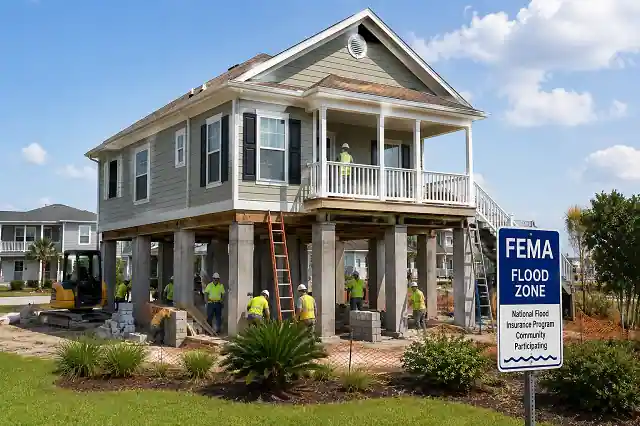
Why Home Elevation Matters for Flood-Prone Homes
Floodwater can damage foundations, electrical systems, heating and cooling equipment, flooring, walls, insulation, appliances, and other components of a home. Repeated flooding can create a cycle in which homeowners repair the same property several times without addressing the underlying flood risk.
Elevation changes the building’s relationship to expected floodwater. When a structure is raised appropriately, floodwater may pass below the living area rather than entering the occupied portions of the home.
FEMA’s National Flood Insurance Program also explains that elevation and other mitigation measures can affect flood risk and insurance costs. However, homeowners should not assume that every elevation project produces a fixed insurance discount because NFIP pricing considers multiple property-specific factors.
| Potential Benefit | What It Can Mean |
|---|---|
| Lower flood exposure | The occupied portion of the home may be farther above expected floodwater. |
| Reduced future damage | Floodwater may have less access to living areas and vulnerable building systems. |
| Improved resilience | The property may be better prepared for future flood events. |
| Potential insurance benefit | Higher elevation can affect flood insurance pricing depending on the property’s characteristics. |
| Floodplain compliance | An approved project can address applicable elevation and building requirements. |
Flood Risk Statistics Homeowners Should Know
The National Flood Insurance Program reports that 99% of U.S. counties have experienced a flood event during the past 20 years. NFIP materials also report average claim payments of about $68,000 for policyholders during 2016 through 2021. These figures illustrate the potential financial impact of flooding, although they do not determine whether an individual homeowner qualifies for mitigation funding.
- 99% of U.S. counties have experienced a flood event during the past 20 years.
- $68,000 was the average NFIP claim payment reported for policyholders during 2016–2021.
- Flood insurance and mitigation programs serve different purposes, so homeowners should understand both before planning a major project.
For homeowners who need more context about the financial consequences of postponing essential repairs, our cost of delayed home repairs guide provides a broader look at repair-related risks.
Federal Home Elevation Grant Programs in 2026
Several federal mitigation programs can support flood-risk reduction, but their application windows and eligibility rules are different. Homeowners should never assume that a program mentioned in an older article is currently accepting applications.
| Program | Primary Purpose | 2026 Status or Key Point |
|---|---|---|
| Flood Mitigation Assistance (FMA) | Reduce flood risk to eligible structures and communities through approved mitigation projects. | The FY2024 annual opportunity closed August 6, 2026. |
| FY2024 FMA Swift Current | Accelerate flood mitigation funding after qualifying flood-related disasters. | The opportunity is listed with a December 30, 2026 closing date. |
| FY2026 FMA Swift Current | Accelerate flood mitigation funding following qualifying flood-related disasters. | The opportunity is listed with $600 million in program funding and a January 31, 2028 closing date. |
| Hazard Mitigation Grant Program (HMGP) | Support long-term mitigation after qualifying Presidential major disaster declarations. | Availability depends on disaster declarations and state, Tribal, or territorial administration. |
| Building Resilient Infrastructure and Communities (BRIC) | Support pre-disaster mitigation and resilience projects. | The FY2024–2025 opportunity closed July 23, 2026. |
| Community Development Block Grant Disaster Recovery (CDBG-DR) | Support long-term disaster recovery and mitigation through HUD-funded state and local programs. | Availability depends on disaster-specific allocations and local program design. |
The FY2024 FMA Swift Current opportunity is also important for homeowners researching current flood mitigation funding. The official opportunity is listed with a December 30, 2026 closing date. Homeowners should contact the appropriate state, Tribal, or local government sponsor to determine whether their property can be considered under the applicable project and disaster requirements.
The current FY2026 FMA Swift Current opportunity is listed with $600 million in program funding. Grants.gov identifies state governments and federally recognized Tribal governments as eligible applicants, with local governments applying through the applicable state or territory. A cost-sharing requirement also applies. Check the official FY2026 FMA Swift Current opportunity before relying on its current requirements.
The regular FY2024 FMA opportunity closed August 6, 2026. It included individual flood mitigation projects such as home elevation for eligible structures in applicable funding categories. Review FEMA’s Flood Mitigation Assistance information for current program guidance.
The FY2024–2025 BRIC opportunity closed July 23, 2026. It should therefore not be presented as an open homeowner application route in this article unless a new official funding opportunity is announced. Check the official BRIC listing for status changes.
FEMA funding cycles can open and close during the year. Do not rely on an old deadline, grant amount, or eligibility statement without checking the current FEMA and Grants.gov opportunity.
Flood Mitigation Assistance and Home Elevation
Flood Mitigation Assistance, commonly called FMA, is one of the major federal programs associated with reducing flood risk. FEMA’s FMA materials identify individual flood mitigation projects such as structure elevation, mitigation reconstruction, and property acquisition or conversion to open space in applicable funding cycles.
FMA is not normally a simple direct-to-homeowner grant. Eligible government applicants develop and submit projects, while homeowners may participate through the sponsoring state, Tribal government, territory, county, city, or other eligible applicant.
FEMA’s published materials also identify cost sharing as part of FMA funding. The exact federal share and project requirements depend on the applicable funding opportunity.
Homeowners should therefore ask their local sponsor whether the community is currently collecting properties for an FMA application and whether their property meets the current project criteria.
FMA Swift Current in 2026
FMA Swift Current is especially important to watch in 2026 because the current FY2026 opportunity is listed as open through January 31, 2028. The program is designed to accelerate mitigation funding after qualifying flood-related disasters.
The opportunity is administered through eligible government applicants rather than direct individual homeowner applications. A homeowner should therefore contact the relevant state or local emergency management office to determine whether the property can be included in an eligible project.
Ask your county, city, Tribal, or state emergency management office: “Is my community currently collecting homeowner elevation projects for FMA Swift Current or another FEMA mitigation opportunity?”
Hazard Mitigation Grant Program and Home Elevation
The Hazard Mitigation Grant Program, or HMGP, supports long-term mitigation following qualifying Presidential major disaster declarations. FEMA materials specifically identify elevation as an eligible type of mitigation project.
HMGP applications are generally sponsored by governments or other eligible applicants rather than submitted directly by individual homeowners. FEMA’s homeowner guidance explains that local communities can sponsor homeowner projects and forward eligible projects through the state process.
Because HMGP is tied to disaster declarations and state or territorial processes, there is no single nationwide homeowner application date. The deadline depends on the applicable disaster, state, territory, Tribal government, and local process.
Homeowners affected by a recent disaster should also review our emergency home repair grants guide if they need immediate repair assistance in addition to long-term mitigation.
What Happened to BRIC in 2026?
Building Resilient Infrastructure and Communities, or BRIC, requires careful treatment in a current article. The FY2024–2025 BRIC opportunity listed $1 billion in program funding, but the application period closed July 23, 2026.
That means homeowners should not be told that BRIC is currently accepting direct applications. A new funding opportunity would need to be announced through official federal sources before the program should be described as open.
For this reason, the safest approach is to use the official FEMA mitigation program information and Grants.gov when checking future BRIC opportunities.
Who May Qualify for Home Elevation Assistance?
Eligibility varies by program. A homeowner may need to meet property ownership, flood-risk, community participation, insurance, engineering, environmental, and other requirements before an elevation project can be considered.
For FMA-related projects, the structure and applicable flood insurance status can be important because the program is tied to the National Flood Insurance Program. Current funding notices should always be reviewed for the precise requirements.
HMGP has a different pathway because it is connected to qualifying disaster declarations and post-disaster mitigation planning.
Local and state programs may also use additional criteria when ranking projects. These can include repetitive flood losses, substantial damage, flood-zone location, project cost effectiveness, social vulnerability, and local hazard mitigation priorities.
- Ownership of the residential property.
- Location within an eligible or participating community.
- Documented flood risk or qualifying flood history.
- NFIP insurance where required by the applicable program.
- Engineering feasibility.
- Environmental and historic-preservation compliance.
- Consistency with local and state mitigation priorities.
- Availability of a sponsoring government applicant.
For a broader explanation of income, ownership, age, disability, location, and other requirements, see our home repair grants eligibility guide. Remember that general home-repair eligibility and FEMA mitigation eligibility are not identical.
Do Low-Income Homeowners Receive Priority?
FEMA mitigation programs do not use one nationwide income limit for every elevation project. However, state and local programs can use additional scoring or prioritization factors, and some funding structures can provide enhanced consideration for disadvantaged or socially vulnerable communities.
Low-income homeowners should therefore ask the local mitigation administrator whether household income is included in the project’s scoring criteria and whether any local cost-share assistance is available.
Homeowners looking for separate income-based repair assistance can also review our home repair grants for low-income families guide.
What Documents Should Homeowners Prepare?
Preparing documents early can make it easier to respond when a local sponsor begins collecting homeowner information. The exact documentation varies by program and property.
- Proof of property ownership.
- Property address and parcel information.
- Flood insurance information when applicable.
- Previous flood insurance claim records.
- Photographs showing previous flood damage.
- Existing elevation certificate, if available.
- Property survey or engineering information when requested.
- Preliminary project estimates when requested.
- Previous disaster assistance and repair records.
- Local permits or inspection records when required.
An elevation certificate documents important information about a building’s elevation and flood-zone characteristics. FEMA’s NFIP guidance says homeowners can first ask their local floodplain manager whether an elevation certificate is already on file. If one is not available and it is needed for the applicable purpose, a qualified surveyor, engineer, or architect may be able to prepare it.
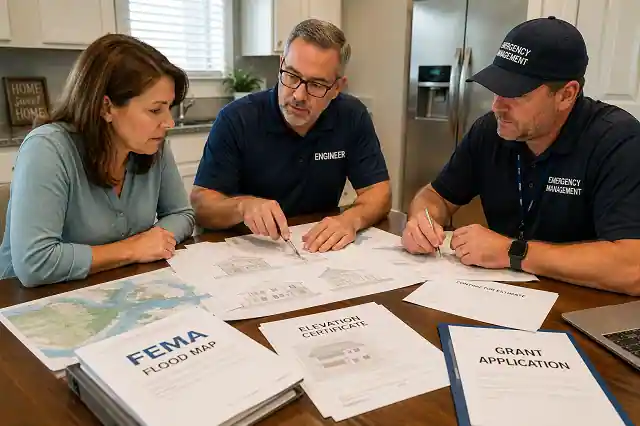
How to Check Your Flood Zone
Before investing in engineering work, homeowners should understand the property’s flood risk and the local floodplain requirements that could affect an elevation project.
The FEMA Flood Map Service Center is the official public source for FEMA flood hazard information. Homeowners can search by address or location to find available flood maps and related products.
You should also contact your local floodplain administrator. Local officials can explain whether the community has additional elevation, freeboard, permitting, or substantial-damage requirements beyond what appears on the federal map.
- Search the property in FEMA’s Flood Map Service Center.
- Record the current flood zone and map information.
- Ask the local floodplain manager about Base Flood Elevation requirements.
- Ask whether an elevation certificate is already on file.
- Ask whether local freeboard or substantial-improvement rules apply.
How Much Can Home Elevation Grants Cover?
There is no universal homeowner grant amount for elevation projects. The amount depends on the funding program, project design, eligible costs, engineering requirements, federal cost share, available funding, and the applicable cost-effectiveness review.
Potential project expenses can include engineering, architectural design, surveys, foundation modifications, lifting the structure, utility work, site restoration, permits, inspections, and other costs approved by the applicable program.
| Potential Expense | May Be Eligible? |
|---|---|
| Engineering and design | Potentially, when approved by the program. |
| Property surveys | Potentially, when required for the project. |
| Structure elevation | Yes, for eligible elevation projects. |
| Foundation work | Potentially, depending on the approved project. |
| Utility relocation or reconnection | Potentially, when required by the project. |
| Luxury remodeling | Generally outside the mitigation purpose. |
| Unapproved construction | Do not assume reimbursement. |
Homeowners who need to fund repairs outside the elevation project can also read our guide on how a $10,000 home repair project can be funded for a broader comparison of grants, assistance, loans, and other funding sources.
Do not assume that costs incurred before program approval will be reimbursed. Ask the sponsoring agency about pre-award costs, environmental review, procurement, permits, construction authorization, and eligible expenses before signing a major contract.
Benefit-Cost Analysis and Project Selection
Cost effectiveness is an important consideration in FEMA mitigation funding. A project may be evaluated based on whether the expected long-term benefits from reducing future losses justify the cost of the mitigation work.
This means a homeowner should not look only at the construction price. Project review can also consider documented flood losses, expected future losses, project feasibility, engineering requirements, and other factors specified by the funding opportunity.
Strong documentation can help the sponsoring agency understand the property’s history and the proposed mitigation benefit.
- Document previous flood events.
- Keep insurance claim information.
- Save photographs and repair records.
- Maintain accurate ownership information.
- Obtain realistic project estimates when requested.
- Keep engineering documents organized.
- Respond promptly to agency requests.
How State and Local Agencies Handle Home Elevation Grants
Federal home elevation funding usually reaches homeowners through state, Tribal, county, or city programs rather than through a direct federal homeowner application. The local process can determine how properties are identified, how projects are ranked, what documents are required, and when homeowner information is collected.
Start with your county or city emergency management office, local floodplain administrator, or state emergency management agency. Ask whether your community is currently developing an application for Flood Mitigation Assistance, FMA Swift Current, the Hazard Mitigation Grant Program, or another eligible mitigation funding source.
| Agency or Office | What to Ask |
|---|---|
| County or city emergency management office | Whether homeowner elevation projects are being collected for a current or future FEMA mitigation application. |
| State emergency management agency | Which FEMA mitigation programs are currently available and how local projects are submitted. |
| Local floodplain administrator | Whether the property meets local floodplain, elevation, freeboard, and permitting requirements. |
| Housing or community development agency | Whether disaster-recovery or housing assistance can help with eligible work outside the elevation project. |
| Tribal government or Tribal emergency management office | Whether Tribal mitigation or housing programs may apply to the property. |
Do not wait for a homeowner grant application to appear online. Contact the local or state mitigation office and ask whether homeowner properties are being collected for an upcoming federal mitigation application.
How to Apply for Home Elevation Grants in 2026
Applying for a home elevation project requires coordination with the sponsoring agency. Unlike a simple homeowner grant application, FEMA mitigation projects usually move through a government applicant and can require technical, environmental, engineering, and cost-effectiveness reviews.
- Check your flood risk. Use FEMA’s Flood Map Service Center and speak with your local floodplain administrator.
- Identify the appropriate program. Ask whether FMA, FMA Swift Current, HMGP, CDBG-DR, or another local program may apply.
- Contact the local sponsor. Speak with your county, city, Tribal government, or state emergency management agency.
- Gather your documents. Prepare ownership, insurance, flood-loss, property, and engineering information.
- Complete technical reviews. Provide surveys, elevation information, engineering reports, environmental documentation, or other materials requested by the sponsor.
- Submit through the eligible applicant. Follow the specific application process established for the funding opportunity.
- Wait for written authorization. Do not begin major construction until the program and local authorities confirm the required approvals.
Contact the local sponsor even when there is no active homeowner application. Communities may collect property information in advance of future FEMA mitigation applications.
If you need broader grant-application guidance, our home repair grant application guide explains general preparation techniques, but FEMA mitigation projects can require additional technical documentation.
Common Reasons Home Elevation Projects Are Delayed
Elevation projects can take time because they involve more than a standard home repair. Engineering, floodplain compliance, environmental review, property documentation, cost-effectiveness analysis, procurement, and funding availability can all affect the timeline.
| Potential Problem | How to Reduce the Risk |
|---|---|
| Incomplete ownership records | Prepare current property documentation. |
| Missing flood-loss history | Keep insurance claims, photographs, invoices, and repair records. |
| Engineering issues | Use qualified professionals when engineering work is required. |
| Environmental review | Respond promptly to agency requests. |
| Unclear project scope | Prepare a clear description and realistic cost estimate. |
| Limited funding | Stay in contact with the local sponsor about future opportunities. |
Homeowners who have already experienced significant water damage may also review grants to fix water-damaged walls and ceilings for separate repair assistance. If a property has other serious safety hazards, our home hazard removal grants guide may also be useful.
Do not pay a company that promises guaranteed FEMA approval. Verify program names, deadlines, eligibility rules, and application instructions through official FEMA, Grants.gov, state, Tribal, county, or city sources.
Home Elevation and Flood Insurance
Elevating a home can affect flood insurance costs, but homeowners should not rely on a fixed savings percentage when planning the project.
Under the NFIP’s current pricing approach, premiums are based on multiple factors related to the property’s flood risk. FEMA explains that elevation, first-floor height, distance from a flooding source, flood characteristics, building characteristics, and rebuilding cost can all influence rates.
An elevation certificate can provide useful property-specific elevation information. FEMA explains that an elevation certificate is no longer generally required to purchase NFIP coverage under its current pricing methodology, although it can still be useful for floodplain management and may help an insurance agent determine whether more detailed elevation information could lower the premium.
Ask your flood insurance professional to evaluate the property’s actual flood risk and insurance pricing after the proposed elevation. Do not assume that elevating by a specific number of feet automatically creates a specific premium reduction.
Additional Assistance for Seniors, Veterans, Disabled Homeowners, and Rural Families
FEMA mitigation funding is primarily based on the mitigation need and the applicable program requirements rather than simply on age, veteran status, disability, or income. However, state and local programs can use social vulnerability, affordability, or other local factors when ranking projects.
Older homeowners who need separate repair assistance can review home repair grants for seniors. Homeowners with disabilities can review home repair grants for disabled homeowners when they need accessibility or safety improvements outside the elevation project.
SSI recipients can review our home repair grants for SSI recipients guide for separate assistance options. Veterans can review home repair grants for veterans for non-mitigation repair assistance.
Disabled veterans with additional accessibility or repair needs can review home repair grants for disabled veterans. Rural homeowners can also review home repair grants for rural homeowners when they need assistance beyond the flood-mitigation project.
Native American homeowners should also consider whether Tribal mitigation and housing programs apply to their property. Our home repair grants for Native American homeowners guide covers broader repair assistance and should be considered separately from FEMA mitigation funding.
| Homeowner Situation | Useful Question to Ask |
|---|---|
| Senior homeowner | Does the local mitigation program consider age or vulnerability when ranking projects? |
| Disabled homeowner | Can accessibility needs be incorporated into the project or addressed through separate assistance? |
| Veteran | Are separate veteran housing resources available for repairs outside the mitigation project? |
| Low-income household | Does household income affect local scoring or cost-share assistance? |
| Rural homeowner | Are state, Tribal, USDA, or local rural housing resources available? |
Flood-Resilient Improvements to Consider
Elevation can be more effective when the rest of the property is designed to handle flood exposure. Homeowners should discuss additional measures with qualified engineers, contractors, and local officials.
- Elevate HVAC equipment where practical.
- Protect or relocate vulnerable electrical equipment.
- Use flood-damage-resistant materials in appropriate areas.
- Install required flood openings where applicable.
- Protect plumbing and mechanical systems.
- Follow local freeboard and floodplain requirements.
- Maintain appropriate flood insurance.
- Inspect the foundation and utilities after major storms.
Homeowners planning separate repair projects should not assume that those improvements can automatically be included in the FEMA elevation project. Separate funding may be required for unrelated work.
For homeowners who need to locate assistance across multiple programs, the Home Repair Program Finder can be used as a starting point for identifying broader home-repair assistance categories.
How to Avoid Home Elevation Grant Scams
Flood mitigation funding can attract scams, especially after major disasters. Be cautious if a company promises guaranteed approval, asks for a large upfront fee, or claims to have special access to federal grant money.
FEMA mitigation funding is administered through formal government processes. Homeowners should independently verify the program, sponsoring agency, application period, and requirements.
- Guaranteed FEMA approval.
- Requests for large upfront application fees.
- Pressure to sign a construction contract immediately.
- Requests for sensitive information through an unsolicited message.
- A grant deadline that cannot be verified on FEMA, Grants.gov, or a government website.
Official Government Sources for Home Elevation Grants
Because mitigation programs and funding cycles can change, official sources should be treated as the final authority.
- FEMA Hazard Mitigation Assistance — federal mitigation programs and guidance.
- Grants.gov — federal funding opportunities and official notices.
- National Flood Insurance Program and FloodSmart — flood insurance and mitigation information.
- FEMA Flood Map Service Center — official flood mapping information.
- HUD Community Development Block Grant Disaster Recovery — disaster recovery funding administered through eligible state and local programs.
Frequently Asked Questions About Home Elevation Grants in 2026
Does FEMA give home elevation grants directly to homeowners?
Generally, no. FEMA mitigation funding is normally awarded to eligible government or Tribal applicants, while homeowners participate through the sponsoring program.
Who qualifies for home elevation assistance?
Eligibility depends on the specific program and can involve flood risk, property characteristics, community participation, insurance requirements, engineering feasibility, cost effectiveness, and local priorities.
Is the FY2026 FMA Swift Current opportunity open?
The current FY2026 FMA Swift Current opportunity is listed on Grants.gov as open through January 31, 2028. It has specific applicant, project, and cost-sharing requirements, and homeowners should contact the appropriate government sponsor to determine whether their property can be considered.
Is the regular FY2024 FMA opportunity still open?
No. The FY2024 annual FMA opportunity closed August 6, 2026. Future FMA cycles may have different deadlines and requirements.
Is BRIC currently open?
The FY2024–2025 BRIC opportunity closed July 23, 2026. Homeowners should check for a new official funding opportunity before treating BRIC as an active application route.
How much money can a homeowner receive?
There is no single nationwide homeowner grant amount. Funding depends on the applicable program, project design, eligible costs, federal cost share, available funding, and technical review.
Does my home have to be in a flood zone?
Not every mitigation program uses identical eligibility rules. However, flood risk is central to flood-mitigation funding, and the applicable program may require documented flood exposure or other qualifying conditions.
Can elevating a home reduce flood insurance costs?
It may. FEMA’s NFIP guidance explains that elevation and other property characteristics can affect flood insurance pricing, but homeowners should not assume a fixed percentage of savings.
Do I need an elevation certificate?
Not necessarily for every purpose. An elevation certificate provides detailed elevation information and can be useful for floodplain management and insurance questions. Contact your local floodplain manager to determine whether one is already available or needed.
Where should I start?
Start with your county or city emergency management office, local floodplain administrator, or state emergency management agency. Ask whether the community is sponsoring current or future elevation projects.
Why You Can Trust This Home Elevation Grants Guide
Last Updated: August 10, 2026
Reviewed By: HomePropertyGrants Editorial & Research Team
- Official-source research: Federal program information is checked against FEMA, Grants.gov, the National Flood Insurance Program, and HUD where applicable.
- 2026 funding verification: Open and closed funding opportunities are distinguished rather than treating all programs as continuously available.
- Homeowner-focused guidance: The article explains the practical steps homeowners can take before contacting a sponsoring agency.
- No guaranteed-funding claims: Eligibility, funding, cost sharing, and project selection depend on the applicable program and funding cycle.
- Ongoing verification: Homeowners should confirm current requirements and deadlines with the relevant government agency before making financial commitments.
Conclusion
Home elevation can be an important long-term strategy for reducing flood risk, but it is not usually a simple direct-to-homeowner grant. Most federal mitigation projects move through eligible state, Tribal, territorial, county, or city applicants, with homeowners participating through the local program.
In 2026, homeowners should pay close attention to the difference between current and closed funding opportunities. The FY2026 FMA Swift Current opportunity is currently listed as open, while the FY2024 annual FMA opportunity and FY2024–2025 BRIC opportunity have closed. Check the official federal opportunity before relying on any deadline or funding amount.
Prepare your ownership documents, flood-loss history, insurance information, property records, and engineering information before contacting the local sponsor. Most importantly, verify the current program requirements with FEMA, Grants.gov, your state emergency management agency, or your local government before paying for engineering work or signing a major construction contract.

Arthur Pendelton is a senior housing policy researcher and public welfare analyst with over eight years of experience tracking federal, state, and non-profit residential repair programs. He specializes in statutory grant frameworks, including USDA Section 504 Rural Housing, the Department of Energy’s Weatherization Assistance Program (WAP), and municipal HUD Community Development Block Grants (CDBG). Arthur systematically audits Federal Register publications and Title 7/42 CFR regulatory updates to provide low-income homeowners, seniors, and military veterans with accurate, barrier-free application guidance.